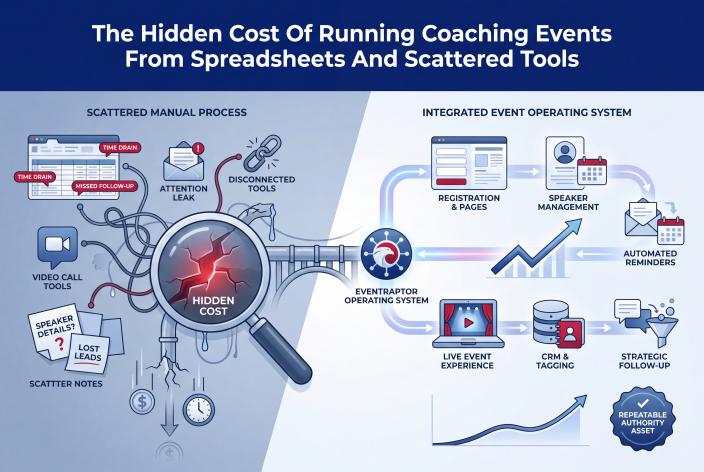
If you've ever run a coaching event from a spreadsheet, an inbox, a page builder, Zoom, an email tool, and a CRM, you already know the feeling.
At first, it seems manageable.
You create the registration page. You paste the Zoom link somewhere safe. You track speakers in a spreadsheet. You write reminders in your email platform. You export registrants. You upload contacts. You tag people later.
Then the event gets closer.
Suddenly, you're hunting for links, checking whether reminders went out, answering attendee questions, chasing speaker details, updating pages, and trying to remember who needs follow-up.
And here's the part most coaches underestimate.
The real cost isn't the software bill.
The real cost is the attention leak.
Every disconnected tool adds one more place where trust can weaken, leads can get lost, and your event can become harder to repeat.
If your coaching is strong, your event should help people experience that strength before they ever get on a call with you. That requires more than a date on the calendar. It requires a cleaner path from visibility to registration to attendance to follow-up to qualified conversation.
The Real Cost Of Manual Event Management
Manual events often feel cheaper because you're using tools you already have.
A spreadsheet is free. Your inbox is already open. Your page builder is already paid for. Zoom works. Your CRM can technically hold the contacts.
So why does the process feel so heavy?
Because the cost shows up in places that don't appear on a software invoice.
You pay with:
- Time spent copying links, updating pages, and checking details
- Mental energy spent remembering what still needs to happen
- Slower execution because every step depends on manual coordination
- More mistakes because information lives in too many places
- Weaker follow-up because attendee data is scattered
- Poorer attendee experience because reminders and access details are inconsistent
- Less useful data after the event because tracking was improvised
- More pressure on you or your small team
You may still get the event live. That isn't the issue.
The issue is what it takes out of you before, during, and after the event.
A summit, workshop, webinar, or speaker-led event should build authority. It should help your market see you as the person who can gather the right experts, frame the right conversation, and guide them toward a meaningful next step.
When the backend is messy, you spend too much of the campaign acting like the event technician.
That is expensive.
Where Leads Get Lost In Scattered Event Systems
Most lead loss doesn't look dramatic.
It looks like small gaps.
Someone registers but doesn't receive the right reminder. A VIP registrant isn't tagged properly. A speaker promotes the event, but you can't see which registrants came from that partner. An attendee watches a session, gets interested, and then never receives the right follow-up.
No single gap feels catastrophic in the moment.
Together, they weaken the whole event.
Here are the common places where leads slip through the cracks.
| Event Area | What Happens In A Scattered Setup | Why It Costs You |
|---|---|---|
| Registration | Contacts sit in a form tool, spreadsheet, or page builder | You don't have a clean follow-up path |
| Speaker Data | Bios, headshots, session titles, and links live in email threads | Your event pages become slower to update and easier to break |
| Reminders | Emails are scheduled separately from event timing and access details | Attendees miss sessions or arrive confused |
| Partner Tracking | Speaker and promoter links are tracked manually | You can't see which relationships created momentum |
| CRM Updates | Contacts are exported, uploaded, and tagged later | Warm leads cool off before follow-up begins |
| Post-Event Follow-Up | Messages are written after the event when you're tired | Interested prospects may never get the next step |
This is why the follow-up problem is rarely just a motivation problem.
Most coaches know they should follow up.
But when the system makes follow-up difficult, delayed, or emotionally heavy, it gets pushed aside. You tell yourself you'll do it tomorrow. Then tomorrow becomes next week.
By then, the warm moment has passed.
Why Manual Events Are Hard To Repeat
You can often brute-force one event.
You stay up late. You check every tab. You ask your assistant to update the spreadsheet. You send last-minute emails. You make it work.
But can you repeat it without rebuilding everything from scratch?
That is where manual event systems usually reveal the real problem.
If your process is scattered, every new event asks you to reconstruct the machine:
- Where was the final registration page?
- Which reminder emails worked?
- Who promoted the event?
- Which speakers sent assets on time?
- Which attendees became good sales conversations?
- Which CRM tags were used?
- Which follow-up sequence went to which segment?
- What should be improved next time?
If the answers are spread across tools, folders, email threads, exports, and memory, improvement becomes guesswork.
And a growth system can't mature when every event is treated like a one-off project.
A coach who wants consistent client flow needs reusable assets. Pages. speaker workflows, registration paths, reminder patterns, follow-up logic, CRM tags, reporting, and a clear event rhythm.
That doesn't mean every event should be identical.
It means every event should make the next one easier, cleaner, and smarter.
The Attendee Experience Is Part Of Your Authority
Your prospects are paying attention before the sales call.
They notice whether registration is clear. They notice whether reminders arrive at the right time. They notice whether the event page feels organized. They notice whether speaker information is easy to find. They notice whether the next step after the event makes sense.
This matters because coaching is built on trust.
If your event feels polished, calm, and useful, prospects get a small preview of how you lead.
If the experience feels confusing, delayed, or duct-taped together, that also communicates something.
Now, this doesn't mean you need a giant production team or a complicated tech stack.
It means the basics need to work:
- A clear registration page
- A helpful thank-you page
- Reliable reminder emails
- Easy event access
- Organized speaker and session information
- A simple attendee dashboard or event hub
- Useful follow-up after the event
- A relevant invitation into the next step
Those pieces protect the trust you're trying to build.
A Cleaner Event Operating System For Coaches
So what should replace the spreadsheet-and-inbox approach?
Think of your event as an operating system.
A good event operating system gives every important part of the campaign a home. It connects the front-end experience people see with the backend process that helps you follow up.
Here are the core pieces.
Event Pages That Match The Strategy
Your registration page should do more than collect names and emails.
It should make the event feel relevant to the right audience. It should clarify who the event is for, what problem it helps them understand, and why attending is worth their time.
You also need supporting pages, such as thank-you pages, event access pages, attendee dashboards, and replay pages where relevant.
When these pages are managed in one event system, updates are easier. Dates, session details, links, and messaging are less likely to drift across multiple tools.
Speaker And Session Management That Does Not Live In Your Inbox
Multi-speaker events can create a lot of moving parts.
Speaker applications. Invitations. Bios. Headshots. Session titles. Agreements. Uploads. Scheduling. Presentation details. Promotional copy.
If all of that sits in your inbox, you become the search function.
A cleaner system lets you manage speaker profiles, sessions, applications, agreements, schedules, and communication in a more organized way. That gives speakers a better experience and helps you lead the event with more confidence.
Registrant Management That Keeps Leads Organized
Every registration is a raised hand.
That person saw something relevant enough to give you their information. Now the system needs to preserve that signal.
You want to know:
- Who registered
- When they registered
- Where they came from
- Whether they are a VIP attendee
- Which partner or promoter referred them
- What CRM tags or fields should be applied
- Which follow-up path fits them
Without that structure, your list grows in a fog. You may have more names, but you don't have a clear relationship path.
Reminders That Help People Actually Attend
People are busy.
They forget. They get distracted. They register with good intentions and then miss the session because the reminder didn't land or the access link was buried.
Good reminders are not pushy. They are service.
They help attendees know what is happening, when to show up, where to click, and what to expect next.
A cleaner event system can support welcome emails, scheduled reminders, event-day communications, and follow-up messages that keep the relationship moving while interest is still warm.
CRM And Follow-Up That Continue After The Event
This is the part that turns visibility into pipeline.
The event creates attention. The CRM and follow-up system help you continue the conversation.
That may include:
- Tagging registrants based on source, interest, or event behavior
- Sending relevant post-event emails
- Inviting attendees to a workshop, call, replay, or next resource
- Separating ready-now prospects from people who need more nurture
- Keeping long-term leads warm without manual chasing
This is where EventRaptor and GHL/CRMRaptor can work together naturally.
EventRaptor manages the virtual event side: pages, registrations, speakers, schedules, reminders, attendee data, promoter tracking, and event workflows.
GHL/CRMRaptor supports the CRM side: contact records, tags, fields, calendars, funnels, workflows, automation, and follow-up.
Together, they give the event a cleaner path from registration to nurture to qualified conversation.
The Goal Is A Repeatable Client Attraction Asset
A coaching event can be much more than a live session.
It can become an authority asset.
It can help you borrow authority from speakers and partners. It can grow your audience. It can show prospects how you think. It can create useful conversations. It can give you content, data, and market feedback.
But that only happens when the event is connected to a follow-up path.
Otherwise, the event ends, the spreadsheet gets archived, and the best opportunities are left sitting in a file you meant to revisit.
Here is a simple way to think about it.
Your event should answer 5 operational questions:
- How will the right people find and register for this event?
- How will speakers, partners, and promoters be managed?
- How will attendees be reminded, guided, and supported?
- How will registrants be organized inside the CRM?
- How will the relationship continue after the event?
If those answers are unclear, scaling the event may only scale the chaos.
If those answers are clear, your next event becomes easier to improve.
How To Know Your Next Event Needs Better Infrastructure
You don't need better infrastructure because software is exciting.
You need it when the current process is starting to limit the growth strategy.
Look for these signs:
- You are manually copying data between tools
- Speaker details are scattered across emails and spreadsheets
- You are unsure who promoted the event effectively
- Reminder emails are hard to manage or easy to forget
- Attendee questions repeat because access details are unclear
- CRM tagging happens late or inconsistently
- Follow-up depends on your energy after the event
- You cannot easily tell what worked last time
- You feel tired before the event even starts
If several of those are true, the issue may be infrastructure.
And that's good news.
Because infrastructure can be fixed.
You don't have to become more frantic, more technical, or more glued to your inbox. You can build a cleaner system around the visibility you're already creating.
Your Event Should Support Sales Conversations After The Applause Ends
The strongest coaching events don't stop at attendance.
They guide people into trust.
A right-fit prospect may need to hear you teach, see who you associate with, experience your point of view, receive thoughtful follow-up, and then decide a conversation makes sense.
That journey deserves structure.
When registration, speaker management, reminders, CRM updates, and follow-up are connected, the event has a better chance of becoming part of your client attraction system instead of another exhausting launch project.
So before you scale your next summit, workshop, webinar, or collaborative event, pause and ask:
Is the event infrastructure strong enough to support the opportunity we're trying to create?
If you want help answering that for your coaching business, Book your Client Attraction Planning Call.
On the call, we'll look at where your current client flow is getting stuck, whether your next gap is positioning, authority, funnel, CRM, follow-up, virtual event strategy, or implementation, and what kind of client attraction system could make sense next.