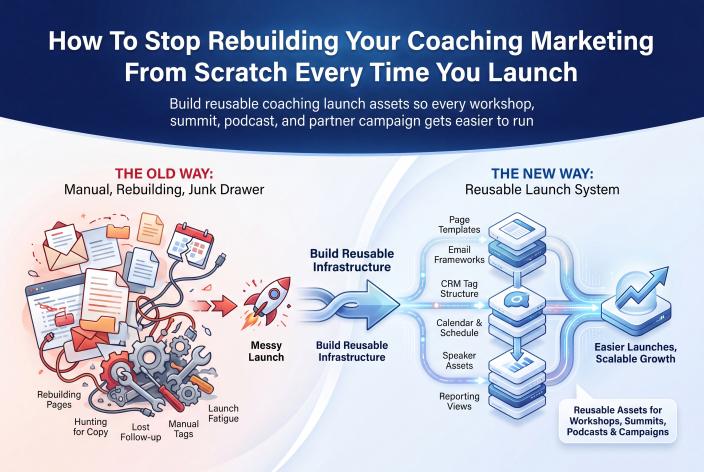
If every launch feels like opening a junk drawer, you're going to burn more energy than the campaign deserves.
You know the feeling.
You decide to run a workshop, summit, webinar, podcast campaign, giveaway, or partner promotion. Suddenly, you're digging through old Google Docs, copying email drafts, hunting for the right Zoom link, asking where the registration page went, rebuilding tags, checking calendar settings, and wondering whether anyone remembered the follow-up.
The campaign might still work.
But it costs too much attention.
And when you're the coach, strategist, speaker, salesperson, and tech troubleshooter at the same time, that hidden cost shows up fast. You delay launches. You avoid partnerships. You procrastinate on visibility because you can already feel the operational mess coming.
Here's the better path.
Build reusable campaign infrastructure once, then improve it every time you launch.
That way, each event becomes easier to run, easier to measure, and easier to connect to qualified conversations.
Why Rebuilding Every Launch Drains Your Business
A one-off campaign feels innocent at first.
You need a page, so you build a page. You need emails, so you write them. You need a calendar link, so you grab one. You need to track partners, so you make a spreadsheet.
Then the next campaign arrives and you do it again.
That creates 4 problems.
- You Lose Time Before The Campaign Even Starts
Every hour spent recreating pages, emails, tags, forms, and reminders is an hour you could have spent refining the offer, inviting partners, following up with warm prospects, or preparing a stronger teaching experience.
And those are the activities that actually move trust forward.
- You Create More Room For Mistakes
Manual rebuilding usually means copy-paste errors, old dates, broken links, missing tags, wrong reminders, forgotten speakers, or leads that never make it into the right follow-up path.
None of these mistakes means you're careless.
It means your business is asking your memory to do the job of a system.
- You Make Launches Harder To Repeat
If every campaign is built from scratch, you don't really have a launch process. You have a heroic effort.
That might work once. It gets exhausting when events become part of your growth strategy.
- You Lose The Learning From The Last Campaign
If your pages, tracking, tags, registrant data, partner links, and follow-up are scattered across different tools, it's hard to see what worked.
Which partner promoted well? Which registration page converted better? Which reminder got people to show up? Which follow-up created conversations?
When you can't see the pattern, every launch feels like guessing again.
The takeaway is simple. Repetition without infrastructure creates fatigue. Repetition with infrastructure creates momentum.
What Reusable Campaign Infrastructure Actually Means
Reusable infrastructure doesn't mean every campaign looks identical.
It means the bones are already in place.
Your message can change. Your topic can change. Your speakers can change. Your offer can change. But the core structure that moves people from attention to trust to conversation should be ready to adapt.
Think of it like a kitchen in a good restaurant.
The menu changes. The ingredients change. The team can create something fresh. But the prep stations, tools, checklists, timing, and workflow are already there.
For a coaching business, reusable campaign infrastructure includes:
- Page templates
- Email frameworks
- Registration flows
- CRM tags and fields
- Calendar structures
- Speaker and partner assets
- Tracking links
- Reminder sequences
- Follow-up workflows
- Reporting views
- Post-campaign review checklists
Once those pieces exist, your next workshop or summit doesn't start with a blank screen.
It starts with a working system you can tailor.
The Assets You Should Reuse Across Different Campaigns
A coach's growth strategy usually includes more than one format.
You might run workshops, summits, webinars, podcasts, giveaways, partner trainings, or small expert panels. Each format has its own feel, but they all need a similar path behind the scenes.
Here are the assets worth building once and reusing often.
Page Structures
You don't need to reinvent the page flow for every event.
Create reusable templates for:
- Registration pages
- Thank-you pages
- Attendee dashboards
- Speaker pages
- Replay pages
- VIP or upgrade pages, if relevant
- Application pages for speakers or contributors
- Post-event next-step pages
The goal is to make the next campaign faster while keeping the experience clear and credible.
EventRaptor supports event page creation for registration pages, thank-you pages, attendee dashboards, custom event pages, reusable templates, draft and publish controls, and dynamic event content. That gives the event a clearer page system instead of turning every campaign into a separate web project.
Email Frameworks
Most campaigns need the same categories of email.
You can reuse the structure even when the copy changes.
Build frameworks for:
- Invitation emails
- Registration confirmation emails
- Pre-event reminders
- Speaker or partner swipe copy
- Event-day reminders
- Replay notifications
- Follow-up emails
- Next-step invitations
- No-show follow-up
- Warm nurture after the campaign
A helpful question is this:
What does this person need to know, feel, and do at this point in the journey?
That one question will improve nearly every email you write.
EventRaptor supports welcome emails, scheduled reminders, VIP promotions, nurturing emails, follow-up emails, personalization placeholders, test emails, and send-status tracking. In plain English, that means you can keep communication moving before, during, and after the event without relying on last-minute manual sending.
CRM Tags And Segments
Your CRM should tell you what happened.
Someone registered. Someone attended. Someone clicked. Someone became a VIP. Someone came from a partner. Someone asked a qualifying question. Someone requested the next step.
If those signals don't get captured, you lose useful context.
A practical tag structure might include:
- Campaign name
- Event type
- Registration status
- Attendance status
- Partner source
- VIP status
- Speaker or contributor status
- Offer interest
- Follow-up stage
- Sales call booked
- Not a fit or nurture longer
Keep it simple enough that you'll actually use it.
EventRaptor can collect registrant details, track VIP indicators, manage attendee data, export lists, and sync contacts with connected CRM systems. It also supports CRM tagging and contact sync, including GoHighLevel integration where connected.
When your CRM layer is GHL/CRMRaptor, the point is not having a fancier database. The point is having contact records, tags, calendars, funnels, workflows, and follow-up connected to the campaign journey.
Calendar And Schedule Structures
Events break down quickly when timing is unclear.
People need to know when to show up. Speakers need their session times. Your team needs internal deadlines. Your CRM needs to know when reminders and follow-ups should fire.
Reusable calendar structures help with:
- Event dates
- Time zones
- Registration windows
- Session schedules
- Speaker deadlines
- Reminder timing
- Replay availability
- Follow-up windows
- Sales call availability after the event
EventRaptor supports timezone selection, start dates, duration, registration windows, recurring events, calendar exports, ICS feeds, session scheduling, tracks, run of show, and attendee calendar tools.
That matters because a professional attendee experience is built from dozens of small clarity points.
Speaker And Partner Assets
If you run summits, giveaways, podcasts, or partner campaigns, you need reusable speaker and promoter assets.
Create templates for:
- Speaker invitations
- Speaker application questions
- Bio and headshot requests
- Topic submission forms
- Speaker agreement language
- Promotion guidelines
- Swipe copy
- Partner tracking links
- Reminder messages
- Thank-you and follow-up messages
Multi-speaker campaigns create a lot of moving parts. Applications, invitations, bios, images, session details, agreements, scheduling, files, and communication all need a place to live.
EventRaptor supports speaker profiles, speaker applications, invitation workflows, presentation review, tags, speaker files, schedules, agreement workflows, and speaker status tracking. That helps you manage the campaign without coordinating every detail from your inbox.
Tracking And Reporting Assets
If you want launches to get easier, you need to learn from them.
That means tracking should be designed before the campaign starts.
At minimum, look at:
- Registrations
- Registration growth over time
- Partner or promoter source
- VIP status
- Attendance signals
- Email send status
- Speaker status
- Follow-up progress
- Booked calls
- Qualified conversations
You don't need to become a data analyst. You need enough visibility to make better decisions after the campaign.
EventRaptor provides clearer visibility into registrations, growth trends, promoter performance, attendee data, speaker status, agreement progress, email status, task completion, and event health. It also supports promoter links, dashboards, performance reports, leaderboards, CSV exports, and cross-event attribution.
That helps you answer a very useful question:
What should we repeat, improve, or retire next time?
How To Build A Reusable Launch System
You don't need to build the perfect machine in one weekend.
Start with the assets that remove the most repeated friction.
Step 1 Create Your Core Campaign Map
Before you open another page builder, map the journey.
Use this simple sequence:
- How does the right person hear about the campaign?
- What page do they land on?
- What do they register for?
- What happens immediately after registration?
- What reminders prepare them to attend?
- What happens during the event?
- What follow-up happens after?
- How do interested prospects move toward a conversation?
- How are not-yet-ready prospects nurtured?
- What do you review after the campaign?
This turns the launch from a pile of tasks into a client attraction path.
Step 2 Build One Reusable Page Kit
Create a standard set of pages for your campaigns.
For example:
- Main registration page
- Confirmation page
- Attendee dashboard
- Replay or resource page
- Application page, if speakers or contributors are involved
- Next-step page for qualified prospects
Keep sections modular.
You might reuse the event promise section, speaker section, schedule section, FAQ section, host bio, and next-step block. Then you can update the topic and campaign-specific copy without rebuilding the whole thing.
Step 3 Build Email Templates By Journey Stage
Don't start by writing 20 emails.
Start with the stages.
A basic event email structure might include:
| Stage | Purpose |
|---|---|
| Invitation | Help the right people understand why the event is relevant |
| Confirmation | Reassure them they're registered and show them what happens next |
| Reminder | Help them attend prepared |
| Event-Day | Make access easy and timely |
| Replay | Continue value for people who missed or want to revisit |
| Follow-Up | Move interested prospects toward the right next step |
| Nurture | Keep trust building after the campaign |
Once the structure is clear, copy gets easier.
Step 4 Standardize Tags And Naming
Messy naming creates messy reporting.
Choose a naming convention you can repeat.
For example:
Event - Registered - [Campaign Name]Event - Attended - [Campaign Name]Event - VIP - [Campaign Name]Partner - [Partner Name]Offer Interest - [Offer Name]Follow-Up - Needs Call Invite
You don't need those exact tags. You need a repeatable logic.
The magic is not the label. The value is that your team can understand the contact's journey without guessing.
Step 5 Connect Calendar And Follow-Up Timing
Your event timing should trigger your communication timing.
That includes:
- Registration confirmation right away
- Reminder emails before the event
- Calendar links for attendees
- Speaker deadlines before the campaign
- Replay emails after the event
- Follow-up messages while interest is warm
- Sales call invitations for qualified prospects
This is where automation starts to feel more human.
Good automation doesn't replace relationship. It protects relationship by making sure people hear from you at the right time, with the right message, while they still remember why they raised their hand.
Step 6 Review Every Campaign Before Reusing It
Reusable does not mean frozen.
After each campaign, review what happened.
Ask:
- Which page needs improvement?
- Which emails were confusing or unnecessary?
- Which partners created momentum?
- Which tags helped us understand the pipeline?
- Where did follow-up slow down?
- Which questions came up repeatedly?
- Which prospects were most qualified?
- What should we change before the next campaign?
This is how your launch system compounds.
You run the campaign. You learn. You improve the infrastructure. Then the next launch starts from a smarter place.
Where EventRaptor Fits In The System
EventRaptor is useful because event-based marketing has a lot of moving parts.
A summit, workshop, giveaway, or speaker-led campaign can build authority and grow your audience. But the admin can bury you if the pieces are scattered.
EventRaptor gives the event one organized home for:
- Event setup
- Registration pages
- Thank-you pages
- Attendee dashboards
- Registrant management
- Speaker applications and profiles
- Session scheduling
- Email reminders and follow-up
- Calendar tools
- Partner and promoter links
- Promoter tracking and reporting
- CRM syncing
- Exports and event data
- To-do lists and diagnostics
That matters because your event should support the full journey.
People register. They attend or watch later. They engage with your topic. They receive follow-up. Some become better-fit prospects for a sales conversation. Others continue in nurture.
When EventRaptor is connected with GHL/CRMRaptor, the virtual event side and CRM follow-up side can work together. EventRaptor manages the event infrastructure. GHL/CRMRaptor supports the CRM, funnel, calendar, workflow, and follow-up infrastructure.
The result is a cleaner path from visibility to registration to nurture to qualified conversation.
When Done-For-You Support Makes Sense
You can build a reusable launch system yourself.
And if your campaigns are simple, your tech is clean, and you have the time, that may be the right move.
But there is a point where DIY starts costing more than it saves.
Consider getting done-for-you support when:
- You keep delaying campaigns because setup feels heavy
- Your pages, emails, CRM, calendar, and follow-up are scattered
- You are running partner campaigns and need better tracking
- You want summits or workshops to become a repeatable growth channel
- Your follow-up is inconsistent after people register or attend
- You don't know which campaign activities are creating qualified conversations
- You are spending too much time managing tech instead of leading, coaching, and selling
Here's a tip.
Don't wait until you're completely overwhelmed.
The best time to build infrastructure is when your offer is real, your audience is worth reaching, and you know visibility needs to turn into a more consistent client attraction system.
That is the natural stage where a proven coach installs business infrastructure that matches the quality of their work.
A Simple Reusable Launch Checklist
Use this before your next campaign.
Strategy
- Is the campaign connected to a clear offer?
- Is the audience specific enough?
- Is the topic tied to a problem your right-fit prospects already care about?
- Is there a next step after the event?
Pages
- Is the registration page ready?
- Is the thank-you page clear?
- Is the attendee dashboard or access page prepared?
- Are replay or resource pages planned?
- Are speaker or partner pages needed?
CRM And Tags
- Are registrants tagged correctly?
- Are partner sources tracked?
- Are VIP or qualified-interest signals captured?
- Is the follow-up path defined?
- Are sales call invitations connected to the right segment?
Emails
- Is the confirmation email ready?
- Are reminders scheduled?
- Are speaker or partner swipe emails prepared?
- Are replay emails drafted?
- Is post-event follow-up written?
- Is long-term nurture planned?
Calendar And Access
- Are dates and time zones correct?
- Are calendar links available?
- Are speaker times confirmed?
- Are access links tested?
- Are reminder times aligned with the event schedule?
Reporting
- Can you see registrations?
- Can you see partner performance?
- Can you review email status?
- Can you identify who needs follow-up?
- Can you learn what to improve next time?
If you can answer these questions clearly, your launch is already becoming more repeatable.
Build Once Then Improve Every Time
Your coaching business shouldn't need a fresh construction project every time you want to be visible.
Workshops, summits, podcasts, giveaways, and partner campaigns become much easier when the core infrastructure is already in place.
You still bring your voice. You still shape the message. You still lead the conversation. But the machinery behind the campaign gets calmer, cleaner, and easier to improve.
And that is what creates leverage.
If you want help applying this to your coaching business, Book your Client Attraction Planning Call. We'll look at where your current client flow is getting stuck, what pieces of your campaign infrastructure are missing, and whether a summit, webinar, funnel, CRM, follow-up system, or done-for-you implementation path makes sense next.