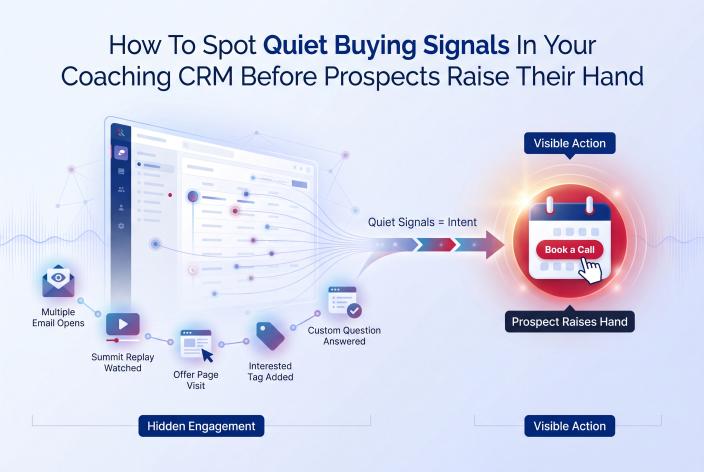
Your Warmest Prospects Are Not Always The Loudest Ones
Some of your best prospects will not book a call the first time they see your calendar link.
They may not even reply to your email.
But that does not mean they are cold.
They might be reading 3 emails in a row. Watching your summit replay. Clicking through to your offer page. Registering for a workshop. Buying the VIP upgrade. Answering a registration question in a way that quietly tells you, "This is becoming important."
The problem?
If those signals are buried inside disconnected tools, you miss them.
And when you miss them, follow-up becomes guesswork. You either chase people who are not ready, or you ignore people who are much warmer than they look.
A good coaching CRM helps you see the difference.
Used well, GHL/CRMRaptor can organize tags, custom fields, calendars, funnels, workflows, and follow-up around the real behavior of your prospects. EventRaptor can support the event side by collecting registrant information, tracking VIP status, organizing attendee data, supporting follow-up emails, syncing contacts with connected CRM systems, and helping create a clearer path from registration to trust to conversation.
That is where quiet buying signals become useful.
Why Ready Prospects Still Delay Booking A Call
Coaches often assume that if someone is interested, they will click the calendar link.
Sometimes they will.
But many right-fit prospects need more time before they raise their hand publicly.
They may be thinking:
- "Is this really for someone like me?"
- "Do I trust this person enough to talk about my business?"
- "Can I afford this right now?"
- "Will I be pressured on the call?"
- "Do they understand my kind of problem?"
So they keep watching.
They open the next email. They attend the event. They click the replay. They visit the page again. They read the client attraction content. They look for proof that your approach fits their values.
That behavior matters.
Buying intent often shows up before the calendar booking. Your job is to notice the trail and respond like a helpful guide, not a salesperson with a megaphone.
The 4 Types Of Quiet Buying Signals To Watch
You do not need to track every tiny action.
That gets overwhelming fast.
Start by watching for 4 categories of behavior: curiosity, urgency, trust, and offer fit.
Curiosity Signals
Curiosity means the prospect is paying attention.
They are exploring the topic, learning your language, and trying to understand whether your way of solving the problem makes sense.
Curiosity signals can include:
- Registering for a summit, webinar, workshop, or training
- Opening multiple emails in a campaign
- Clicking educational links
- Visiting a registration page or funnel page
- Watching a session or replay
- Downloading a planning resource
- Following a partner or speaker link into your event
Curiosity alone does not mean they are ready to buy.
But it tells you they are no longer invisible.
Urgency Signals
Urgency means the problem may be active now.
This is where behavior becomes more interesting.
Urgency signals can include:
- Clicking a booking link more than once
- Visiting a pricing, application, or planning call page
- Answering a registration question with a specific struggle
- Attending live instead of only registering
- Watching replays soon after they are released
- Replying to an email with a question about fit, timing, or next steps
- Engaging with content about inconsistent leads, weak follow-up, or client attraction gaps
A prospect who says, "I rely mostly on referrals and my calendar has been quiet," is giving you a very different signal than someone who says, "Just curious."
Your CRM should help you separate those two people.
Trust Signals
Trust means the prospect is giving you more attention and more permission.
They may not be ready to book yet, but they are letting you stay in the conversation.
Trust signals can include:
- Attending multiple events
- Watching more than one session
- Clicking emails from a nurture sequence
- Staying subscribed after a launch or event
- Buying a low-ticket or VIP upgrade
- Asking a thoughtful question
- Sharing more detail in a form answer
- Returning after a previous period of silence
This is why follow-up matters so much after a summit or workshop.
The event creates attention. The follow-up keeps the relationship moving while interest is still warm.
Offer Fit Signals
Offer fit means the prospect looks like someone your coaching or service can actually help.
This matters because not every engaged person is a good prospect.
Offer fit signals can include:
- Their role, niche, or business type matches your ideal client
- Their challenge matches the problem your offer solves
- Their stated goal matches your transformation
- Their timeline suggests they are actively looking for help
- Their current stage fits your program or service
- Their answers suggest they value implementation, not just information
This is where custom registration questions can be extremely useful.
For example, if you run an authority-building summit for coaches, you might ask:
- "What is your biggest client attraction challenge right now?"
- "How are most clients currently finding you?"
- "Do you already have a coaching offer you sell through conversations?"
- "What would make your client flow feel more predictable?"
Those answers give you context a simple email click never will.
What To Track Inside GHL/CRMRaptor
You do not need a complicated scoring system to start.
You need a clean way to capture behavior, organize it, and trigger the right follow-up.
GHL/CRMRaptor can support the CRM layer of this process with contact records, tags, custom fields, calendars, funnels, workflows, automation, and follow-up. EventRaptor can support the event layer with registration details, VIP status, attendee data, custom registration questions, promoter attribution, dashboards, reminder emails, follow-up communications, and CRM syncing.
Together, they help you see the journey more clearly.
Tags
Tags are useful for simple behavior markers.
Examples:
Registered For SummitAttended Live WorkshopClicked Planning Call LinkWatched ReplayPurchased VIPPartner ReferralHigh Intent TopicNeeds Follow-Up
Keep your tag names plain.
If your team cannot understand a tag at a glance, it will not help you follow up faster.
Custom Fields
Custom fields are better for information that should be stored as a specific answer.
Examples:
- Main client attraction challenge
- Current business stage
- Primary offer type
- Source of registration
- Interested topic
- Preferred next step
- Timeline
- Notes from registration answers
Tags tell you what happened.
Custom fields tell you what it means.
Source Data
Source data helps you understand where the prospect came from.
That might be a speaker, partner, affiliate, social post, email campaign, event page, or funnel.
This matters because warm leads often come through borrowed trust.
If someone registers because a trusted speaker invited them, they may arrive with more openness than a cold visitor. Partner and promoter attribution helps you see which relationships are creating momentum, rather than trying to reconstruct the story later from memory and spreadsheets.
Calendar Behavior
Calendar behavior is one of the clearest buying signals.
Watch for:
- Booking a call
- Starting but not completing a booking
- Clicking the calendar page
- Rescheduling
- No-showing
- Rebooking after a reminder
A missed booking does not always mean disinterest.
Sometimes it means hesitation, distraction, or bad timing. A human follow-up can help.
Funnel And Page Behavior
Page visits and funnel clicks tell you what the prospect is considering.
A prospect who only reads a general article is in a different place than someone who visits your planning call page, watches a case-focused training, and clicks your booking link.
You do not need to treat those people the same.
That is the point of tracking.
A Simple Hot Warm And Nurture Model
Here is a practical segmentation model you can start with.
Do not overbuild it.
Start simple, use it, then improve it as you learn.
| Segment | What It Means | Common Signals | Best Follow-Up |
|---|---|---|---|
| Hot | The prospect is showing urgency and fit | Clicked booking link, attended live, answered with a clear problem, visited offer page, purchased VIP | Personal email, direct invitation, helpful question, call reminder |
| Warm | The prospect is engaged but not clearly ready | Registered, opened emails, watched replay, clicked topic content, returned to events | Nurture sequence, relevant resource, soft invitation to next step |
| Nurture | The prospect is early, quiet, or not yet qualified | Registered but did not attend, limited email engagement, broad curiosity | Educational content, periodic check-ins, future event invitations |
Hot Prospects
Hot prospects deserve personal attention.
That does not mean pressure.
It means relevance.
If someone attends your workshop live, clicks the planning call page, and says in a registration answer that they are tired of inconsistent referrals, do not drop them into a generic newsletter and hope they figure it out.
Send a short, human note.
Try something like:
"Hi Sarah, I noticed you joined the workshop on building a more consistent client attraction system. You also mentioned referrals have been unpredictable lately. If it would help, I can point you toward the best next resource, or we can talk through what might make sense for your business."
That feels very different from, "Are you ready to buy?"
Warm Prospects
Warm prospects need useful continuation.
They have shown interest, but they may still be sorting out the problem.
Send them content that helps them diagnose where they are stuck:
- Positioning
- Authority
- Offer clarity
- Funnel path
- CRM setup
- Follow-up
- Sales conversation readiness
Then invite them gently when the next step depends on their specific situation.
Nurture Prospects
Nurture prospects are still worth caring for.
They may not be ready now. They may not be qualified. They may be watching from a distance.
Keep the relationship clean and useful.
Send practical content. Invite them to future events. Let them see how you think. Give them chances to engage when the timing improves.
Good nurture protects your reputation because it respects the prospect's pace.
How To Follow Up Without Feeling Pushy
A lot of coaches hesitate here.
They do not want to sound needy. They do not want to pressure people. They do not want automation to make their business feel cold.
Good follow-up should feel like good coaching.
It should be timely, relevant, and based on what the person has already shown you.
Lead With Context
Reference the real signal.
For example:
- "You registered for the workshop on client attraction systems."
- "You mentioned that referrals have been inconsistent."
- "You clicked through to the planning call page, so I wanted to send this in case it helps."
- "You joined the summit session on follow-up, and this is a common place coaches get stuck."
Context makes the message feel personal.
Ask A Useful Question
You do not need to pitch immediately.
Ask something that helps them clarify their next step:
- "Is client flow the main thing you are trying to stabilize right now?"
- "Are you trying to improve visibility, follow-up, or the sales path after people show interest?"
- "Do you already have a CRM in place, or is most follow-up still manual?"
- "Would it help to map the gap between your current visibility and booked calls?"
A good question opens the door without forcing the conversation.
Match The Message To The Signal
Hot prospects can receive a direct invitation.
Warm prospects may need a helpful resource and a softer next step.
Nurture prospects may simply need a future invitation.
This is where workflows can help. The point is not to automate your humanity away. The point is to make sure the right person gets the right message while the moment still matters.
A Simple Workflow You Can Build This Week
Here is a clean starting point.
Step 1 Create 5 Core Tags
Start with:
Event RegisteredAttended LiveReplay WatchedClicked Call LinkVIP Purchased
These 5 tags already tell you a lot.
Step 2 Add 3 Fit Fields
Use custom fields for:
- Main challenge
- Current stage
- Desired next step
Collect these through registration forms, application forms, or planning resources.
Step 3 Define Your Segments
Create simple rules:
- Hot means high intent plus good fit
- Warm means engagement without clear urgency
- Nurture means early interest or unclear fit
You can refine later.
Step 4 Write 3 Follow-Up Paths
Create one path for each segment.
Hot follow-up should feel personal and timely.
Warm follow-up should educate and invite.
Nurture follow-up should build trust over time.
Step 5 Review Weekly
Set a weekly rhythm.
Look at new hot prospects, recent VIP buyers, call link clickers, engaged replay viewers, and strong registration answers.
Then ask:
- Who needs a personal note?
- Who needs a useful resource?
- Who should be invited to a call?
- Who should stay in nurture?
This turns your CRM from a contact database into a decision tool.
Where EventRaptor Fits In The Signal Path
If you use virtual events, summits, workshops, or speaker campaigns, the buying signals often start before someone reaches your main funnel.
They start at registration.
They continue through attendance, session choices, replay behavior, VIP interest, speaker referrals, and post-event clicks.
EventRaptor is useful here because the event journey has many moving parts: registration pages, attendee dashboards, reminder emails, custom registration questions, speaker and promoter tracking, VIP status, attendee data, follow-up communications, and CRM syncing.
GHL/CRMRaptor then supports the CRM and follow-up layer: contact records, tags, custom fields, funnels, calendars, workflows, automation, and booking paths.
When those pieces are connected, your summit or workshop becomes more than a date on the calendar.
It becomes a managed path from visibility to trust to conversation.
And that is what most proven coaches are missing.
They are visible in pockets. They have helpful content. They may even run good events.
But the signals are scattered, and the follow-up depends too much on memory.
The Takeaway For Coaches
Your prospects are already telling you things.
Some tell you with a booked call.
Others tell you through clicks, attendance, answers, replays, VIP purchases, and repeated engagement.
When your CRM is organized around those signals, follow-up gets calmer and smarter. You stop treating every lead the same. You start seeing who is curious, who is urgent, who trusts you, and who fits your offer.
That is where better client attraction begins.
Not with louder marketing.
With a clearer path from attention to trust to the right conversation.
If you want help applying this to your coaching business, Book your Client Attraction Planning Call. On the call, we will look at where your client flow is getting stuck and what kind of authority, funnel, CRM, follow-up, or event strategy could make sense next.