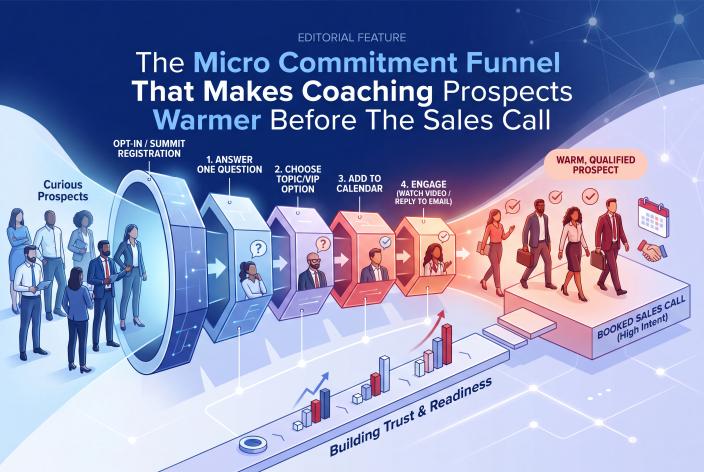
If you can sell well once the right person is on a call, your funnel has one job before that call happens.
It needs to help the prospect become more ready.
That sounds simple. But a lot of coaching funnels jump too quickly. Someone sees a post, clicks a link, downloads a thing, and immediately gets asked to book a call.
Sometimes that works.
But often, the prospect is still sorting out a few quiet questions:
- Is this actually relevant to me?
- Do I trust this person enough?
- Is my problem urgent enough to talk about now?
- Will this feel pushy?
- Am I going to be sold something before I feel understood?
A micro commitment funnel answers those questions through small, natural steps.
Each step asks for a small yes. Not a huge leap. Not a high-pressure decision. Just enough engagement to help the prospect move from curiosity to trust to a more qualified conversation.
And for coaches, this matters.
Because the goal is not more calls with anyone who can click a calendar link. The goal is better conversations with people who already understand why your work matters.
What A Micro Commitment Funnel Really Is
A micro commitment funnel is a path of small actions that build trust before you ask for a bigger commitment.
It might include:
- Opting in for a workshop, summit, guide, or assessment
- Answering a few registration questions
- Choosing a topic, session, track, or interest area
- Clicking a thank-you page next step
- Adding the event to their calendar
- Watching a short pre-call or pre-event video
- Replying to an email
- Choosing a VIP upgrade, replay option, or deeper resource
- Booking a call after they have been warmed and educated
None of these actions need to feel dramatic.
That is the point.
The prospect is not being dragged through a sales maze. They are being guided through a trust path.
For a coach with a meaningful offer, this can be the difference between a call that starts with skepticism and a call that starts with, "I feel like you understand what I am dealing with."
That is a very different sales conversation.
The Belief Shifts A Prospect Needs Before They Book A Call
Before someone books a coaching sales call, several beliefs usually need to move.
They may not say these out loud. But they are there.
They Need To Believe The Problem Is Real Enough To Address
A prospect may know something feels off.
Their health is slipping. Their business is inconsistent. Their leadership role feels heavier. Their relationship patterns keep repeating. Their money decisions feel reactive.
But knowing something is uncomfortable is different from deciding it deserves action.
Your funnel can help them name the problem clearly.
A good opt-in, summit session, workshop, or assessment should help them think, "Yes, that is exactly what is happening."
That first recognition is a micro commitment.
They Need To Believe Your Approach Makes Sense
Your prospect does not need your entire methodology before the call.
They do need enough of your thinking to feel safe taking the next step.
This is where a short teaching video, useful event session, clear email sequence, or diagnostic framework helps. You are not proving every detail. You are giving them a taste of how you see the problem and how you help clients move through it.
The question in their mind is simple.
"Does this person see what I have not been able to fix on my own?"
If the answer starts to feel like yes, the sales call becomes easier.
They Need To Believe You Are Relevant To Them
Generic coaching funnels create generic interest.
Right-fit prospects need to see themselves in the path.
That can happen through:
- Specific registration page copy
- Custom registration questions
- Session titles that reflect real pain points
- Thank-you page options based on interest
- Follow-up emails that speak to their situation
- CRM tags that trigger the right nurture path
Relevance warms people up because it lowers the mental effort.
They do not have to translate your message into their world. You have already done some of that work for them.
They Need To Believe The Next Step Will Be Respectful
Many coaches are careful about how they sell.
Your prospects are careful too.
If they sense pressure, hype, or a bait-and-switch, they back away. A micro commitment funnel should make each next step feel clear and voluntary.
That means your thank-you page can invite action without forcing it. Your emails can educate without cornering people. Your calendar invitation can explain who the call is for and what will be discussed.
The feeling you want is calm momentum.
Not urgency for the sake of urgency.
Start With The Smallest Meaningful Yes
Every funnel asks for something.
The mistake is asking for the biggest commitment before enough trust has been built.
A better starting question is this:
What is the smallest meaningful yes your prospect can give?
For a coach, that could be:
- Registering for a focused workshop
- Signing up for a virtual summit around a specific problem
- Completing a short self-assessment
- Choosing the session they care about most
- Sharing their biggest challenge in a registration form
- Watching a 5-minute orientation video
The action should give value to the prospect and useful information to you.
For example, if you are a leadership coach, your registration question might ask:
"Which leadership challenge is costing you the most energy right now?"
Then offer choices like:
- Difficult conversations
- Team accountability
- Decision fatigue
- Executive presence
- Burnout and boundaries
That one answer tells you a lot.
It helps the prospect name the issue. It helps you segment follow-up. And it makes the next message feel more personal.
Use Registration Questions To Reveal Readiness And Fit
Registration questions are one of the most underused parts of a funnel.
A plain name and email form captures contact information. A better registration flow captures context.
EventRaptor supports custom registration questions, registration management, attendee dashboards, VIP messaging, and CRM syncing, which means the registration step can do more than collect a name and email. It can help you understand and serve your audience more clearly.
So what should you ask?
Keep it light. Keep it useful. And ask questions you will actually use.
Ask About The Problem
Use a simple question that helps you understand what they are dealing with.
Examples:
- What is your biggest challenge with client attraction right now?
- What are you hoping to improve in your health, business, leadership, or relationships?
- Which topic made you decide to register?
This creates self-awareness for the prospect and segmentation data for your follow-up.
Ask About Timing
Timing matters.
A prospect who wants help this month should be treated differently from someone who is casually exploring.
You might ask:
- How soon are you hoping to make progress on this?
- Are you actively looking for support, gathering ideas, or just exploring?
- What would make this event or resource most useful to you right now?
This does not need to feel like qualification pressure. It can feel like care.
Ask About Fit
Fit questions help protect both sides.
For example:
- What type of coaching or support have you tried before?
- What would make a sales conversation useful for you?
- What kind of outcome are you looking for?
These questions help you spot prospects who may be ready for a call, need more nurture, or are not aligned with your offer.
And that is a good thing.
A clean funnel should improve call quality, not just calendar volume.
Build Thank-You Pages That Guide Without Pressure
The thank-you page is a powerful moment.
The prospect has just said yes.
They are paying attention. They have momentum. They are wondering what happens next.
Do not waste that moment with a dead-end confirmation page.
Use it to guide the next micro commitment.
Give Them A Clear Next Step
A good thank-you page can say:
"You are registered. Here is what to do next."
Then give them a short list:
- Add the event to your calendar
- Check your inbox for the confirmation email
- Answer one short question so we can tailor the experience
- Watch this short video before the session
Simple. Clear. Useful.
This helps them show up more prepared.
Invite A Deeper Step For The Ready Prospect
Some people will be ready sooner than others.
Your thank-you page can include a calm invitation for those people.
For example:
"If you already know this is an issue you want help solving, you can book a planning conversation here."
No pressure. No fake deadline. Just a clear path for the person who is already leaning in.
This is also where a VIP upgrade, replay package, private workshop, or deeper resource can make sense when it supports the event journey. EventRaptor supports VIP promotions, dashboard messaging, follow-up emails, and attendee experience tools that can help make those options clear and organized.
The key is relevance.
The upgrade should feel like a useful next layer, not a random checkout page.
Use Calendar Invitations As A Commitment Tool
Adding something to a calendar is a small action.
But it matters.
When someone adds your workshop, summit session, webinar, or call to their calendar, the event becomes more real. It moves from "interesting link" to "scheduled attention."
Make this easy.
EventRaptor supports event timing, registration windows, calendar exports, ICS feeds, visual schedules, reminder emails, attendee dashboards, and event access links. That kind of event infrastructure helps attendees know when to attend, how to access the event, and what happens next.
For a coach, this is not just logistics.
It is part of trust.
A clear calendar path tells the prospect, "This is organized. I know where to go. I know what to expect."
That feeling carries into the sales conversation.
Continue The Commitment Path With Email And CRM Follow-Up
Many warm prospects do not disappear because they were never interested.
They disappear because the follow-up goes quiet, gets generic, or happens too late.
Good follow-up keeps the relationship moving while interest is still warm.
EventRaptor supports welcome emails, scheduled emails, reminders, nurture sequences, follow-up emails, personalization placeholders, test emails, email status tracking, and CRM syncing. It can also connect event registrations and speaker activity to broader follow-up systems through GoHighLevel contact sync, registrant and speaker sync, tag management, automated tagging, Zapier, and webhooks.
GHL/CRMRaptor then supports the CRM side of the path with contact records, tags, custom fields or values, calendars, funnels, workflows, automation, and follow-up.
Together, the event activity and the follow-up system can stay connected.
Here is what that looks like in practice:
- A prospect registers for your event
- Their registration answers are captured
- Their contact record is created or updated
- Tags identify their interest area, readiness, or attendee type
- They receive the right confirmation and reminder emails
- They attend, click, upgrade, reply, or book
- Their activity shapes the next follow-up step
- The ready prospect is invited into a planning or sales conversation
- The not-yet-ready prospect continues receiving useful nurture
That is a much healthier path than dumping every lead into the same newsletter and hoping they remember you later.
Design Follow-Up Around Behavior
The best micro commitment funnels pay attention to what people actually do.
Not in a creepy way.
In a helpful way.
Someone who registers but does not attend may need a replay and a short recap.
Someone who attends several sessions may be ready for a deeper invitation.
Someone who clicks a case-related resource may need more education around fit, timing, and next steps.
Someone who answers "I need help now" on a registration form should not receive the same slow nurture as someone who says they are casually exploring.
This is where CRM tagging and workflow automation become practical.
Good automation protects the relationship by making follow-up timely and consistent. It helps you respond to interest without relying on memory, mood, or a messy spreadsheet.
And yes, the copy still needs to sound like you.
Automation handles the timing. Your voice handles the trust.
What To Include Before The Sales Call
Once a prospect books a call, the micro commitment path should keep working.
The pre-call experience is part of the sales conversation.
Use it to reduce uncertainty and build trust.
You might include:
- A confirmation email that explains what the call is for
- A short pre-call questionnaire
- A calendar reminder with the meeting link
- A useful article, video, or event replay connected to their interest
- A reminder of who the call is best suited for
- A simple note about how to prepare
This helps the prospect arrive more focused.
It also helps you avoid spending the first part of the call explaining basics they could have understood beforehand.
For coaching offers, this matters because your sales conversation should not feel like dragging someone uphill.
It should feel like continuing a conversation they already chose to begin.
A Simple Micro Commitment Funnel For Coaches
Here is a simple structure you can adapt.
| Funnel Stage | Prospect Action | What You Learn | Your Next Step |
|---|---|---|---|
| Registration | They opt in for a summit, workshop, or resource | Topic interest and basic intent | Send confirmation and segment by interest |
| Registration Questions | They answer a few useful questions | Problem, timing, and possible fit | Tag and personalize follow-up |
| Thank-You Page | They choose the next step | Level of readiness | Offer calendar add, intro content, VIP option, or planning call |
| Event Or Content | They attend, watch, click, or reply | Engagement level | Send relevant recap and next invitation |
| CRM Follow-Up | They receive behavior-based nurture | Ongoing readiness | Invite qualified prospects into a call when appropriate |
| Pre-Call Nurture | They complete prep and review useful context | Seriousness and clarity | Hold a warmer, more focused conversation |
You do not need to make this complicated.
You do need to make it intentional.
Every step should answer one question:
What small yes would help this person move closer to clarity, trust, and the right next conversation?
Where Coaches Usually Overcomplicate This
Coaches often make the funnel too big in the wrong places and too thin in the important places.
They spend hours on page design but do not ask useful registration questions.
They create a strong workshop but send weak follow-up.
They attract attention through a summit or webinar but do not connect that attention to CRM tags, calendar paths, and post-event nurture.
They ask for a call before the prospect has enough context.
You do not need a giant system to fix this.
Start with the commitment path.
Ask:
- What does the prospect believe when they first arrive?
- What do they need to believe before a call makes sense?
- What small action could help them move forward?
- What information do we need to follow up intelligently?
- What should happen for the ready prospect?
- What should happen for the still-warming prospect?
When you answer those questions, your funnel stops feeling like a pile of pages and emails.
It starts becoming a client attraction system.
How EventRaptor Plus GHL/CRMRaptor Supports The Path
This is much easier when the event, funnel, CRM, and follow-up pieces are connected.
EventRaptor handles the virtual event management side. That can include registration pages, custom registration questions, attendee dashboards, speaker profiles, schedules, reminder emails, VIP messaging, registrant data, promoter tracking, and CRM sync.
GHL/CRMRaptor supports the CRM and follow-up side. That can include contact records, tags, custom fields or values, calendars, funnels, workflows, automation, and nurture.
Together, they help you manage the journey from visibility to registration to trust to qualified conversation.
The point is not more tech.
The point is a clearer path.
Your prospects should not have to figure out what to do next. Your team should not have to rebuild every event from scratch. And your best leads should not get lost because the follow-up was buried in someone’s inbox.
A micro commitment funnel gives everyone a cleaner experience.
The prospect feels guided.
You get better context.
The sales call starts warmer.
The Takeaway
A coaching funnel should do more than capture an email address.
It should help the right person take small, meaningful steps toward trust.
That is what a micro commitment funnel gives you. It lets your prospect raise their hand, tell you what matters, engage with your thinking, choose the next step, and arrive at the sales call with more clarity.
If your client flow is inconsistent, this is a smart place to look.
You may not need to shout louder. You may need a better commitment path behind the visibility you already create.
If you want help applying this to your coaching business, Book your Client Attraction Planning Call. On the call, we will look at where your client flow is getting stuck and what kind of authority, funnel, CRM, follow-up, or event strategy could make sense next.