If you've been in coaching for more than a few minutes, you've probably heard this advice:
"Run a free workshop."
And yes, a free workshop can work beautifully.
But only when it's designed as part of a real client attraction system.
A lot of coaches build workshops that attract curious people, freebie collectors, and polite attendees who say, "This was great," then disappear. That can feel discouraging, especially when you know your coaching creates real results.
The workshop itself usually isn't the problem.
The issue is the path around it.
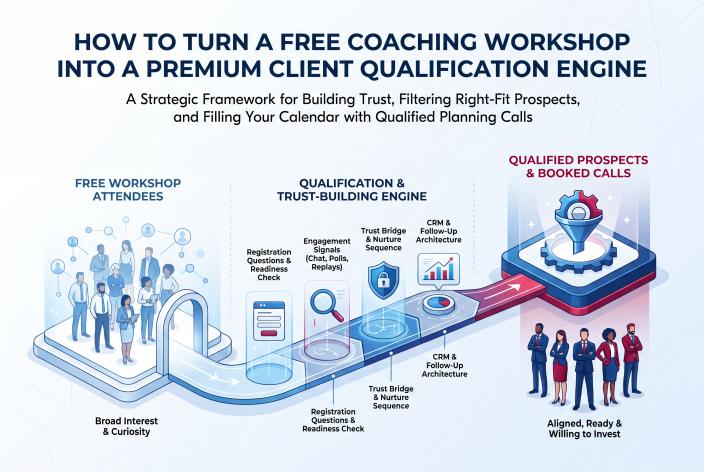
Your free workshop should do 5 things:
- Attract people with a problem they already care about.
- Reveal who is ready, qualified, and aligned.
- Build trust before the sales conversation.
- Create useful engagement signals.
- Move warm prospects toward a clear next step.
When you design it that way, your workshop becomes more than a teaching session. It becomes a premium client qualification engine.
Let's walk through how to build one.
Start With One Urgent Problem Your Best Prospects Already Want Solved
A strong workshop starts before the slides.
It starts with the problem you choose.
Your best workshop topic should sit at the intersection of 3 things:
- Your ideal client already feels the pain.
- They believe solving it would matter now.
- It naturally connects to your paid coaching offer.
This is where many coaches get too broad.
They choose topics like:
- "How To Improve Your Life"
- "How To Grow Your Business"
- "How To Feel More Confident"
- "How To Become A Better Leader"
Those topics may be meaningful, but they don't create enough urgency.
A better workshop topic names the specific moment your best prospect is living through.
For example:
| Broad Topic | Stronger Workshop Topic |
|---|---|
| Grow Your Coaching Business | How To Turn Warm Referrals Into Booked Sales Conversations |
| Improve Your Health | How To Stop Evening Cravings Without Starting Another Strict Diet |
| Become A Better Leader | How To Handle Difficult Team Conversations Without Losing Authority |
| Build Confidence | How To Make Clear Decisions When You're Second-Guessing Everything |
See the difference?
The stronger topic gives the right person a small jolt of recognition.
"That's me. I need that."
That moment matters.
Your workshop doesn't need to solve their entire life, business, health, marriage, leadership style, or money story in 60 minutes. It needs to help them see one problem clearly, make progress on it, and understand why a deeper path may be needed.
Here's a tip.
If your paid offer helps clients create a larger transformation, choose a workshop problem that acts like the front door to that transformation.
Not the whole house.
Just the front door.
Use Registration Questions To Reveal Readiness And Fit
Your registration page should do more than collect a name and email.
It should help you understand who's raising their hand.
EventRaptor's registration configuration can support custom registration questions, attendee dashboard messaging, VIP dashboard messaging, and embeddable registration forms. That matters because registration can become the first step in qualification, not just a technical form.
Good registration questions tell you 4 things:
- What problem they think they have.
- How urgent it feels.
- What they've already tried.
- Whether they're open to support.
You don't need a long application.
In fact, too many questions can slow people down. But a few smart questions can give you a clearer view of readiness before the workshop even starts.
Useful Registration Questions For A Coaching Workshop
Try questions like these:
- "What is the main challenge you want help with right now?"
- "What have you already tried to solve this?"
- "How important is it for you to solve this in the next few months?"
- "If this workshop helps you see a clear next step, would you be open to a planning conversation?"
- "What would make this workshop most useful for you?"
These questions do something important.
They shift your workshop from anonymous attendance to informed follow-up.
Now you know who is mildly interested, who is feeling urgency, who has already invested effort, and who may be ready for a deeper conversation.
And by the way, this also helps your teaching.
If 15 registrants all describe the same sticking point in slightly different words, you just received language you can use inside the workshop. Real prospect language beats polished marketing language almost every time.
Build The Thank-You Page As A Trust Bridge
Most thank-you pages waste the moment.
They say, "You're registered. Check your inbox."
That's accurate, but it doesn't build momentum.
Your thank-you page should reassure the attendee that they made a good decision and guide them toward the next small action.
A strong thank-you page can include:
- The workshop date and time.
- A short reminder of what they'll learn.
- A calendar link.
- A simple pre-work question.
- A short video from you.
- A soft invitation to book a call if they already know they want help.
Keep it human.
Something like:
"You're registered. Before the workshop, take 2 minutes and write down where this problem is costing you the most right now. We'll use that as your lens during the training."
That small prompt prepares them to pay attention.
It also starts the internal conversation your coaching will continue.
If you're using an event platform, this is where connected pages, registration data, calendar details, and reminder emails become useful. EventRaptor supports registration pages, thank-you pages, attendee dashboards, scheduled emails, reminders, and follow-up emails, which can help keep the workshop journey organized instead of scattered across tools.
Teach Enough To Build Trust Without Overwhelming The Audience
This is where skilled coaches sometimes trip over their own expertise.
You know a lot.
You can see the layers behind the problem. You understand the nuance. You want to serve well, so you try to give them everything.
Then the audience leaves with a full notebook and no clear next step.
The job of a free workshop is to create clarity, trust, and movement.
A good structure looks like this:
- Name the real problem.
- Show why it keeps happening.
- Teach a simple framework.
- Help them apply one piece of it.
- Show what becomes possible with deeper support.
- Invite the right people into the next conversation.
Let's make that practical.
If you're a health coach teaching about evening cravings, you might explain the relationship between food timing, stress patterns, and environment. Then you give attendees one practical evening reset plan.
If you're a business coach teaching about referrals, you might show why referrals go quiet, then help attendees map one follow-up path for warm contacts.
If you're a leadership coach teaching difficult conversations, you might explain why leaders avoid tension, then give them one conversation planning tool.
The workshop should give them a real win.
But the win should also help them see the larger transformation.
That's what builds trust.
You are not hiding the good stuff. You're helping them experience how you think, how you guide, and why your paid work goes deeper.
Design For Engagement Signals During The Workshop
A premium client qualification engine needs signals.
You want to know who is leaning in.
That doesn't mean you need to pressure people or turn the workshop into a sales interrogation. It means you create simple moments where interested people can reveal themselves.
Watch for signals like:
- They attend live.
- They answer questions in chat.
- They complete a poll.
- They ask specific questions.
- They stay until the end.
- They click the next-step link.
- They reply to follow-up emails.
- They mention urgency in registration or chat.
These signals are not perfect. Someone quiet may still be highly qualified. Someone active may not be a fit.
But signals help you follow up more intelligently.
Simple Engagement Prompts To Use Live
Use prompts that help people self-diagnose:
- "Drop a 1 in the chat if this is something you've been trying to fix for a while."
- "Which part is most familiar for you, the visibility problem, the follow-up problem, or the sales conversation problem?"
- "What is one thing you know you need to tighten up after seeing this framework?"
- "If you already know you need help building this, I'll share a planning-call link at the end."
Notice the tone.
Calm. Useful. Direct.
No pressure.
Your right-fit prospects don't need to be cornered. They need to feel understood and guided.
Use Reminder Emails To Build Pre-Call Trust Before The Workshop
Reminder emails are often treated like logistics.
"Don't forget, we're starting soon."
That's necessary. But reminders can also build trust.
EventRaptor supports welcome emails, scheduled emails, event reminders, nurture sequences, personalization placeholders, test emails, and email status tracking. The practical benefit is simple: you can communicate before, during, and after the event without relying on memory or last-minute manual emails.
For a coaching workshop, your reminders should do 3 jobs:
- Reinforce the value of attending live.
- Help the prospect think about their own situation.
- Warm up the beliefs they'll need to hear during the workshop.
Here is a simple reminder flow:
| Timing | Purpose | Example Message Angle |
|---|---|---|
| Immediately After Registration | Confirm And Orient | "You're registered, here's what we'll cover and how to prepare." |
| 1 Day Before | Build Relevance | "Before tomorrow's workshop, notice where this problem shows up most often." |
| 1 Hour Before | Increase Attendance | "We're starting soon, bring the specific situation you want to work through." |
| After The Workshop | Continue The Conversation | "Here are the key takeaways and the next step if you want help applying them." |
The reminder sequence should sound like you.
Not robotic. Not overhyped. Not stuffed with false urgency.
Good automation protects relationships because it helps you show up consistently when interest is warm.
Create A Follow-Up Path For Different Levels Of Readiness
Not every attendee should get the same follow-up.
Some people are ready to talk now.
Some need more trust.
Some are curious but not qualified.
Some attended because the topic was useful, but they are not a fit for your paid work.
That's normal.
This is why your follow-up should be organized around readiness.
A simple version could look like this:
| Attendee Type | Signal | Follow-Up Path |
|---|---|---|
| Highly Warm | Registered with urgency, attended live, clicked call link | Personal email plus planning-call invitation |
| Interested But Not Ready | Attended or watched replay, engaged lightly | Nurture emails with case-relevant teaching and soft CTA |
| Low Engagement | Registered but did not attend | Replay email plus one useful takeaway |
| Poor Fit | Their answers show misalignment | Helpful content, no aggressive sales push |
This is where your CRM matters.
GHL/CRMRaptor can support the CRM, contact records, tags, custom fields or values, calendars, funnels, workflows, automation, and follow-up side of the system. EventRaptor manages the virtual event side, while GHL/CRMRaptor supports the CRM and follow-up side.
Together, they help the workshop become a managed path from registration to attendance to follow-up to qualified conversations.
And that's the real goal.
You don't want more names sitting in a spreadsheet. You want a clear view of who is warm, who needs nurturing, and who should be invited into a conversation.
Make The Planning-Call Invitation Feel Like A Natural Next Step
Your call invitation should not feel like a trapdoor at the end of the workshop.
It should feel like the obvious next step for the person who is thinking:
"This is exactly what I need help with. I don't want to figure this out alone."
The easiest way to do that is to connect the call directly to the workshop topic.
For example:
"If today's workshop helped you see that your client flow problem is really a visibility, follow-up, and conversion path problem, the next step is to look at your business specifically. On a Client Attraction Planning Call, we'll look at where your current system is getting stuck and what kind of path could make sense next."
Then use the exact CTA:
Book your Client Attraction Planning Call
That's it.
No hype.
No exaggerated promises.
No awkward pressure.
Just a clear invitation for the right person.
Where To Place The CTA
Use the planning-call invitation in 4 places:
- On the thank-you page, as an optional early path.
- Near the end of the workshop, after you've taught the framework.
- In the first follow-up email, for live attendees and engaged replay viewers.
- In later nurture emails, when the teaching naturally points back to implementation.
You can also segment the invitation based on registration answers and engagement.
For example, someone who says the problem is urgent and clicks the workshop reminder emails may deserve a more personal follow-up than someone who registered and never opened anything.
Simple. Respectful. Useful.
Put The Workshop Into A Bigger Client Attraction System
A free workshop becomes powerful when it's connected to the rest of your client acquisition path.
Here is the full journey:
- Choose a specific urgent problem.
- Create a registration page that attracts the right people.
- Ask questions that reveal readiness and fit.
- Use the thank-you page to build momentum.
- Send reminders that create trust and improve attendance.
- Teach a belief-shifting framework that creates clarity.
- Track engagement signals.
- Follow up based on readiness.
- Invite qualified prospects to a planning conversation.
- Continue nurturing everyone who is not ready yet.
That is funnel architecture in plain English.
It is the full journey from attention to trust to conversation.
When your workshop is built this way, you stop relying on hope after the event. You have a system that helps the right people identify themselves and take the next step when they are ready.
And for a proven coach, that changes the feeling of marketing.
Less guessing.
Less chasing.
More trust before the sales call.
Your Next Step
If your free workshops have been attracting interest but not enough qualified conversations, don't assume the topic is useless or your audience is wrong.
Look at the path.
Is the problem specific enough?
Are your registration questions revealing readiness?
Are your reminders building trust?
Is your teaching creating clarity instead of overwhelm?
Is your follow-up organized around what people actually did?
If you want help applying this to your coaching business, Book your Client Attraction Planning Call.
On the call, we'll look at where your client flow is getting stuck, whether your main gap is positioning, workshop strategy, funnel, CRM, follow-up, or implementation, and what kind of client attraction system could make sense next.