If you've ever registered for an event and immediately thought, "Did this go through?", you already know how fragile trust can be.
The topic might be good. The speaker might be credible. The offer might be strong.
But if the confirmation page is vague, the access instructions are confusing, the reminders feel random, and nobody follows up afterward, the attendee starts to feel the wobble.
And that wobble matters.
For a coach, your event is often the first real experience a prospect has with your brand. They are not only listening to your ideas. They are feeling what it might be like to be guided by you.
Do you make things clear?
Do you anticipate questions?
Do you follow through?
Do you help them know what to do next?
That is where the attendee experience becomes more than event logistics. It becomes part of your authority, your trust-building, and your client attraction system.
The Premium Feeling Starts Before The Event Begins
A premium attendee experience does not mean expensive production, fancy graphics, or a broadcast studio.
It means the person feels guided.
From the moment they register, they should have a quiet sense of, "Good, I'm in the right place. This is organized. I know what happens next."
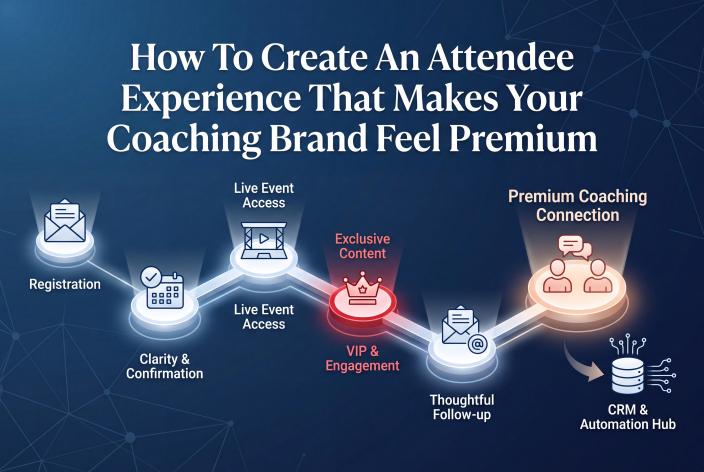
That feeling comes from a few practical pieces working together:
- A clear registration page
- A confirmation or thank-you page that reduces uncertainty
- Reminder emails that arrive at useful times
- Simple agenda and access instructions
- An attendee dashboard or event hub
- Helpful VIP messaging when relevant
- Follow-up that continues the relationship after the event
EventRaptor supports this kind of attendee journey with registration pages, thank-you pages, attendee dashboards, dashboard messaging, VIP messaging, reminder emails, calendar feeds, and event access links. The point is simple. Attendees should not have to dig through their inbox, guess where to click, or wonder what they signed up for.
When your event feels organized, your coaching brand feels more trustworthy.
Define The Emotional Journey Before You Build The Pages
Before you write emails or build pages, map what you want attendees to feel.
Most hosts start with tasks. Page. Email. Zoom link. Agenda. Replay.
Useful, yes. But the better starting point is emotional.
Ask yourself, "What should the attendee feel at each stage?"
Here is a simple map.
| Stage | What Attendees Often Feel | What You Want Them To Feel |
|---|---|---|
| Registration | Curious, skeptical, mildly distracted | Clear that this event is relevant to them |
| Confirmation | Unsure if they are fully registered | Reassured and ready for the next step |
| Pre-Event | Busy, forgetful, half-committed | Reminded, interested, and oriented |
| Event Access | Rushed, confused, looking for the link | Calm and able to join easily |
| During Event | Evaluating your value and fit | Engaged, respected, and guided |
| VIP Decision | Interested but unsure | Clear about the added value |
| Follow-Up | Busy again, processing what they learned | Invited into the next right step |
You see the shift?
You are not just managing attendance. You are designing a trust pathway.
That pathway matters because coaches sell through belief, relevance, safety, and timing. A scattered event experience makes the prospect work too hard. A thoughtful one lets them relax enough to pay attention.
Make The Registration Page Clear Enough To Build Confidence
Your registration page has one job at first. Help the right person decide, "This is for me."
A premium registration page should answer the attendee's practical questions without burying them in copy.
Include:
- Who the event is for
- What problem or desire the event addresses
- What they will learn or experience
- When it happens
- How they will access it
- Whether replays or VIP options are available
- What happens after they register
This is also where you can start qualifying attention.
Custom registration questions can help you understand who is signing up, what they care about, and whether they may be a fit for a later coaching conversation. EventRaptor supports custom registration questions, registrant management, VIP indicators, promoter attribution, exports, and CRM sync, which helps turn registration into useful audience data instead of a name-and-email pile.
Here's a tip.
Ask questions that help you serve and segment, not questions that feel like a sales interrogation.
Good examples include:
- "What is your biggest challenge with client attraction right now?"
- "Which topic are you most interested in?"
- "Are you currently coaching clients, building your offer, or growing your audience?"
- "Would you like information about the next step after the event?"
The answers can shape your follow-up, your VIP messaging, and your sales conversations later.
Use The Thank-You Page To Reduce Doubt Immediately
The thank-you page is one of the most underused parts of an event.
Many hosts treat it like a receipt. "You're registered. Check your email."
That is a missed moment.
Right after registration, the attendee's attention is still warm. They have just said yes. So give them clarity.
A strong thank-you page should include:
- A simple confirmation that registration is complete
- The event date and time
- A button to add the event to their calendar
- Clear instructions on where to find access details
- A short reminder of why the event matters
- An invitation to share the event if partner growth is part of the strategy
- A next step for VIP access, if you offer one
Keep it calm. Keep it clean.
The attendee should not feel sold to the second they register. They should feel taken care of.
By the way, this is also where an attendee dashboard can be powerful. Instead of scattering details across multiple emails, you can direct registrants to one clear event hub with the agenda, access details, speaker information, VIP messaging, and updates.
That alone can make a coaching brand feel more polished.
Write Reminder Emails That Help People Actually Attend
People miss events for ordinary reasons.
They get busy. They forget. They cannot find the link. They registered on a good day and then life happened.
Reminder emails are not nagging when they are useful. They are part of the service experience.
Your reminder sequence should do 4 things:
- Confirm the value of attending
- Make the date, time, and access instructions obvious
- Build anticipation for the most relevant sessions
- Point attendees to the next useful action
A simple reminder rhythm might include:
- Immediately after registration
- A few days before the event
- The day before
- The morning of the event
- Shortly before going live
- After the event with replay or next-step information
Use your own timing based on your event length and audience. The principle is consistency.
EventRaptor supports welcome emails, scheduled emails, event reminders, follow-up emails, personalization placeholders, test emails, email status tracking, and CRM syncing. That makes the reminder process easier to manage without relying on memory or last-minute manual sends.
And remember this. A reminder email should not be a wall of text.
Give people what they need fast:
- "Here is when we start."
- "Here is where to join."
- "Here is what you will get from attending live."
- "Here is what to do if you want the VIP option."
Clear beats clever.
Make The Agenda Page Easy To Scan
Your agenda page is where attendees decide how much attention they are willing to give you.
If the schedule feels confusing, they may only show up for one session. If it feels clear and relevant, they are more likely to plan around it.
A good agenda page should show:
- Session titles
- Speaker names
- Times and time zones
- Short descriptions
- Tracks or categories if the event has multiple themes
- Which sessions are live, recorded, or on demand
- Where to access each session
For larger events, tracks can help attendees follow the sessions most relevant to them. For a smaller workshop or summit, a simple chronological layout may be enough.
The goal is not to impress people with complexity. The goal is to help them choose.
EventRaptor supports calendar and schedule tools, session scheduling, tracks, attendee dashboards, calendar feeds, and event access links. Used well, those pieces help attendees move through the event without feeling lost.
That is premium.
Not because it is flashy. Because it respects their attention.
Use VIP Messaging To Guide Warmer Prospects
If your event has a VIP offer, replay package, bonus bundle, or premium next step, the messaging should feel connected to the attendee's journey.
Warm prospects need context.
They need to understand why the VIP option matters, who it is for, and how it helps them get more value from the event.
VIP messaging can appear in:
- The thank-you page
- The attendee dashboard
- Reminder emails
- Replay emails
- Session pages
- Post-event follow-up
The key is relevance.
For example, a business coach hosting a summit on client attraction might use VIP messaging to help attendees go deeper into implementation. A wellness coach might position VIP access around replays, guided resources, or extended learning.
Keep the message grounded:
- "If you want to revisit the sessions, VIP access gives you more time."
- "If you want the bonus implementation resources, this is the upgrade path."
- "If this topic is directly tied to your next business move, here is the next step."
EventRaptor supports VIP status, VIP dashboard messaging, VIP package promotions, attendee dashboards, and follow-up communications. That helps you present VIP options in the right places without making every email feel like a pitch.
Connect The Attendee Journey To CRM Follow-Up
This is where many events quietly lose money.
The event goes well. People attend. Some people engage. A few people seem interested.
Then everything gets fuzzy.
Who registered but did not attend?
Who attended live?
Who clicked on VIP information?
Who answered a registration question in a way that suggests they may need help?
Who should be invited into a coaching conversation?
If that information lives in spreadsheets, inboxes, chat notes, and memory, follow-up becomes fragile.
A CRM helps you keep the relationship organized. GHL/CRMRaptor supports the CRM, funnel, calendar, workflow, automation, and follow-up side of the client attraction system. EventRaptor handles the virtual event management side, including registrations, attendee data, event pages, reminders, speaker details, promoter tracking, and event follow-up paths.
Together, the event and CRM layers help you move from general visibility to specific next steps.
You can tag people based on:
- Registration source
- VIP status
- Topic interest
- Event attendance
- Custom registration answers
- Follow-up needs
- Calendar booking activity
Then your follow-up can speak to the person more intelligently.
A prospect who registered but missed the event needs a different message than someone who attended live, watched the replay, and clicked your coaching invitation.
Good automation makes that easier.
It protects the relationship by making follow-up timely, relevant, and consistent.
Keep Production Professional Without Making It Complicated
Some coaches delay events because they think a premium experience requires a huge production setup.
You do need quality. You do need clarity. You do need follow-through.
But you do not need to turn your event into a television production.
Focus on the pieces attendees actually feel:
- Can they understand the promise?
- Can they register easily?
- Do they know what happens next?
- Can they find the agenda?
- Can they access the sessions?
- Do reminders arrive on time?
- Does the event look organized?
- Are speakers presented professionally?
- Is the follow-up clear and useful?
That is where trust is built.
EventRaptor's event pages, speaker profiles, session scheduling, dashboard messaging, reminders, access links, registrant management, promoter tracking, and reporting support the operational side of that experience. The software does not replace strategy, positioning, or your expertise. It gives the event one organized home so the strategy can be delivered with less chaos.
That matters when your brand is personal.
Your attendee experience tells people what kind of guide you are.
Review The Journey Before You Launch
Before you promote the event, walk through the journey like an attendee.
Register with a test email.
Read the confirmation page.
Open the reminder emails.
Visit the attendee dashboard.
Click the access links.
Check the agenda on mobile.
Look at the VIP message.
Ask yourself:
- Where would someone feel unsure?
- Where are the instructions too thin?
- Where does the page feel generic?
- Where does the next step need more context?
- Where could follow-up become more personal?
This is not busywork. This is brand protection.
A smooth attendee journey makes your coaching brand feel calmer, clearer, and more credible.
Turn The Event Into A Qualified Conversation Path
Your event does not need to push every attendee toward a sales call.
It should help the right people identify themselves.
Some attendees will simply learn and stay on your list. Some will upgrade to VIP. Some will need more nurturing. Some may be ready for a conversation now.
The job of the attendee experience is to make that movement natural.
A strong path might look like this:
- They register for a topic that speaks to a real problem.
- They receive clear confirmation and reminders.
- They attend or watch sessions that build trust.
- They see relevant VIP or next-step messaging.
- Their behavior and answers are organized in the CRM.
- They receive follow-up that matches their interest.
- The right people are invited into a coaching conversation.
That is the difference between hosting an event and building an event-based client attraction system.
The summit, workshop, or speaker campaign becomes part of a larger journey from attention to trust to conversation.
The Premium Experience Is Really About Trust
Premium is not about being slick.
Premium means the attendee feels respected.
They feel like you thought through the details. They feel like their time matters. They feel like the next step is clear. They feel like your brand is steady.
For a coach, that matters deeply.
Because before someone trusts you with their goals, health, leadership, business, money, relationships, or life direction, they are paying attention to how you guide the small moments.
Registration is a small moment.
A reminder email is a small moment.
An access page is a small moment.
A thoughtful follow-up is a small moment.
Together, those moments create the feeling of your brand.
If you want help applying this to your own coaching business, Book your Client Attraction Planning Call. On the call, we can look at where your current client flow is getting stuck and what kind of summit, funnel, CRM, follow-up, or event strategy could make sense next.