If you can sell when the right person gets on a call, your sales problem may be happening before the call ever gets booked.
That can feel frustrating.
You post. You network. You run a workshop. You get a referral. Someone joins your list. Then what happens?
Too often, every lead gets pushed toward the same sales page, the same booking link, or the same generic email sequence.
But your leads are not all in the same place.
Some are curious.
Some know they have a problem but are still naming it.
Some are actively comparing solutions.
Some trust you and are waiting for the right invitation.
And some are ready to talk now.
A buyer readiness ladder helps you organize that journey so your funnel speaks to people based on where they actually are. Done well, it makes your follow-up feel calmer, more relevant, and more human.
And for a coach, that matters. Because the goal is not to process people through a machine. The goal is to guide the right people from first interest to trust to a better sales conversation.
What A Buyer Readiness Ladder Really Is
A buyer readiness ladder is a simple map of the stages a prospect moves through before they are ready for a coaching conversation.
Think of it as the path between:
- First noticing you
- Understanding the problem
- Believing change is possible
- Trusting your way of solving it
- Feeling ready to talk about working together
That path is your funnel.
A funnel is more than a page. It is the full journey from attention to trust to conversation.
When you build this ladder clearly, you stop treating every lead like they should be ready to buy today. You give each person the next step that matches their level of awareness, trust, and urgency.
Here’s a tip.
If your follow-up feels pushy, vague, or inconsistent, your ladder is probably missing a few rungs.
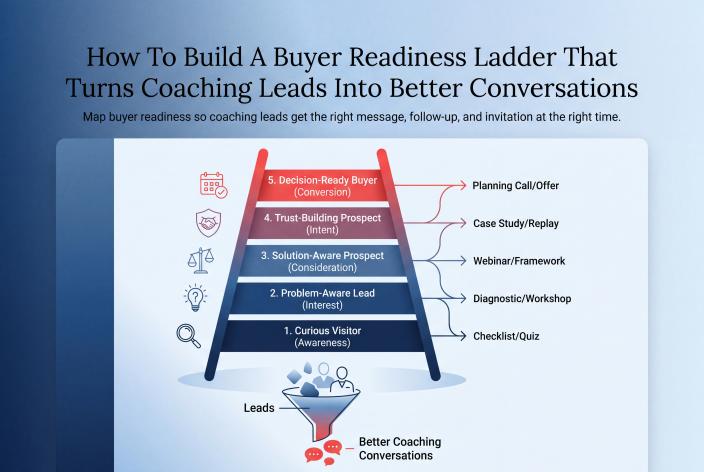
The 5 Stages Of Buyer Readiness For A Coaching Offer
You can make this complicated, but you don’t need to.
For most coaching offers, 5 stages are enough.
Stage 1 Is The Curious Visitor
This person has noticed you, your topic, or your event, but they are not deeply engaged yet.
They might find you through:
- A summit speaker promotion
- A podcast interview
- A social post
- A referral
- A webinar invitation
- A partner email
At this stage, they are thinking, “This seems relevant. I’ll take a look.”
They are not ready for a sales call yet. And that’s fine.
Your job here is to earn attention and create a low-friction next step.
Good assets for this stage include:
- A short checklist
- A quiz
- A simple guide
- A podcast episode
- A summit registration page
- A useful diagnostic question
The goal is simple. Help them recognize that your world contains something useful for them.
Stage 2 Is The Problem-Aware Lead
Now the person sees the problem more clearly.
Maybe they realize their health habits keep collapsing under stress. Maybe they see their leadership style is creating team friction. Maybe they finally admit their business growth depends too much on referrals.
For this person, the right content helps them name the real issue.
Good assets include:
- A deeper lead magnet
- A diagnostic worksheet
- A focused podcast episode
- A summit session about the core problem
- A short email sequence that explains symptoms and causes
- A workshop that helps them assess where they are stuck
This stage is where a lot of coaching funnels go wrong.
The lead is interested, but the relationship is still early. Sending them straight to a high-ticket coaching sales page can feel like jumping ahead in the conversation.
A better next step is education that helps them say, “Yes, this is exactly what’s happening.”
Stage 3 Is The Solution-Aware Prospect
At this point, the person knows they want help.
They are starting to compare approaches.
They may be asking:
- Should I work with a coach?
- Should I join a group program?
- Should I try to solve this myself first?
- Is this the right time?
- Do I trust this person’s method?
This is where your authority needs to become visible.
Good assets include:
- A workshop
- A webinar
- A summit session
- A framework article
- A comparison guide
- A mini-training that explains your method
- A podcast episode with a client challenge or transformation pattern
For coaches, virtual summits can work especially well here because they create borrowed authority and relationship momentum. You are not only publishing content. You are hosting a useful conversation around a problem your audience already cares about.
That is why the event needs a path behind it.
When someone registers for a summit, attends a session, clicks on a resource, or engages with a speaker topic, that behavior tells you something. EventRaptor helps organize registrations, attendee data, speaker sessions, reminder emails, promoter tracking, event pages, and follow-up paths so the event activity can support a clearer journey instead of ending as a messy spreadsheet.
Stage 4 Is The Trust-Building Prospect
This person is interested in your way of helping.
They may be opening your emails, watching sessions, attending workshops, reading stories, or revisiting your offer page. They may not have booked yet, but they are warming up.
This is where you need proof, clarity, and thoughtful follow-up.
Good assets include:
- Case studies, when you have permission to use them
- Client stories
- Deeper framework content
- Replays from a workshop or summit
- A behind-the-scenes explanation of your process
- Emails that answer common objections
- Invitations to a more personal next step
Remember, trust is built through consistency.
If your follow-up depends on memory, mood, or spare time, people slip through the cracks. They may still be a fit, but the relationship goes quiet.
Good automation protects the relationship by making follow-up timely and relevant. It helps you stay present without needing to manually remember every click, registration, replay view, or reply.
Stage 5 Is The Decision-Ready Buyer
This person is ready for a real conversation.
They understand the problem. They see the value of getting help. They have enough trust to consider your offer. Now they need a clear invitation.
Good assets include:
- A planning call invite
- A short application
- A pre-call video
- A clear offer page
- A nurture email that explains who the call is for
- A calendar path with reminders and pre-call education
At this stage, your job is to reduce friction and increase fit.
That does not mean begging people to book. It means making the next step clear for the right person.
For example:
“You’ve seen the framework. You’ve looked at where your client flow is getting stuck. If you want help applying this to your coaching business, book a planning call and we’ll map the next step.”
Simple. Human. Clear.
How To Match Each Stage With The Right Asset
Here is a simple way to think about it.
| Buyer Readiness Stage | What They Need | Best Asset Types | Follow-Up Focus |
|---|---|---|---|
| Curious Visitor | A reason to pay attention | Checklist, quiz, short guide, podcast episode, summit registration | Introduce the problem and your point of view |
| Problem-Aware Lead | Language for what is happening | Diagnostic, focused email sequence, problem-based workshop | Help them name the real issue |
| Solution-Aware Prospect | A clear path forward | Webinar, summit session, framework article, method training | Show how your approach works |
| Trust-Building Prospect | Confidence and credibility | Case study, replay, objection email, process explanation | Build trust and answer concerns |
| Decision-Ready Buyer | A clear next step | Planning call invite, application, offer page, pre-call content | Invite the right conversation |
You see the pattern?
Each stage has a different job.
Your lead magnet does not need to close the sale. Your workshop does not need to explain every detail of your program. Your planning call page does not need to educate a totally cold stranger from scratch.
Each piece should move the right person one step closer to clarity.
Why Sending Every Lead To The Same Sales Page Creates Friction
A sales page is useful when the person has enough context.
Without context, it can feel like too much, too soon.
Imagine meeting someone at a networking event. They ask what you do. You immediately hand them a full proposal, pricing, testimonials, program modules, and payment terms.
Awkward, right?
That is what happens when every new lead gets the same direct pitch before they understand the problem, the method, or why you are the right guide.
A buyer readiness ladder lets you ask a better question.
“What does this person need next to move toward trust?”
That next step might be a podcast episode.
It might be a summit session.
It might be a workshop.
It might be a case study.
It might be a planning call.
When the next step matches the person’s readiness, the whole funnel feels more respectful.
And better conversations usually begin before the calendar invite is ever sent.
How CRM Tags Make Follow-Up Feel More Relevant
Segmentation does not need to be complicated.
Start with simple CRM tags that show what someone did, what they care about, and where they are in the journey.
For example, you might tag people by:
- Lead source
- Summit registration
- Workshop attendance
- Topic interest
- Replay watched
- VIP status
- Call booked
- Application submitted
- Speaker or partner referral
Then your follow-up can speak more directly.
A person who registered for a summit session on “building executive confidence” should not receive the exact same first follow-up as someone who downloaded a checklist on “reducing emotional eating” or joined a webinar on “scaling a coaching business.”
The system does not need to be fancy. It needs to be useful.
With GHL/CRMRaptor, the CRM layer can support contact records, tags, custom fields or values, calendars, funnels, workflows, automation, and follow-up. EventRaptor handles the virtual event side, including registrations, event pages, attendee data, reminders, speaker activity, promoter tracking, and CRM syncing where connected.
Together, they help you connect visibility with follow-up.
That is the missing piece for many coaches. They create attention, but the attention does not always get captured, organized, nurtured, and invited into the next right step.
A Simple Buyer Readiness Ladder You Can Build This Week
You do not need to rebuild your entire marketing system today.
Start with one offer and one audience.
Then map this:
-
First Interest
What is the easiest useful thing someone can say yes to? -
Problem Clarity
What helps them understand why they are stuck? -
Solution Belief
What helps them see your method as a credible path? -
Trust And Fit
What helps them decide whether you are the right guide? -
Conversation
What invitation makes sense when they are ready to talk?
Now match one asset to each stage.
You might build:
- A diagnostic checklist for first interest
- A 3-email sequence for problem clarity
- A workshop for solution belief
- A case study or process article for trust
- A planning call invitation for conversation
That is enough to start.
Once the ladder exists, your CRM tags and follow-up can help people move through it without you manually chasing every lead.
Where Virtual Events Fit Into The Ladder
A summit, webinar, workshop, or speaker-led campaign can sit in several places on your ladder.
For a cold audience, a summit can create first interest because speakers and partners introduce you to new people.
For a problem-aware audience, a workshop can help prospects diagnose what is really going on.
For a solution-aware audience, a summit session can demonstrate your framework and help people see your authority in context.
For a trust-building audience, replays and follow-up emails can deepen belief over time.
The event becomes much more powerful when it has a path behind it.
EventRaptor helps coaches and experts manage authority-building events, grow an audience, organize speakers and attendees, track partner promotion, and follow up with right-fit prospects through one organized system. GHL/CRMRaptor supports the CRM, funnel, calendar, workflow, and follow-up side.
That means your summit can become more than a calendar date.
It can become part of the path from visibility to registration to trust to qualified conversation.
The Most Important Question To Ask Before You Build More Content
Before you create another post, lead magnet, or webinar, ask this:
“Where does this fit on my buyer readiness ladder?”
If you cannot answer that, the asset may still be useful, but it will be harder to connect it to client flow.
Your content should have a job.
Some content earns attention.
Some content builds trust.
Some content explains your method.
Some content invites a conversation.
When those pieces work together, your marketing starts to feel less random. You can see why leads are warming up, where they are stalling, and what kind of follow-up would help them take the next step.
That is how a funnel becomes a relationship path.
Your Next Step
If your coaching works but your leads are not turning into enough qualified conversations, the problem may be the path between first interest and the sales call.
A buyer readiness ladder gives that path structure.
It helps you speak differently to curious leads, warm prospects, and decision-ready buyers. It also gives your CRM and follow-up a clear job, so people are not all receiving the same generic message at the wrong time.
If you want help applying this to your own coaching business, Book your Client Attraction Planning Call.
On the call, we’ll look at where your client flow is getting stuck and what kind of authority, funnel, CRM, follow-up, or virtual event strategy could make sense next.