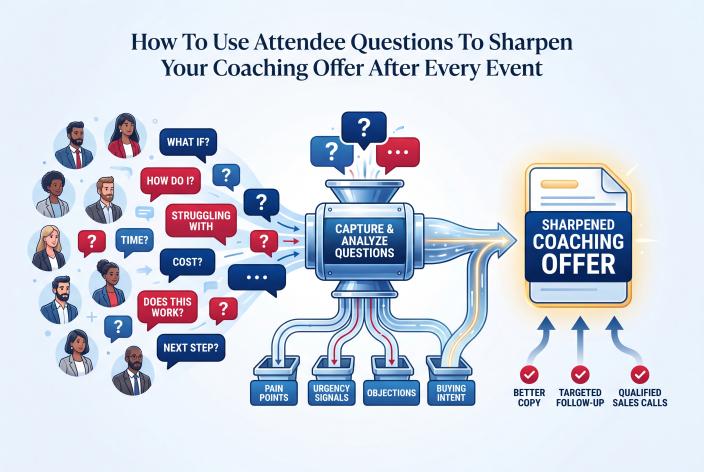
If you run workshops, webinars, summits, roundtables, or live trainings, your best offer research is probably already sitting in the chat box.
It shows up in the questions people ask before they register.
It shows up when someone says, "This sounds great, but what if I don't have a big audience yet?"
It shows up when an attendee watches the replay, clicks the follow-up email, and still doesn't book a call.
Those moments are gold.
Why? Because attendee questions show you how your market thinks before they buy. They reveal the language, fears, confusion, urgency, and readiness that your offer copy needs to address.
And when you use them well, every event becomes more than a visibility play. It becomes a message sharpening tool, a lead qualification tool, and a better path to right-fit conversations.
Why Attendee Questions Are Better Than Guessing
A lot of coaches try to improve their offer by sitting alone with a blank document.
They rewrite their headline. They tweak the promise. They change the name of the program. Then they wonder why the market still feels quiet.
Attendee questions give you something better than internal brainstorming. They give you market language.
A question can tell you:
- What the prospect is worried about
- What they already tried
- What they don't understand yet
- What feels urgent right now
- What would make them trust you more
- What might stop them from taking the next step
- Whether they're curious, serious, skeptical, or ready
That last one matters.
Raw attendance can feel exciting. But qualified conversations are what move a coaching business forward. A room full of passive attendees may give you a nice registration number, but the real value is in spotting the people who are leaning in, asking better questions, and showing signs of fit.
This is why your event follow-up should never be generic. The questions people ask should shape what you say next.
What Different Types Of Questions Reveal
Not every question means the same thing.
Some questions reveal pain. Some reveal objections. Some reveal buying intent. Some reveal that the person is simply information gathering.
Here's a simple way to read the room.
| Attendee Question Type | What It Often Reveals | How To Use It |
|---|---|---|
| "How do I know if this will work for me?" | Fit concern or skepticism | Add clearer qualification language and examples of who the offer is for |
| "What if I don't have a big audience?" | Readiness concern | Explain the minimum inputs needed and how authority can be built through partnerships |
| "How much time does this take?" | Capacity concern | Clarify the commitment, support, and implementation path |
| "Can this work in my niche?" | Relevance concern | Improve niche-specific copy and sales call discovery questions |
| "What should I do first?" | Decision fatigue | Create a clearer first step, diagnostic, or planning call invitation |
| "Do I need a CRM for this?" | System awareness | Educate on capture, nurture, tagging, follow-up, and sales path |
| "Can you help me build it?" | Implementation intent | Invite them into the next right conversation |
You see the pattern?
Their questions are not random. They're clues.
And if several people ask the same version of a question, your market is telling you something your current messaging has not made clear enough yet.
Capture Questions Before The Event Starts
The best offer research often starts at registration.
If your registration page only collects name and email, you're missing context. A simple question can help you understand why someone is showing up.
Use questions like:
- "What made you interested in this event?"
- "What is your biggest challenge with client attraction right now?"
- "What have you already tried?"
- "What would make this event worth your time?"
- "If you could leave with one answer, what would it be?"
Keep it easy to answer. One or two well-chosen questions are usually enough.
This gives you language you can use before the event even begins.
For example, if several registrants mention that referrals are inconsistent, you can address that in your opening. If people mention that follow-up feels awkward, you can include a practical follow-up framework. If people say they don't know whether they need a summit, webinar, funnel, or CRM, you can position the event around diagnosis instead of selling one fixed tactic.
This is where EventRaptor can help on the event side because registration, attendee information, custom questions, event pages, reminders, and follow-up paths can be part of one organized event journey. GHL/CRMRaptor can then support the CRM, tagging, calendar, workflow, and follow-up layer around that journey.
The goal is simple. Capture what people care about while interest is fresh.
Listen During The Event For The Buying Language
Live questions are different from registration answers.
Registration answers tell you why people showed up. Live questions tell you what they're processing while trust is being built.
Pay attention to questions that start with:
- "How would I..."
- "What if..."
- "I'm struggling with..."
- "I tried this before and..."
- "Would this work if..."
- "What do you recommend for someone who..."
These are not just content prompts. They're sales intelligence.
A health coach might hear, "What if my clients don't stick with the plan?"
A business coach might hear, "What if my offer is good but nobody responds?"
A leadership coach might hear, "How do I sell this to a company that doesn't see coaching as urgent?"
Each question points to a gap between interest and action.
Write them down exactly as people say them. Don't clean them up too quickly. The raw version usually contains the most useful copy.
For example, "I'm tired of posting and feeling invisible" is stronger than "I need a better content strategy."
Your prospect's words carry emotion. Use them carefully and respectfully.
Watch What Happens After The Event
The event doesn't stop teaching you when the live session ends.
Replay behavior, email replies, link clicks, no-shows, and delayed questions all add context.
A person who registered but didn't attend may still be interested. They may have had a scheduling conflict, or they may not yet feel enough urgency.
A person who watches the replay and replies with a specific question is often more engaged than someone who attended live but stayed silent.
A person who clicks a planning call link after reading 3 follow-up emails may need more nurture before they're ready to talk.
So don't treat all attendees the same.
Segment based on behavior and questions. Then follow up in a way that matches the stage of trust.
For example:
- Registrants who ask urgent problem questions may need a direct invitation to talk
- Attendees who ask strategic questions may need a deeper teaching email
- Replay viewers may need a short recap and next-step prompt
- Silent registrants may need a simple "what were you hoping to learn?" email
- People who ask implementation questions may be ready for a planning conversation
This is where CRM structure matters. In GHL/CRMRaptor, you can tag contacts based on the problems they raise, the event they attended, the replay they watched, or the next step they clicked. That makes follow-up feel more relevant because the system remembers what the person already showed you.
Good automation protects the relationship. It helps you follow up on time, with the right message, while the conversation still feels warm.
Turn Repeated Objections Into Better Offer Copy
Objections are not annoyances. They're unfinished answers.
If you hear the same objection again and again, your offer copy probably needs to handle it earlier.
Let's say people keep asking, "What if I don't have a large email list?"
That may mean your event, funnel, or program sounds like it's only for people with big audiences. You could add a section explaining how partner leverage, speaker-led visibility, and focused positioning can help a coach build authority without relying only on their existing list.
If people keep asking, "How much tech do I need?"
You may need to explain the system more clearly. EventRaptor can manage the virtual event side, such as registration, event pages, speakers, attendee data, reminders, promoter tracking, and follow-up paths. GHL/CRMRaptor can support the CRM, funnels, calendars, workflows, and automation around the event. The coach does not have to duct-tape the whole campaign together across disconnected tools.
If people keep asking, "Will this get me clients?"
The answer needs to be honest. A system can support client attraction by building authority, capturing leads, nurturing trust, and creating qualified conversations. It still needs a clear audience, meaningful offer, credible expertise, and consistent follow-through.
That answer belongs in your sales page, webinar, emails, and sales conversation.
Don't wait for the prospect to worry silently.
Address the real question before it becomes the reason they disappear.
Turn Questions Into Lead Magnets And Follow-Up Content
Your attendees are also telling you what content to create next.
A repeated question can become:
- A lead magnet
- A short email series
- A webinar segment
- A sales page FAQ
- A sales call question
- A nurture email
- A workshop title
- A summit session topic
- A diagnostic checklist
Here are a few examples.
| Repeated Question | Content Asset To Create |
|---|---|
| "Why am I getting views but no calls?" | A checklist on the missing path from visibility to conversation |
| "Do I need a summit or a webinar?" | A comparison guide based on audience, offer, and sales path |
| "How do I follow up without sounding pushy?" | A nurture sequence teaching timely, useful follow-up |
| "What should I track after an event?" | A post-event review worksheet |
| "How do I know who is ready for a call?" | A lead scoring or tagging guide for engaged attendees |
This makes content creation easier because you're not guessing at topics.
You're answering the questions your market has already raised.
And that usually makes your content sharper, more grounded, and more useful.
Build A Simple Post-Event Offer Review
After every event, schedule a short offer review.
Don't make this complicated. You only need a basic process you can repeat.
Use these 5 questions:
- What question came up more than once?
- What objection created hesitation?
- What phrase did attendees use that felt emotionally accurate?
- Who seemed most ready for a next step?
- What should we change in the offer, follow-up, or sales call before the next event?
Then sort your notes into 4 buckets:
- Pain language
- Urgency language
- Objections
- Buying signals
Now you have something useful.
Pain language improves your headline and opening copy.
Urgency language improves your event promise and follow-up emails.
Objections improve your FAQ, nurture, and sales call preparation.
Buying signals improve your tagging, segmentation, and call invitations.
This is how events become reusable growth assets. Each event teaches you how to make the next one clearer.
Tag And Segment Based On The Problems People Raise
A prospect who asks about pricing is in a different place than a prospect who asks about implementation.
A prospect who says, "I don't know what my offer should be" needs a different follow-up than someone who says, "I have an offer, but I don't get enough qualified calls."
Use tags that reflect real buying context.
For example, in GHL/CRMRaptor, you might tag contacts based on:
- Main problem raised
- Event attended
- Replay viewed
- Question submitted
- Offer interest
- Implementation intent
- Planning call clicked
- No-show or attended live
Then your follow-up can be more useful.
A coach worried about authority might receive content about becoming known in a niche through events and partnerships.
A coach worried about follow-up might receive a teaching email on how CRM workflows keep relationships moving.
A coach asking about implementation might receive a direct invitation to talk through what kind of client attraction system makes sense for their business.
This is how automation stays human. It responds to what the person already told you.
Know When To Invite Someone To The Planning Call
Not every attendee needs an immediate call invitation.
Some need more education. Some need more trust. Some are not a fit.
But there are moments when the next step should be clear.
Invite engaged attendees to Book your Client Attraction Planning Call when they:
- Ask how the strategy would apply to their business
- Share a specific client attraction problem
- Ask about implementation support
- Click several follow-up links related to the offer
- Reply to an email with a serious question
- Attend live and stay engaged through the end
- Ask whether they need a summit, webinar, funnel, CRM, or follow-up system
Frame the invitation naturally.
You might say:
"Based on what you asked, it sounds like the next step is to look at where your client attraction system is getting stuck. If you want help mapping that out, you can Book your Client Attraction Planning Call."
That feels different from a hard pitch.
It connects their question to a useful next step.
Make Every Event Sharpen The Next One
A strong event gives you visibility.
A smarter event also gives you feedback.
Listen to the questions. Capture the exact words. Tag the problems. Improve the copy. Adjust the follow-up. Invite the right people into the right conversation.
That's how you stop treating events as isolated marketing pushes and start using them as part of a client attraction system.
If you want help applying this to your coaching business, Book your Client Attraction Planning Call. On the call, we'll look at where your current client flow is getting stuck and what kind of authority, funnel, CRM, follow-up, or event strategy could make sense next.