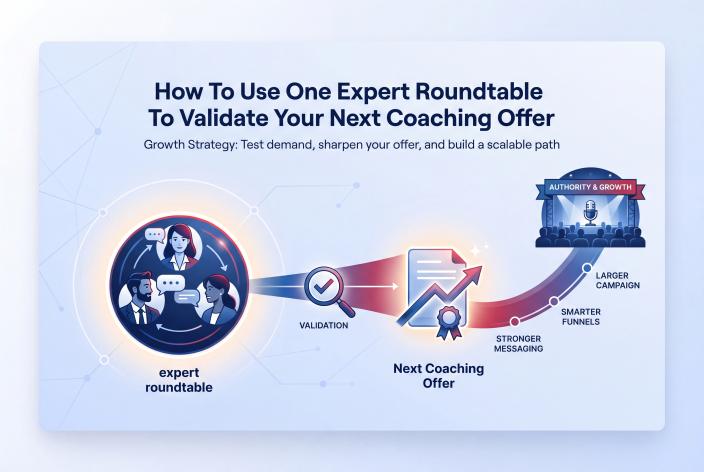
If you've been thinking about launching a new coaching offer, there's a tempting path most people take.
They build the whole thing first.
They write the sales page, outline the program, create the webinar, plan the emails, maybe even start mapping a summit or podcast campaign. Then they put it in front of the market and wait.
And sometimes the silence is painful.
The offer might be good. Your coaching might be strong. But the market may not yet understand the problem the way you're explaining it.
That's where a small expert roundtable can save you a lot of time, money, and second-guessing.
A roundtable gives you a lower-pressure way to test the topic, hear real audience language, notice objections, build relationships with aligned experts, and see whether your next offer has enough heat behind it before you build a bigger campaign.
Let's walk through how to do it.
Why A Roundtable Works Before A Bigger Campaign
A full summit, webinar funnel, or podcast campaign can be powerful. But those campaigns work best when your audience, offer, message, and follow-up path are already pointed in the same direction.
That alignment matters.
In one Virtual Summit Strategies podcast conversation, Jennie Wright described how she starts by understanding the end offer, the ideal client, the messaging, the niche, the brand, and the program before building the summit around it. She also pointed out that when different parts of the business point in different directions, people get confused and confused minds do not decide.
That's a useful warning.
A roundtable is a smaller test of that alignment.
Instead of asking, "Can I pull off a huge campaign?" you ask better questions:
- Does this topic attract the right people?
- Do they describe the problem the way I thought they would?
- What questions come up when they hear the idea?
- Which objections appear before the offer is even made?
- Which experts already understand this audience?
- Is there enough demand to justify a larger campaign?
You get market feedback while building authority. That's a good combination.
And you don't have to turn it into a massive production.
Step 1 Choose A Narrow Topic Tied To The Offer You Want To Validate
The roundtable topic should be close enough to your offer that the conversation gives you usable feedback.
If you're validating a group coaching program for executive women navigating burnout, don't host a broad roundtable on "wellness at work."
That's too wide.
A stronger topic might be:
- "Why High-Achieving Women Ignore Burnout Until Their Body Forces A Decision"
- "The Hidden Cost Of Leading Everyone Else While Running On Empty"
- "How Executive Women Can Rebuild Energy Without Stepping Back From Leadership"
See the difference?
A narrow topic attracts people who recognize themselves in the problem. It also helps your expert guests speak with more specificity.
Here's a simple filter.
Your roundtable topic should connect to:
- A specific audience
- A specific painful situation
- A specific desired shift
- The belief change your offer needs to create
- The next step you may eventually invite people into
You are not trying to prove that people like your general category.
You are trying to see whether the market cares about the problem your offer solves.
A Simple Topic Test
Before you commit to the topic, finish this sentence:
"This roundtable is for people who are struggling with ______ and want ______, but keep getting stuck because ______."
If you can't complete that sentence clearly, your event will probably feel fuzzy.
And fuzzy events create fuzzy feedback.
Step 2 Invite 3 To 5 Aligned Experts Who Understand The Audience
You don't need 25 speakers for this.
Start with 3 to 5 aligned experts who understand the audience and can add useful perspective. The goal is quality of insight, not size of lineup.
Look for people who can help you see the market more clearly.
Good roundtable guests might be:
- Adjacent experts who serve the same audience in a different way
- Coaches or consultants who hear similar objections from prospects
- Practitioners who understand the problem from a different angle
- Community leaders with access to the audience you want to reach
- Past clients or client-like experts who can speak intelligently about the journey
There is a reason this matters.
Jennie Wright also talked about researching experts before inviting them, including looking beyond list size to understand whether their audience is engaged and whether they are a good fit. That applies beautifully to a roundtable.
A guest with a smaller, highly relevant audience may bring better conversation than someone with a large but disconnected following.
What To Ask Experts Before They Say Yes
You don't need a heavy application process. But you do want a quick fit check.
Ask questions like:
- "What do you see this audience struggling with most right now?"
- "What language do they use when they talk about this problem?"
- "What do they usually misunderstand before they get help?"
- "What objections keep them from taking action?"
- "What would make this roundtable genuinely useful for them?"
These answers can help you shape the event before registration even opens.
By the way, this is also relationship building.
You are not just collecting speakers. You are building a small authority circle around a topic your market cares about.
Step 3 Design Registration To Capture Useful Signals
Most coaches treat registration like a name and email form.
That's a missed opportunity.
For offer validation, registration is research.
Ask a few questions that help you spot demand, urgency, awareness, and fit. Keep it short, but make it useful.
Good registration questions include:
- "What made you interested in this roundtable?"
- "What is the biggest challenge you're facing with this topic right now?"
- "What have you already tried?"
- "What would make this conversation worth your time?"
- "If you could ask one question to the panel, what would it be?"
These answers show you the words your audience actually uses.
That's gold.
Your future offer page, webinar title, email sequence, lead magnet, and sales call framework should all be informed by the language people use before they have been coached by you.
EventRaptor can support this kind of process because it includes registration setup, custom registration questions, registrant management, attendee data, and CRM sync. The practical benefit is simple. You can collect more than contact information and use that data to guide the next step in your client attraction system.
Step 4 Use The Live Conversation To Spot Buying Signals
A roundtable is not only content.
It is a listening room.
During the live session, pay attention to what people ask, where they get animated, and what keeps coming back.
Look for these signals:
- Repeated questions around the same pain point
- Specific frustration instead of vague curiosity
- People asking what to do next
- Questions about timing, readiness, or sequence
- Comments that reveal urgency
- Objections that show fear, confusion, or skepticism
- Requests for examples, templates, checklists, or next steps
Not every engaged attendee is ready to buy. But buying intent often shows up as a search for clarity.
They ask:
"Where do I start?"
"How do I know if this applies to me?"
"What if I've already tried something similar?"
"What should I fix first?"
Those questions are useful because they show you what your offer must answer before someone feels safe enough to move forward.
Assign One Person To Watch The Chat
If you're hosting, it is hard to facilitate and track insights at the same time.
Have someone capture:
- Exact phrases from attendees
- Questions that repeat
- Objections that surface
- Moments where experts agree strongly
- Topics that create the most energy
- Follow-up opportunities
Don't rely on memory.
Memory gets fuzzy after the adrenaline wears off.
Step 5 Turn The Insights Into Offer Language
After the roundtable, your job is to translate the data.
Look at the registration answers, chat questions, expert comments, and post-event replies. Then organize what you learned into categories.
Use a simple table like this:
| What You Heard | What It Might Mean | How To Use It |
|---|---|---|
| "I don't know where to start" | The audience needs sequence and diagnosis | Create a roadmap lead magnet |
| "I've tried this before and it didn't work" | Trust is low because of past disappointment | Address failed attempts in nurture emails |
| "How do I know if I'm ready?" | Readiness criteria are unclear | Add a fit checklist to the offer page |
| "I don't have time to manage this" | Implementation support may matter | Emphasize done-for-you or guided support |
This is how a roundtable becomes more than a nice conversation.
It becomes a message-sharpening tool.
You can turn the strongest insights into:
- A better offer promise
- A more specific sales page headline
- A lead magnet built around a real question
- A follow-up email sequence
- A webinar outline
- A sales call diagnostic
- A summit theme
- A podcast series angle
- A partner outreach message
The point is to let the market help you write the next version.
Step 6 Build A Follow-Up Path While Interest Is Warm
The roundtable should not end when everyone logs off.
This is where many coaches lose momentum.
People attended because the topic mattered to them. They gave you questions. They listened. Some stayed until the end. Some may have watched a replay. Some may have clicked a resource.
That attention deserves a thoughtful next step.
Your follow-up can include:
- A thank-you email with the replay or recap
- A short summary of the strongest insights from the conversation
- A useful resource related to the main problem
- A segmented message based on registration answers or attendee behavior
- An invitation to a planning call, workshop, diagnostic, or waitlist
- A nurture sequence for people who are interested but not ready yet
Good automation helps here because it protects the relationship.
It makes sure people hear from you while the conversation is still fresh. It helps you follow up consistently without trying to remember every person manually.
EventRaptor supports event reminders, follow-up emails, attendee management, promoter tracking, and CRM-connected workflows. GHL/CRMRaptor can support the CRM, funnel, calendar, workflow, and follow-up side, so the event activity can feed a more organized sales and nurture path.
That's the real play.
Visibility creates attention. Follow-up turns attention into opportunity.
Step 7 Use The Roundtable As A Stepping Stone
After one roundtable, you may discover several things.
Maybe the offer is ready for a webinar.
Maybe the audience wants a checklist before they want a sales call.
Maybe the topic needs to be narrower.
Maybe your experts revealed a stronger positioning angle than the one you started with.
Maybe the audience is interested, but the objection pattern tells you the offer needs more proof, more clarity, or a lower-friction entry point.
That is all useful.
The roundtable gives you feedback before you scale the campaign.
From there, your next move might be:
- A larger virtual summit
- A focused webinar funnel
- A workshop series
- A podcast campaign
- A better lead magnet
- A revised coaching offer
- A more specific nurture sequence
- A partner-powered promotion campaign
EventRaptor's own positioning recognizes that the right event format depends on the audience, offer, and growth strategy. It can support different authority-building formats, including meetings, workshops, summits, multi-speaker events, and speaker-led campaigns.
So you don't have to force a big summit first.
You can start with the format that gives you the clearest feedback and the cleanest path to qualified conversations.
A Practical Roundtable Planning Checklist
Before you launch your roundtable, use this checklist.
Offer Alignment
- What offer are you trying to validate?
- What specific problem does it solve?
- Who is the right-fit buyer?
- What belief must shift before they buy?
- What next step will you offer after the roundtable?
Topic And Positioning
- Is the topic narrow enough to attract the right people?
- Does the title name a real pain or desired outcome?
- Would your ideal client recognize themselves in it?
- Does the event connect naturally to your offer?
Expert Fit
- Do the experts understand the audience?
- Do they bring useful perspective?
- Are they aligned with the tone and values of the event?
- Can they help promote or deepen credibility?
Data And Follow-Up
- What registration questions will you ask?
- Who will monitor chat and questions?
- How will you tag or segment attendees?
- What follow-up emails will go out?
- What will you offer as the next step?
Keep it simple. But don't skip the thinking.
The Bigger Lesson For Coaches
If your client flow is inconsistent, the answer is often a clearer path from attention to trust to conversation.
An expert roundtable helps you build that path in miniature.
You get visibility. You borrow and build authority through aligned experts. You hear the market's language. You notice what people actually ask. You test whether the topic has energy. Then you turn the strongest insights into your offer, funnel, lead magnet, and follow-up.
That's how a small event can become the first piece of a larger client attraction system.
And if you want help mapping that system for your coaching business, the next step is simple.
Book your Client Attraction Planning Call
On the call, we'll look at where your client flow is getting stuck, what you're trying to validate, and whether a roundtable, summit, webinar, funnel, CRM, follow-up system, or done-for-you implementation path makes the most sense next.