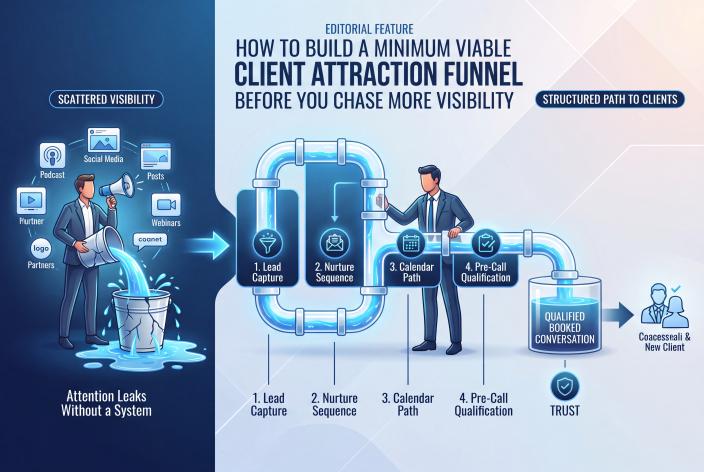
If you’re a coach with real client results, visibility can feel like the obvious next move.
More podcasts. More summits. More posts. More partners. Maybe ads.
And yes, visibility matters.
But here’s the part that gets expensive fast. More visibility sends more people into whatever path already exists behind your marketing. If that path is clear, useful, and connected, great. If it’s scattered, more attention can create more leaks.
People hear about you, visit a page, download something, register for an event, or click a calendar link. Then what?
Do they get nurtured?
Do they understand your offer?
Do they know who the planning call is for?
Do you know where they came from, what they wanted, and how to follow up?
That’s where a minimum viable client attraction funnel comes in.
It’s the smallest complete path that helps a right-fit prospect move from attention to trust to a qualified conversation. And for many growing coaches, it’s the missing layer between being good at what they do and having steadier client flow.
What A Minimum Viable Client Attraction Funnel Really Is
A minimum viable client attraction funnel is not a giant launch machine.
It’s not a complicated maze of 27 emails, 5 offers, 3 webinars, and a dashboard you’re afraid to open.
It’s the simplest working version of your client acquisition path.
At minimum, it needs 4 pieces:
- Lead Capture
- Nurture
- Calendar Path
- Pre-Call Qualification
That’s it.
Simple, yes. Lightweight, yes. Optional, no.
Because if you’re serious about turning attention into clients, people need a clear next step before they forget why they were interested in the first place.
The 4 Core Funnel Pieces
Here’s the practical version.
| Funnel Piece | What It Does | What It Should Answer |
|---|---|---|
| Lead Capture | Turns anonymous attention into a known prospect | Why should I raise my hand now? |
| Nurture | Builds trust after the first click | Why should I keep paying attention? |
| Calendar Path | Invites the right person into a conversation | Is this the right next step for me? |
| Pre-Call Qualification | Helps both sides confirm fit | Am I ready, aligned, and relevant for this call? |
You don’t need perfection here.
You need a path that works well enough to test, improve, and build on.
Why More Visibility Exposes Weak Follow-Up
Visibility is like turning up the water pressure.
If the pipes are solid, more water moves through the system. If the pipes are loose, the leaks get louder.
The same thing happens with podcasts, summits, webinars, partner promotions, and ads.
A coach gets invited onto a stage. People listen. A few are interested. Some click. Some register. Some download. Then the trail gets messy.
Maybe the lead magnet is vague.
Maybe the follow-up email sounds generic.
Maybe the calendar link appears too soon.
Maybe there’s no segmentation, no CRM tag, no reminder, no post-event follow-up, and no clear way to tell who is ready for a conversation.
So the coach concludes, “That visibility didn’t work.”
But sometimes the visibility worked fine. The follow-up path was too thin to carry the interest.
This is why EventRaptor’s positioning is built around the journey from visibility to trust to conversation. Event attention has to be organized into registration, engagement, CRM updates, follow-up, and the right next step. The software alone does not create demand, but a structured system gives your visibility a better chance of turning into qualified conversations.
That’s the job of your minimum viable funnel.
It protects the attention you worked to earn.
Start With One Offer
Before you build pages, emails, automations, or event campaigns, choose one offer to support.
Not every offer.
One.
Pick the offer that is:
- Clear enough to explain in plain language
- Valuable enough to justify a sales conversation
- Relevant to the people you want more of
- Proven enough that you can stand behind it
- Specific enough that your content can point toward it naturally
For example, if you’re a leadership coach, your funnel might support a 6-month executive coaching engagement.
If you’re a wellness coach, it might support a private coaching program for stressed professionals.
If you’re a business coach, it might support a strategy intensive or group program.
The offer gives the funnel a direction.
Without that direction, your lead magnet attracts random curiosity, your emails wander, and your planning call becomes too broad.
Here’s a tip.
Write one sentence that completes this thought:
“My funnel is designed to help the right person understand why they may be ready for ______.”
If you can’t fill in the blank clearly, the funnel will feel fuzzy before it even starts.
Choose One Lead Magnet That Signals Real Interest
Your lead magnet should do more than collect an email address.
It should attract the kind of person who may actually need your offer.
That means it needs to sit close to the problem your paid work solves.
Good lead magnet formats for coaches include:
- A self-assessment
- A short scorecard
- A checklist
- A planning worksheet
- A private training
- A diagnostic guide
- A workshop registration
- A summit session bundle tied to one theme
The goal is not to impress people with how much you know.
The goal is to help the right person see their current gap more clearly.
A strong lead magnet usually answers one of these questions:
- “What’s not working in my current approach?”
- “What do I need to fix first?”
- “Am I ready for this next step?”
- “What kind of support would make sense for me?”
For this audience, a self-diagnostic often works better than a big information dump.
Why?
Because a serious prospect doesn’t need another pile of ideas. They need clarity about what’s keeping them stuck.
Build One Nurture Sequence That Creates Movement
Once someone opts in, the next few messages matter.
This is where many coaches accidentally go quiet.
They deliver the lead magnet, send one polite follow-up, and then hope the person remembers them later.
Hope is not follow-up.
Your minimum viable nurture sequence can be simple. Start with 5 emails.
Email 1 Delivers The Resource
Send the lead magnet, welcome them, and tell them what to look for.
Keep it human.
You can say something like:
“Use this to spot where your client attraction path is strongest, where it’s leaking, and what to fix before you chase more visibility.”
Email 2 Names The Problem
Talk about the real issue your prospect is facing.
For a coach, that might be inconsistent referrals, weak follow-up, scattered content, poor qualification, or a visibility path that doesn’t lead anywhere specific.
This email should make them feel understood.
Email 3 Teaches A Useful Shift
Give them one practical framework.
For example:
“Before adding more visibility, make sure every new person has a path from attention to trust to conversation.”
Then show them what that path looks like.
Email 4 Shows The Cost Of Staying Scattered
This does not need to be dramatic.
Just be honest.
When there’s no clear funnel, interested prospects drift. Follow-up depends on memory. Sales calls include people who don’t understand the offer. Campaigns are hard to measure. Every new push feels like starting over.
Most coaches already feel this. You’re helping them name it.
Email 5 Invites The Right Next Step
Invite them into a planning call if the fit is there.
The call should feel like a continuation of the diagnostic, not a sudden pitch.
You might say:
“If this helped you see that your visibility needs a clearer path behind it, the next step is to map what that could look like in your business.”
Then link to the planning call.
Simple. Clear. Calm.
Create A Calendar Path That Qualifies Interest
Your calendar page should not feel like a trapdoor.
Someone should know why they’re booking, what you’ll talk about, and whether the call is for them.
A good planning call page should answer:
- Who is this call for?
- What problem are we looking at?
- What will we discuss?
- What should they already have in place?
- What happens after they book?
For proven coaches, the calendar path should connect to business reality.
You’re not inviting everyone who likes free advice. You’re inviting people who have a real offer, want more consistent right-fit clients, and are ready to look at their authority, funnel, CRM, follow-up, event strategy, or implementation path.
That’s why the CTA matters.
Use a planning call, not a vague “chat.”
A planning call gives the conversation a useful frame.
Add Pre-Call Qualification Without Making It Cold
Pre-call qualification is not about making people jump through hoops.
It helps you protect your time and serve better.
Ask a few useful questions before the call:
- What kind of coaching or expert-led service do you offer?
- Who do you most want to attract?
- How are clients currently finding you?
- Where does client flow feel inconsistent?
- What have you already tried?
- What would you like the system to help you do?
You can also ask about readiness.
For example:
“Are you looking for strategy only, done-for-you implementation, or both?”
That one question can save everyone time.
And by the way, qualification also improves the prospect’s experience. They arrive clearer. You arrive prepared. The call becomes more useful from the first minute.
Map Your First Funnel On One Page
Don’t build this in software first.
Map it on one page.
Use this structure:
- Offer: What paid offer is this funnel supporting?
- Audience: Who is most likely to need this now?
- Lead Magnet: What useful resource helps them diagnose the gap?
- Opt-In Page: What promise gets them to raise their hand?
- Nurture Sequence: What 5 messages build trust and movement?
- Planning Call Page: What makes the next step clear?
- Qualification Questions: What do you need to know before the call?
- Follow-Up: What happens if they book, no-show, attend, or aren’t ready yet?
That last one is important.
A funnel is not finished when someone books.
You need reminders before the call, a clear confirmation message, and thoughtful follow-up after the call. If someone is qualified but not ready yet, they should move into a nurture path instead of disappearing into your inbox.
Run These Funnel Health Checks Before A Bigger Campaign
Before you chase more visibility, run a quick health check.
You’ll learn fast where the path is weak.
Health Check 1 Can A New Person Understand The Offer In 30 Seconds
Open your opt-in page, thank-you page, nurture emails, and calendar page.
Ask:
- Is it clear who this is for?
- Is the problem specific?
- Is the next step obvious?
- Does the language sound like you?
If a stranger needs to work too hard to understand the path, tighten the message.
Health Check 2 Does Every Page Have One Main Job
Each page should do one thing.
- Opt-in page: get the right person to request the resource
- Thank-you page: confirm the next step
- Calendar page: help the right person book with context
- Confirmation page: set expectations
Confusion kills movement.
Clarity creates momentum.
Health Check 3 Do Your Emails Build Toward A Conversation
Read your nurture sequence in order.
Does it create a natural progression?
A good sequence helps the reader say:
“Now I understand what’s happening. I can see why this matters. I know what to do next if I want help.”
Health Check 4 Do You Know Where Leads Came From
If someone books a call, can you tell whether they came from a summit, podcast, referral partner, workshop, ad, or social post?
If not, your future decisions will be guesswork.
Use tags, forms, tracking links, and CRM fields to preserve context.
Health Check 5 Is Follow-Up Timely And Consistent
This one is simple.
If follow-up depends on your memory, mood, or spare time, it will eventually break.
Good automation protects relationships by making follow-up timely and consistent.
That means confirmation emails, reminders, missed-call follow-up, post-call next steps, and longer-term nurture should be handled by the system wherever possible.
Where EventRaptor And GHL/CRMRaptor Fit When You’re Ready To Scale
Once your minimum viable funnel works, visibility becomes easier to scale.
That’s when summits, webinars, workshops, giveaways, speaker campaigns, and partner promotions can feed a path that already knows what to do with attention.
EventRaptor handles the virtual event management side. That can include event pages, registrations, speaker workflows, schedules, attendee communication, promoter tracking, reminders, reporting, and CRM-connected event activity.
GHL/CRMRaptor supports the CRM, funnel, calendar, workflow, automation, and follow-up side.
Together, they help connect the pieces:
- Event registrations can move into the CRM
- Contacts can be tagged by event, interest, or source
- Follow-up workflows can continue after the event
- Calendar paths can invite qualified prospects into the next step
- Speaker and promoter activity can be easier to track
- Attendee data can support better nurture and sales conversations
This matters because a summit should not end when the event ends.
A webinar should not disappear after the replay expires.
A partner promotion should not leave you wondering who came in, who engaged, and who needs follow-up.
When event visibility and CRM follow-up are connected, the whole system becomes calmer and more useful.
The Minimum Viable Funnel Checklist
Before you invest more time, money, or energy into bigger visibility, make sure you can check these boxes:
- I have one offer this funnel supports
- I know who the funnel is for
- I have one lead magnet that signals real interest
- My opt-in page makes a clear promise
- My thank-you page gives the next step
- My nurture sequence builds trust before asking for a call
- My calendar page explains who should book
- My booking form qualifies the prospect
- My CRM records source, interest, and status
- My reminders and follow-up are consistent
- I know what happens when someone books, attends, no-shows, or needs more nurture
If several of these are missing, pause before adding more visibility.
You don’t need to stop marketing. You need to strengthen the path your marketing feeds.
Build The Path Before You Turn Up The Volume
If your coaching works, the next stage is infrastructure.
Not cold, robotic infrastructure.
Human, practical, relationship-protecting infrastructure.
The kind that helps right-fit prospects understand you, trust you, hear from you at the right time, and book a conversation when it makes sense.
That’s what a minimum viable client attraction funnel gives you.
It turns scattered attention into a path.
It turns follow-up into a process.
It turns visibility into something you can actually build on.
And it gives you a cleaner foundation before you step onto bigger stages.
If you want help applying this to your coaching business, Book your Client Attraction Planning Call. On the call, we’ll look at where your current client flow is getting stuck and what kind of offer, funnel, CRM, follow-up, or event strategy could make sense next.