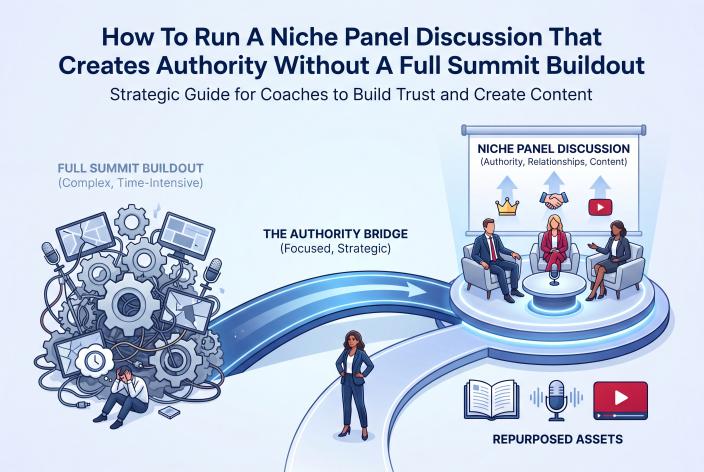
If you know a full virtual summit would help you build authority, but the thought of organizing 20 speakers makes your shoulders tense, start smaller.
A focused niche panel can do a lot of the same strategic work with less weight.
It can help you borrow authority, build relationships with aligned experts, attract a qualified audience, hear the exact language your buyers use, and create content you can repurpose for weeks.
And no, it doesn't have to become a giant production.
A good panel is simple. It brings 3 to 5 thoughtful people together around one specific problem your audience already cares about. You host the conversation, guide the questions, collect registrations, follow up intelligently, and turn the discussion into useful authority assets.
That's the piece many coaches miss.
The panel itself is only the visible part. The real value comes from the system around it: topic, partners, registration, questions, follow-up, CRM, content, and sales conversations.
When A Niche Panel Is Smarter Than A Full Summit
A full summit is powerful when you want to build a larger audience, involve more speakers, create a bigger content library, and make a stronger market splash.
But sometimes the smarter move is a tight panel.
Especially when you're in one of these situations:
- You want to test a topic before committing to a bigger event.
- You have a clear niche, but you need more market feedback.
- You want to build relationships with a few strategic partners.
- Your list is small, but your network has trusted people in it.
- You want authority content without launching a full podcast season.
- You have a coaching offer that sells through conversation, and you need warmer conversations.
- You want to run an event your audience can understand quickly.
A panel works because it's focused.
People don't have to block off 3 days. Speakers don't have to prepare full presentations. You don't have to manage a huge agenda. The promise can be clean and specific.
For example:
- "How High-Achieving Women Can Stop Overthinking Career Decisions"
- "What Business Owners Need To Know Before Hiring Their First Operations Manager"
- "Why Wellness Clients Fall Off Track After 30 Days And What Helps Them Stay Consistent"
- "How Coaches Can Turn Referrals Into A More Predictable Client Flow"
Notice the pattern?
Each topic speaks to a real problem, a specific audience, and a conversation the host can lead with authority.
Here's a simple way to compare the options.
| Format | Best When You Want To | Watch For |
|---|---|---|
| Niche Panel | Test a topic, build partner relationships, create focused authority content | Keep the promise narrow and the follow-up clear |
| Full Summit | Grow a larger audience, involve many speakers, create a bigger authority event | Requires more coordination, speaker management, promotion, and follow-up |
| Webinar | Teach one clear framework and lead toward one offer | Can feel one-directional if the audience needs discussion first |
| Podcast Season | Build authority over time through recurring content | Takes consistency and patience before it creates momentum |
The takeaway is simple.
If you need movement now, but a full summit feels too heavy, a niche panel can give you a practical authority-building stage without overbuilding the campaign.
Choose A Narrow Topic That Attracts The Right Coaching Audience
Your topic does more than name the event.
It qualifies the room.
A broad topic gets broad interest. A narrow topic pulls in people who recognize themselves in the problem.
So ask yourself 4 questions before you choose the panel theme:
- Who do I want in the room?
- What problem are they already trying to solve?
- What do they need to believe before they would trust my coaching offer?
- What conversation would make me look like the right guide?
That last question matters.
You're not hosting a random expert chat. You're creating an authority-building conversation that sits close to your offer.
If you're a leadership coach, a panel about "confidence" may be too wide. A panel about "how first-time executives can lead through conflict without losing trust" gives you a sharper room.
If you're a health coach, a panel about "wellness" may attract everyone and no one. A panel about "why busy professionals regain weight after stressful projects and what helps them stabilize" is more useful.
If you're a business coach, a panel about "marketing" is a swamp. A panel about "how expert coaches can turn inconsistent referrals into a repeatable client attraction path" creates a clearer audience.
Here are 3 useful topic filters:
- Audience Filter: The topic should make the right person think, "This is for me."
- Problem Filter: The problem should be painful enough to deserve an event.
- Offer Filter: The discussion should naturally open the door to your next step.
A strong panel topic does not need to mention your offer directly. It should create the kind of trust your offer depends on.
That's how authority starts to build before the sales call.
Invite Experts Who Deepen The Conversation And Expand Credibility
The easiest mistake is inviting people only because they have an audience.
Audience helps. But credibility fit matters more.
Your panel should feel like a useful room. Each expert should add a perspective your audience values, while still supporting the core conversation.
Think in roles.
For a coaching audience, you might invite:
- A practitioner who sees the problem every day.
- A strategist who can explain the pattern behind the problem.
- A specialist who brings a missing angle.
- A client-facing expert who understands objections and decision points.
- A partner whose audience overlaps with yours.
For example, if you help business owners build healthier teams, you might invite a hiring consultant, a workplace therapist, a leadership trainer, and a founder who has navigated team conflict.
You become the host who brings the right conversation together.
That's authority.
You are not trying to outshine every panelist. You're guiding the room. You're framing the issue. You're asking the questions your audience is already carrying around in their head.
When you invite experts, keep the ask simple:
- Explain the specific topic.
- Explain who the audience is.
- Explain why their perspective matters.
- Share the date, time, and expected commitment.
- Give them easy promotion copy.
- Make the event feel organized from the first touch.
A simple invitation could sound like this:
I'm hosting a focused panel for coaches who are struggling with inconsistent client flow. The conversation is about how authority, partnerships, follow-up, and sales conversations work together. I thought of you because your perspective on relationship-based growth would be useful for this audience. Would you be open to joining as one of 4 panelists?
Notice the tone.
Clear. Respectful. Specific.
That kind of invitation is much easier to say yes to than a vague request to "collaborate sometime."
Build A Registration Path That Tells You Who Raised Their Hand
A panel registration page should do more than collect names and emails.
It should help you understand the people who are interested.
Ask a few smart questions when people register. Not 15. Just enough to help you follow up better.
Useful questions might include:
- What best describes your current situation?
- What is your biggest challenge with this topic right now?
- What have you already tried?
- What would make this panel most useful for you?
- Are you currently looking for help with this?
These answers become gold.
They show you buyer language. They reveal objections. They tell you which subtopics matter. They help you segment follow-up.
For example, if 12 registrants mention that they "get referrals but don't know how to make them predictable," that phrase should influence your post-panel emails, your article titles, your sales call questions, and maybe even your next event topic.
And if someone says they're actively looking for help, that person should not be treated the same way as someone who is simply curious.
This is where your CRM matters.
With EventRaptor managing the event side and GHL/CRMRaptor supporting the CRM and follow-up side, your registration data, tags, reminders, and next-step paths can be organized instead of scattered across spreadsheets, inboxes, and memory.
EventRaptor is not only for large summits. It can support meetings, workshops, giveaways, recurring events, and speaker-led campaigns. That makes it useful for a smaller panel when you still want registration, attendee information, reminders, partner links, and follow-up connected in one organized process.
The principle is simple.
If someone raises their hand for a topic close to your offer, your system should remember what they told you.
Turn Live Questions Into Follow-Up Segments
The questions people ask during the panel are not random.
They show you where trust is missing.
Someone who asks, "How do I know if I'm ready for this?" may need education.
Someone who asks, "What should I do first?" may need a diagnostic next step.
Someone who asks, "Can this work for my niche?" may need a more personal conversation.
After the panel, review the registration questions, live chat, Q&A, poll responses, and any replies to reminder emails.
Then segment your follow-up into groups like:
- People who attended live.
- People who registered but missed it.
- People who asked buying-stage questions.
- People who mentioned a specific problem.
- People who came through a certain partner.
- People who clicked for the replay or next step.
Your follow-up can then feel relevant instead of generic.
For example:
- Attendees can receive a recap and the best takeaways.
- No-shows can receive the replay with a shorter summary.
- People with urgent questions can be invited into a planning conversation.
- Partner-referred leads can receive messaging that acknowledges the shared connection.
- People interested in a subtopic can get a related article, email, or workshop invitation.
Good automation does not make this colder.
It makes it more timely.
And timely follow-up feels more human because it respects the fact that interest has a shelf life.
Repurpose The Panel Into Authority Assets
A 60-minute panel should not disappear after the replay link goes out.
You can turn it into a small content engine.
Start with the raw material:
- The recording.
- The transcript.
- The strongest questions.
- The best clips.
- The panelist quotes or ideas.
- The registration answers.
- The objections that surfaced.
- The follow-up replies.
Then create assets from that material.
Create Email Content
Write 3 to 5 emails from the panel.
Each email can focus on one question, one misconception, one story, or one practical takeaway.
For example:
- "The Question That Came Up 4 Times During Our Panel"
- "What Coaches Usually Miss About Follow-Up"
- "Why Referrals Feel Good But Still Leave Gaps"
- "The Panel Takeaway I Would Apply First"
Keep the emails useful. Then invite people into the next logical step when it fits.
Create Short Clips
Pull short moments where the conversation gets clear, specific, or emotionally honest.
Good clips often come from:
- A strong question.
- A surprising answer.
- A shared frustration.
- A simple framework.
- A moment where the panel agrees on a pattern.
You don't need to become a full-time content creator. You need a few useful moments that remind the right people what you stand for.
Create Articles And Posts
A panel can easily become 2 or 3 articles.
Use the questions as headlines. Use the best answers as supporting points. Add your own perspective as the host.
That last part is important.
Don't just summarize what the panelists said. Interpret it for your audience. Show them what it means and what to do next.
That's how you build authority from the conversation.
Create Partner Touchpoints
After the panel, follow up with your speakers and partners.
Send them:
- The replay link.
- Short clips they can share.
- A thank-you note.
- A summary of audience feedback.
- A suggested next collaboration idea.
This is how one panel can become more than one event.
It can open doors to podcast invitations, newsletter swaps, workshops, affiliate conversations, referral relationships, and future summits.
Keep The Sales Path Clear And Respectful
A niche panel should not turn into a pitch fest.
But it should have a next step.
If your audience has taken the time to register, attend, ask questions, and engage with a problem close to your offer, they deserve a clear path forward.
That path might be:
- Watch the replay.
- Read a related article.
- Take a short assessment.
- Attend a deeper workshop.
- Book a planning call.
- Enter a nurture sequence.
The key is to make the next step match the level of intent.
Some people are ready to talk. Some need education. Some are not a fit. A good follow-up system helps you tell the difference.
This is why the panel should be connected to your broader client attraction system.
Visibility creates attention. The panel builds trust. Registration captures interest. Questions reveal what people care about. Follow-up keeps the relationship moving. Your sales path turns the right interest into qualified conversations.
That's the system.
A Simple Niche Panel Plan You Can Use
Here is a practical version you can adapt.
3 To 4 Weeks Before The Panel
- Choose one narrow topic tied to your coaching offer.
- Invite 3 to 5 aligned experts.
- Create the registration page.
- Add 2 to 4 useful registration questions.
- Give speakers simple promotional copy.
- Set up reminder emails and calendar details.
1 Week Before The Panel
- Review registration answers.
- Adjust your questions based on what people are asking.
- Confirm speaker bios, links, and talking points.
- Send speakers the run of show.
- Prepare your opening, transitions, and closing invitation.
During The Panel
- Frame the problem clearly.
- Introduce each expert with relevance, not fluff.
- Ask questions that serve the audience.
- Watch the chat for buyer language.
- Invite attendees to the next step near the end.
After The Panel
- Send the replay.
- Segment follow-up based on attendance, questions, and intent.
- Create emails, clips, and articles from the discussion.
- Thank speakers and share assets.
- Invite qualified people into a planning conversation.
Simple does not mean sloppy.
A panel still needs a clear promise, clean registration, good reminders, thoughtful moderation, organized follow-up, and a next step.
But compared with a full summit, it's a lighter way to build authority and test momentum.
Make The Panel Part Of A Bigger Client Attraction System
A niche panel can be one of the most useful authority-building formats for a coach who is ready to become more visible, but doesn't want to overbuild too soon.
It gives you a stage.
It gives your audience a reason to pay attention.
It gives partners a reason to collaborate.
And it gives you real market language you can use to improve your messaging, content, follow-up, and sales conversations.
The biggest win is not the event itself. It's what the event starts.
If you want help mapping a panel, summit, webinar, CRM, or follow-up path around your coaching offer, Book your Client Attraction Planning Call.
On the call, we'll look at where your client flow is getting stuck and what kind of authority-building and follow-up system could make sense for your business.