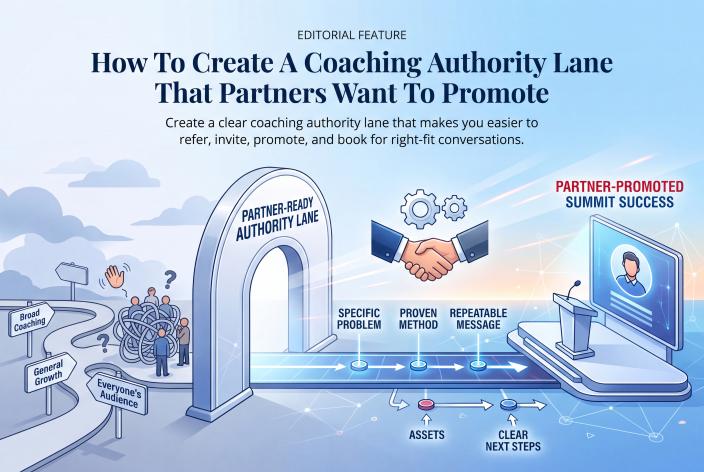
If your coaching is strong but your client flow still feels unpredictable, your problem may be bigger than visibility.
You may be hard to place.
A podcast host hears about you and thinks, "Interesting, but where would I fit this person?" A summit host likes your energy but cannot quickly see the session angle. A referral partner believes you're good, but struggles to explain exactly who should talk to you.
That friction matters.
Partners promote people who are easy to understand, easy to trust, and easy to introduce. They want to know who you help, what problem you solve, why your perspective is useful, and how their audience will benefit.
That is what I mean by an authority lane.
Your authority lane is the specific space you want to become known for. It gives your message shape. It makes your expertise easier to repeat. And when it's clear, partners do not have to work so hard to figure out why their audience should pay attention.
Let's walk through how to build one.
Why Broad Coaching Positioning Creates Weak Partner Momentum
Broad positioning feels safe at first.
You can help more people. You can talk about more topics. You can say yes to more opportunities.
But broad positioning creates a problem for everyone else.
If you say, "I help people live better lives," your audience may nod politely. But a partner cannot promote that easily. It does not give them a sharp reason to say, "You need to hear this person."
A clearer message sounds more like this:
- "I help high-achieving women stop over-functioning in their relationships."
- "I help health coaches turn inconsistent referrals into a repeatable client attraction system."
- "I help midlife professionals rebuild confidence after career burnout."
- "I help financial coaches guide couples through money conversations without shame."
Do you feel the difference?
Specificity gives people a handle. It tells partners who the message is for and why it matters now.
This matters even more with summits, webinars, podcasts, and speaker-led campaigns. EventRaptor's positioning material frames events as authority-building assets that help coaches become more visible, grow an owned audience, follow up consistently, and create a clearer path toward qualified conversations. That only works well when the audience and promise are clear enough to carry the event.
So before you chase more stages, tighten the lane you want those stages to amplify.
Define The Specific Audience Problem You Want To Be Known For
Your authority lane starts with a problem.
Not a topic. Not a category. Not a list of credentials.
A problem.
Why? Because buyers and partners both organize attention around problems. They want to know what pain, stuck point, desire, or transition you help people move through.
A life coach who talks about "personal growth" is hard to promote. A life coach who helps divorced dads rebuild confidence and connection with their children has a clearer lane.
A business coach who talks about "scaling" blends into a crowded room. A business coach who helps introverted consultants sell premium advisory work without relying on daily social content is easier to place.
Ask yourself:
- Who do I most want to be known for helping?
- What specific problem do they already know they have?
- What language would they use to describe that problem?
- What is the moment when they start looking for help?
- What would a partner say to introduce me in one sentence?
That last question is powerful.
If a partner cannot introduce you in one sentence, your positioning probably needs more work.
Here is a simple template:
I help [specific audience] solve [specific problem] so they can [specific desired outcome].
For example:
I help executive coaches turn referral-dependent growth into a more predictable client attraction system so they can book more right-fit conversations without constantly chasing.
That sentence may still need polish. But it gives the market something to remember.
And remembered experts get invited back.
Turn Your Coaching Method Into A Clear Authority Lane
Once your audience problem is clear, your method gives the lane depth.
This is where many coaches get stuck.
They either make the method too vague, such as "mindset and accountability," or too complicated, with too many steps, frameworks, and internal names.
Your method should help people understand how you think.
It does not need to explain every detail of your work. It needs to make your approach easier to trust.
A strong coaching authority lane usually includes these pieces:
- A specific audience
- A specific problem
- A clear point of view
- A simple method or framework
- A visible path to the next step
Let's say you're a leadership coach. You could say:
I help new executives lead through their first 180 days with more clarity, trust, and decision confidence.
Now your method might become:
- Clarify The Leadership Shift
- Build The Trust Map
- Install The Decision Rhythm
- Strengthen The Communication Loop
That's not just content. It's a lane.
A podcast host can build a conversation around it. A summit host can see the session fit. A referral partner can explain why someone should talk to you.
Your method becomes even more useful when it carries a point of view.
For example:
New executives struggle less because they lack skill and more because their old success habits do not match the authority, visibility, and decision pressure of the new role.
That point of view gives your message energy.
It tells people you are not just repeating general advice. You see the problem in a specific way.
And partners like promoting experts who have a perspective.
Make Your Message Easy For Partners To Repeat
Here is a tip.
If your message only sounds good when you explain it for 20 minutes, it is not partner-ready yet.
Partners are busy. Podcast hosts are scanning possible guests. Summit hosts are trying to build a program that feels focused and valuable. Referral partners are trying to remember who fits which problem.
Make it easier for them.
Your message should pass the repeat test.
Can someone hear your positioning once and repeat the basic idea to another person?
If not, simplify.
The Repeatable Message Formula
Use this as a starting point:
[Name] helps [audience] with [problem] using [method or perspective], so they can [outcome].
For example:
Sarah helps wellness coaches package their expertise into a clear signature offer, so prospects understand why the work matters and when to take the next step.
Notice what that gives a partner:
- The audience is clear.
- The problem is clear.
- The outcome is clear.
- The conversation angle is clear.
You can also create a shorter version:
Sarah helps wellness coaches turn scattered expertise into a clear signature offer.
That is the line you want people to remember.
Not because it says everything.
Because it says enough.
Create Partner-Friendly Assets Before You Need Them
Most coaches wait until an opportunity appears, then scramble.
The podcast host asks for a bio. The summit organizer asks for a talk title. The partner asks for a blurb. Suddenly you're digging through old Google Docs, rewriting your intro again, and hoping it all sounds professional.
Create the assets now.
You do not need a huge media kit. You need a small set of clear, useful pieces that make you easy to promote.
Create 3 Talk Titles
Your talk titles should connect your authority lane to problems your audience already cares about.
Good talk titles are specific, useful, and easy to picture.
Examples:
- How To Stop Losing Warm Leads After Your Webinar Ends
- The Referral-Ready Message That Makes Your Coaching Easier To Recommend
- How To Build A Client Attraction Path Behind Your Visibility
Each title should make the host think, "My audience would want that."
Write A Short Bio That Does Not Wander
Your short bio should be tight.
Aim for a version that can be read in under a minute. It should include who you help, what you help them do, and what makes your perspective relevant.
Use this structure:
[Name] helps [specific audience] solve [specific problem]. Through [method, approach, or experience], [he/she/they] helps clients [desired outcome].
Keep it clean. No full life story. No long list of certifications unless they strengthen trust for this audience.
Build A Lead Magnet Angle That Matches Your Lane
Your lead magnet should not feel random.
If your authority lane is about helping coaches turn visibility into booked conversations, a useful lead magnet might be:
- A Client Attraction Gap Checklist
- A Follow-Up Sequence Planner
- A Summit-To-Sales Conversation Map
- A Partner Promotion Readiness Checklist
The lead magnet should continue the conversation your talk started.
This is where many opportunities leak.
A coach gives a great interview, gets attention, and then sends people to a generic website or a vague newsletter signup. Interest cools. Follow-up becomes manual. The moment fades.
EventRaptor's guidance is clear on this point. The event journey should connect registration, pages, speakers, reminders, partner tracking, attendee management, CRM updates, follow-up, and reporting. The goal is a path from visibility to trust to conversation, not a disconnected appearance that disappears after the session ends.
Build A Partner Page That Makes The Yes Easier
Once your lane and assets are clear, create one simple page for potential partners.
This page can be private or public. It does not need to be fancy.
It should answer the questions a host or partner already has:
- Who do you help?
- What problem do you speak about?
- What talk titles are available?
- What makes your point of view useful?
- What lead magnet or next step can their audience receive?
- What is your short bio?
- Where can they find your headshot and links?
You can also include suggested email copy or social copy, especially if partners will promote a summit, workshop, or interview.
Remember, partners are more likely to promote when you reduce the work.
A clear partner page says, "I respect your time. I know how to help your audience. I have made this easy for you."
That professionalism builds trust before you ever step onto the stage.
Use Your Authority Lane To Design Better Events And Summits
A strong authority lane also helps you decide what events to create.
Without a lane, a summit can become a pile of interesting talks. With a lane, the event becomes a guided conversation around a problem your audience wants solved.
For example, a broad summit might be about "wellness and success."
A stronger summit might be about helping burned-out healthcare professionals rebuild energy, boundaries, and career direction.
That narrower theme helps with:
- Speaker selection
- Session topics
- Registration page copy
- Partner outreach
- Email follow-up
- VIP offer positioning
- Sales conversation fit
EventRaptor supports this kind of authority-building event process with event pages, speaker profiles, registration management, session scheduling, partner links, attendee communication, promoter tracking, CRM sync, and follow-up workflows. Those tools matter because a clear event still needs operational follow-through.
You want the event to feel organized from the outside and manageable from the inside.
That is when a summit becomes more than a calendar date. It becomes a relationship-building and pipeline asset.
Connect The Lane To A Planning Conversation
Your authority lane should naturally lead to a conversation.
That does not mean every piece of content needs to sell hard. It means the path should be obvious for the right person.
If your talk helps someone diagnose a costly gap, the next step might be a planning call. If your lead magnet helps them see what is missing, the next step might be a deeper conversation. If your summit gives them language for the problem, the next step might be mapping the system that solves it.
This is especially important for coaching businesses.
You are usually not selling a low-context impulse product. You are selling trust, fit, and transformation. People need to understand the problem, believe you can help, and feel that the next step is safe enough to take.
A clear authority lane makes that easier.
Your planning conversation can then focus on the prospect's real situation:
- What they are trying to accomplish
- Where they are stuck
- What they have already tried
- What kind of support they need
- Whether the timing and fit make sense
That is much better than starting a sales call with a confused prospect who only half understands what you do.
A Simple Authority Lane Checklist
Use this checklist to tighten your lane before your next podcast, summit, workshop, or partner campaign.
Your Audience
- Can you name the specific type of person you help?
- Do they recognize themselves in your language?
- Would a partner know who to refer?
Your Problem
- Is the problem specific enough to create urgency?
- Does your audience already care about it?
- Can a host build a useful conversation around it?
Your Method
- Do you have a simple way to explain how you help?
- Does your method make your perspective easier to trust?
- Can it become a talk, workshop, or lead magnet?
Your Partner Assets
- Do you have 3 strong talk titles?
- Do you have a short bio?
- Do you have a lead magnet angle that matches your lane?
- Do you have a simple page or document partners can use?
Your Next Step
- Does your visibility lead somewhere clear?
- Do prospects know what to do after they hear you?
- Is your follow-up timely, useful, and connected to your sales process?
If you can answer yes to most of these, you're becoming easier to promote.
And that is a real growth advantage.
The Clearer You Are The Easier You Are To Promote
Partners do not want to guess where you fit.
They want confidence.
They want to know that when they introduce you, their audience will understand the value quickly. They want your topic to make sense, your assets to be ready, and your follow-up path to feel professional.
Your authority lane gives them that confidence.
It helps you become known for a specific problem. It turns your method into a message. It gives hosts and partners language they can repeat. And it helps the right prospects move from interest to trust to a real planning conversation.
If you want help applying this to your coaching business, Book your Client Attraction Planning Call.
On the call, we'll look at where your client flow is getting stuck, whether your authority lane is clear enough, and what kind of summit, funnel, CRM, follow-up, or partner strategy could make sense next.