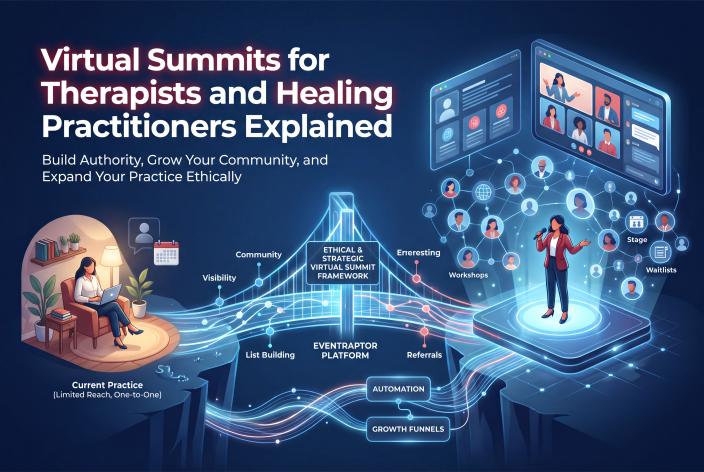
A virtual summit for therapists is a short online event. You and a few practitioners whose work complements yours each teach the public about one problem in your specialty, usually in prerecorded sessions. Run as public education, it helps you become known for that specialty. It also gathers people who are interested in your groups, workshops or waitlist, and it builds referral relationships with your peers.
This page is for licensed therapists, counselors and healing practitioners in private practice. You're good at what you do, and you're often highly qualified. Your caseload probably comes from a directory listing, an insurance panel or a few trusted referral sources. When one of those slows down, so does the practice. And the word "marketing" makes you wince a little.
A summit fits that tension well. You get to teach. Respected colleagues teach next to you. And people hear how you think before they ever contact your office. It's education, so nobody should present it as therapy or promise that watching it will change anyone's mental health.
Key Takeaways
- Choose one problem in your specialty and invite peers from neighboring professions or specialties, so the lineup feels like collaboration and nobody is competing for the same clients.
- Use a one-day or short prerecorded format with a viewing window, so you can fit it around your clinical week and attendees can watch when they're free.
- Say plainly on the registration and attendee pages that the sessions are general education and not therapy, and check your licensing board's advertising rules before you publish anything.
- Ask registrants only which topics and formats interest them, and keep every tag in your CRM non-clinical.
- End with an offer that suits a practice, such as a group program, workshop, intensive or private-pay waitlist, and confirm where you're licensed before you invite anyone to a consultation.
Who a Therapist Summit Is For and What It Can Realistically Do
The format works best for practitioners who already have a defined specialty and some way to serve people beyond one-to-one sessions. That might be a licensed counselor, a marriage and family therapist or a psychologist in private practice. It might also be a healing practitioner whose work can be taught publicly in general terms.
Here's what a well-run summit can realistically give you:
- Visibility in your specialty. People start linking your name with one problem, such as grief after a parent's death, burnout in nurses or couples adjusting to a new baby.
- Public education. You explain things people struggle to find good answers to, in a setting that feels generous rather than salesy.
- Community. Attendees join your list and hear from you between events, so the relationship has room to grow.
- Professional referrals. The peers you invite see how you work up close. They'll know exactly who to send people to.
As for promises about outcomes, the honest answer is that a summit makes none. It doesn't assess anyone, treat anyone or replace care. Keep your copy on the side of education, visibility and community, and you'll stay on firm ground.
Why the Format Suits Practitioners Who Dislike Marketing
A summit is a collaborative event. Each speaker shares it with their own newsletter, colleagues and followers, so much of your audience arrives through other people's trust. You don't have to shout. You have to host well.
There's also the company you keep. When people see you teaching next to clinicians and specialists they already respect, some of that credibility rubs off on you. That's hard to get from a directory profile.
And you build a list without posting every day. If daily content has never felt right for your practice, becoming known in your specialty without daily posts or social media walks through other ways to get there.
Chiropractor Kevin Christie described this kind of event on the Virtual Summit Strategies podcast. He hosted a local virtual health summit for runners and triathletes. He deliberately left other chiropractors off the lineup and invited complementary experts such as a swimming coach instead. He gave the injury prevention talk himself, while the other sessions covered performance. That made him the health expert in the room. When other professionals worried about "bringing on the competition," his experience was that everyone turned out to be a collaborator. He also kept using the sessions as content and as a lead magnet long after the event date.
What a Therapist Summit Looks Like in Practice
One Narrow Theme With Teaching Sessions
Start with one specific problem your ideal clients care about. The narrower it is, the easier it is to choose speakers and to write a registration page that people recognize themselves in.
For example, a perinatal therapist might host a one-day summit for new parents about their first year together. A lactation consultant could cover feeding and sleep. A pelvic floor physical therapist could talk about recovery, and a financial planner could cover money conversations. The host might teach how couples can talk about the changes in their relationship. Each session teaches something useful on its own, and none of them diagnoses anyone. (That's a hypothetical, not a real event.)
Topics that work well are explanatory: what's normal, which questions to ask, how to find the right kind of help and when it makes sense to talk to a professional.
Peers Who Complement Your Specialty
Look for speakers who serve the same people from a different angle. You get a fuller picture for attendees, and the relationships are much easier to build. People who share your exact specialty can still become referral partners, but they're better suited to a later event or a panel.
A Format That Fits a Clinical Week
You don't need a sprawling conference. Here's how the common formats compare:
| Format | Typical shape | Good fit when |
|---|---|---|
| One-day summit | About 5 to 15 speakers, with 8 to 10 a comfortable number, all on one specific problem | You want a focused event that leads into one offer |
| Micro summit | Around 5 to 7 speakers over five days, with short interviews | You'd like a gentle first event with very little live time |
| Multi-day summit | Usually 2 to 14 days with 20 or more speakers | You have more time and a broader theme, and growing your list is the main goal |
Sheri Moise ran a five-day micro summit with five to seven speakers. Every interview was available from day one, none ran longer than about 30 minutes, and the replays stayed up for about a week. Victoria Boyd kept her summits short for a similar reason: her audience was solo business owners who didn't have much spare time.
Prerecorded sessions with a viewing window are kind to everyone's schedule. Adam Kinakin's summit for law enforcement opened each day's sessions at 6:00 AM Eastern and kept them available for 72 hours, because officers worked day shifts and night shifts. Clinicians and many of the people they serve have schedules that are just as awkward.
An Attendee Page That Says This Is Education
Put a short, plain notice on the registration page, the attendee page and any replays. Adapt the wording to your board's guidance, but it might read something like this:
These sessions are general education. They aren't therapy or medical advice, and watching them doesn't make you a client of any speaker. If you're in crisis, please contact your local emergency services.
An Ethics Checklist Before You Invite Anyone
Run through this before your registration page goes live:
- Read your licensing board's advertising rules and your professional association's code, then check your page, emails and speaker bios against them.
- Never collect testimonials or case stories from therapy clients, for the summit or for any of its promotion.
- Ask registrants only about topics and formats they're interested in, never about symptoms, diagnoses or history.
- Keep CRM tags and notes non-clinical ("interested in couples workshop" is fine, and anything describing a person's condition isn't).
- Check where you're licensed to practice before you invite anyone to a consultation, because an online event will reach people in other states and countries.
- Ask every speaker to keep their session educational and to follow their own professional rules, then review sessions before they're published.
- Keep outcome promises out of titles and emails. "Heal your anxiety in a weekend" has no place on a practitioner's page.
- Prepare a kind, short reply for anyone who emails personal details, pointing them to appropriate support and crisis resources.
Offers That Fit the End of a Therapist Summit
Practices usually have offers that sit well after an educational event: a therapy group or psychoeducational group program, a weekend workshop, an intensive, a private-pay waitlist, or a consultation for people in the places you're licensed. We've written a full guide to what therapists can ethically offer at the end of a summit or webinar, so I won't repeat it here.
I will say this. Decide on your offer before you invite a single speaker. I once hosted a summit while I was too exhausted to put a proper offer together. Speakers and attendees loved it, and it added 476 new people to our list, but it made only about $1,800 during the event. Those people will keep buying for years, so I still count it a success. Even so, it taught me to keep my eye on the offer.
The Work EventRaptor Takes Off Your Plate
Most practitioners can see why a summit makes sense. What puts them off is the admin. On EventRaptor, much of that admin is already built in:
- Speakers apply through the platform, sign their speaker agreement and upload their bio and session, so you don't end up with dozens of email threads.
- The schedule, speaker pages and attendee dashboard are built from those speaker and session records. Nobody rebuilds them by hand.
- Your registration and thank-you pages come from templates, with your education notice included.
- Welcome and reminder emails go out on the event's timing, and follow-up that still feels human takes over after.
- Each speaker gets a promoter link, and the leaderboard shows who's sharing the event.
- Registrants sync to GHL/CRMRaptor with non-clinical tags, such as the topic or format they chose, so your follow-up can start straight away.
To be clear about the limits: live sessions run on Zoom, and EventRaptor doesn't offer in-event Q&A or polls. Video hosting for your session recordings and replays is available through CRMRaptor, EventRaptor's GoHighLevel solution, so you don't need a separate video host, and EventRaptor's video view analytics show you how those videos are viewed.
We designed the platform around a real person. She was a 70-year-old group coaching client who had only been using computers for two or three years. In December 2021, she ran a virtual summit with twelve speakers on EventRaptor without help from anyone else.
If you'd rather not touch the tech at all, our team can run the whole summit for you. Jennie and I have hosted 13 summits of our own and over 40 summits for clients. In a done-for-you summit, our team writes the session descriptions and speaker introductions, sets up Zoom and builds the pages. Your part is to teach, host and invite people to your offer. For finding speakers, the EventRaptor directory lists more than 3,800 speakers who want to be invited to events. Speaker Connections also meets on Zoom on the first and third Tuesday of each month, and usually 70 to 110 speakers and hosts attend.
Where to Read Next
If you're worried that nobody knows your name yet, read hosting your first virtual summit before anyone knows your name. It covers how to pitch respected speakers as a newer host. When you're ready to plan, the 13-week plan and checklist for your first virtual summit takes you through topic, audience, offer, format and dates in your first week.
Frequently Asked Questions
Is It Ethical for a Therapist to Host a Virtual Summit?
Yes, as long as you run it as public education and follow your licensing board's advertising rules. Make it clear that the sessions aren't therapy, avoid promising outcomes and never use testimonials or stories from therapy clients. Ask registrants only about the topics and formats they're interested in.
Do I Need a Big Email List or Social Following?
No. Speakers share the event with their own audiences, which is a large part of why the format works for people with small lists. When I ran my first summit in 2020, my list grew from about 100 people to 750. That's my own result, and it doesn't predict yours.
Can I Invite Summit Attendees to a Consultation?
You can, but an online event reaches people far beyond your state, so first confirm where you're licensed to practice. Your invitation should say plainly who the consultation is for. Many practitioners also offer a group, workshop or waitlist, since those can suit attendees wherever they live.
How Many Speakers Does a Therapist Summit Need?
A one-day summit usually has somewhere between 5 and 15 speakers, and 8 to 10 is a comfortable number. A micro summit can work with 5 to 7. Choose people whose work complements your specialty, so every session adds something new for attendees.
What Should I Store About Registrants in My CRM?
Store only what you need for non-clinical follow-up: their name, email, the topics or formats they chose and whether they bought a VIP pass. Leave out anything about symptoms, diagnoses or personal history. When EventRaptor syncs registrants to GHL/CRMRaptor, set up your tags to match that rule.
A Good First Step This Week
Take ten minutes and write down three things: one problem in your specialty that people keep asking you about, three professions that serve those same people from a different angle, and the one offer you'd like attendees to hear about at the end. Those three answers will tell you whether a summit is worth doing yet.
If you'd like help reading those answers against your practice, Book your Client Attraction Planning Call. We'll look at whether a full summit, a smaller panel with two or three peers, or simply better follow-up for the inquiries you already get makes the most sense for you.