If your client flow depends on referrals, random visibility, and the occasional good introduction, partnerships can feel like the obvious next move.
And they can be.
A good collaboration can put you in front of the right people with borrowed trust already attached. A podcast interview, summit session, workshop swap, referral relationship, or giveaway contribution can help your market see you faster than posting alone.
But here's the catch.
Not every partner with an audience is a good authority partner.
Some partners have reach but no alignment. Some love your work but won't promote. Some have a warm audience but no clear path to follow-up. And some collaborations create a nice visibility bump that disappears because nobody tracked the leads, tagged the source, or continued the conversation afterward.
So you need a map.
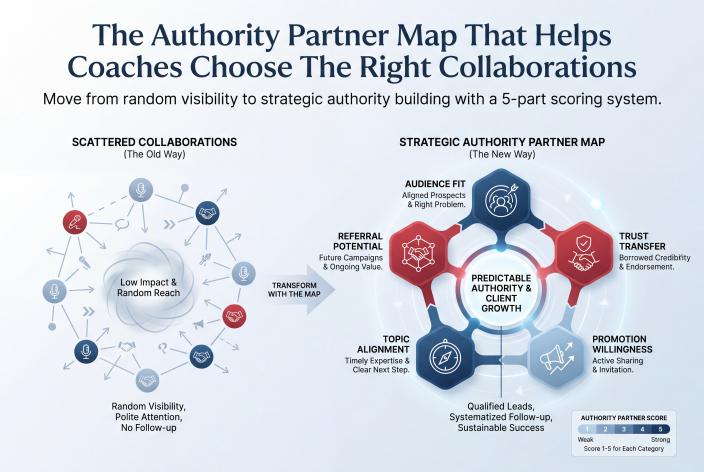
The Authority Partner Map helps you choose collaborations based on fit, trust, promotion, topic alignment, and referral potential. It also helps you turn those relationships into a 90-day authority campaign instead of a pile of one-off appearances.
Why Audience Size Is Only One Part Of Partner Value
A large audience sounds attractive.
But if that audience doesn't contain your right-fit prospects, the size doesn't help much. You can spend hours preparing for a podcast, summit, or workshop and still end up with polite attention from people who were never likely to become clients.
A valuable partner gives you more than reach.
They can give you:
- Access to people who already care about the problem you solve
- Trust transfer because their audience respects them
- Context that makes your message feel relevant
- A reason for prospects to take the next step
- A relationship that may lead to future referrals, events, or introductions
That's why partner selection needs to be more strategic than, "Do they have a list?"
A smaller partner with strong audience fit and high trust can be more useful than a larger partner with weak alignment.
The real question is simple: will this collaboration help the right people know, trust, remember, and respond to you?
The 5-Part Authority Partner Score
Before you pitch a podcast host, summit speaker, workshop collaborator, referral partner, or giveaway contributor, score them across 5 areas.
Use a 1 to 5 score for each category.
1 means weak fit. 5 means strong fit.
Audience Fit
Audience fit asks, "Are their people likely to care about the transformation I help create?"
Look at who follows them, who comments on their content, who attends their events, and what problems they talk about most.
A strong audience fit means their people already have the pain, desire, identity, or buying trigger connected to your offer.
For example, if you coach burned-out founders, a partner who serves early-stage entrepreneurs may be more aligned than a general wellness creator with a larger audience.
Ask:
- Does their audience match my niche?
- Are these people likely to have the problem I solve?
- Would my message feel useful in their world?
- Are they used to investing in support, growth, coaching, or advisory help?
Trust Transfer
Trust transfer is the borrowed credibility you receive when a respected partner introduces you.
This matters because coaches often don't need colder attention. They need warmer attention that arrives with context.
A strong trust transfer happens when the partner's audience believes, "If this person invited you, you must be worth listening to."
Ask:
- Does this partner have a real relationship with their audience?
- Do people engage with them personally, or only consume quietly?
- Do they curate guests carefully?
- Would their endorsement make my expertise easier to trust?
This is one reason virtual summits, podcast interviews, workshops, and speaker-led campaigns can work well as authority-building stages. They let you borrow attention and trust while demonstrating your expertise in a useful way.
Promotion Willingness
Some partners say yes to collaboration but do very little to promote it.
That doesn't make them bad people. It just means you need to know what kind of momentum they are likely to create.
Promotion willingness measures whether the partner will actively share, invite, remind, and follow through.
Ask:
- Have they promoted past collaborations visibly?
- Do they send emails to their audience?
- Do they share partner events on social media?
- Are they comfortable using unique links or partner tracking?
- Do they understand that promotion is part of the collaboration?
This is where trackable links matter.
EventRaptor supports unique promoter links, promoter reporting, leaderboards, attribution, and exports, which helps hosts see which partners, speakers, or affiliates helped create registration momentum. It also supports registrant management, including promoter attribution, search, filtering, VIP indicators, exports, registration growth tracking, and CRM sync.
That gives you better information than, "I think that partner helped."
Topic Alignment
Topic alignment asks whether the collaboration gives you a natural reason to talk about the problem your offer solves.
This is huge.
You can be on a great podcast and still struggle if the topic pulls you away from your best buying conversation.
A strong partner gives you a topic lane where your expertise feels timely, specific, and useful.
Ask:
- Can I teach something useful without bending my message?
- Does the topic connect naturally to my offer?
- Will the audience leave understanding what I help with?
- Can I invite them into a next step without it feeling awkward?
For coaches, the best authority topics usually sit close to the prospect's real problem.
Not broad inspiration. Not vague thought leadership. A clear conversation that helps the right person say, "That is exactly what I need help with."
Referral Potential
Some partners may not drive a huge number of registrations or listeners right away, but they may become valuable referral relationships.
Referral potential measures long-term relationship value.
Ask:
- Do they serve the same audience before or after my work?
- Do they have clients who may need my help?
- Would I feel confident referring to them?
- Could we run future workshops, summits, or campaigns together?
- Is there a natural reason to stay connected after the first collaboration?
This is where authority partnerships become more than lead generation.
They become ecosystem building.
The Authority Partner Scoring Table
Use this simple table before you commit time, energy, and follow-up to a collaboration.
| Partner Criteria | Score 1 To 5 | What To Look For |
|---|---|---|
| Audience Fit | Their audience matches the people you want to serve | |
| Trust Transfer | Their introduction would make you easier to believe and remember | |
| Promotion Willingness | They are likely to share, invite, and follow through | |
| Topic Alignment | The collaboration lets you teach close to your offer | |
| Referral Potential | The relationship could create future introductions or campaigns |
Add the score.
A partner with 20 to 25 points deserves serious attention.
A partner with 15 to 19 points may be useful if the relationship is warm, the timing is good, or the topic is highly aligned.
Below that, be careful. You may still say yes for relationship reasons, but don't build your client attraction plan around it.
How To Map Partners Into A 90-Day Authority Campaign
Once you have your scored list, stop thinking in random appearances.
Think in campaign flow.
A 90-day authority campaign gives your collaborations a job. Each partner activity should help create visibility, capture attention, nurture trust, or move prospects toward a qualified conversation.
Days 1 To 15 Build The Partner Shortlist
Start by listing 20 to 30 potential partners.
Include:
- Podcast hosts
- Summit hosts
- Summit speakers
- Workshop collaborators
- Referral partners
- Giveaway contributors
- Community leaders
- Newsletter owners
- Complementary coaches or consultants
Then score each one using the 5-part map.
Your goal is not to chase everyone. Your goal is to identify the partnerships most likely to support your authority position.
Days 16 To 30 Shape The Collaboration Offer
Now create a clear reason for the partner to say yes.
A weak pitch says, "I'd love to collaborate sometime."
A stronger pitch offers a specific value exchange.
For example:
- A practical workshop for their audience
- A summit session that fills a gap in their event
- A podcast topic their listeners already care about
- A referral resource for clients they don't fully serve
- A giveaway contribution that solves a narrow problem
Keep the pitch focused on their audience.
When the partner can immediately see why their people would care, the conversation gets easier.
Days 31 To 60 Run The Authority Activities
This is where the campaign becomes visible.
You might schedule podcast interviews, host a roundtable, contribute to a summit, invite speakers into your own event, or run a partner workshop.
EventRaptor can support this kind of event-based authority building by organizing event pages, speaker profiles, registration pages, attendee dashboards, schedules, reminders, partner links, and follow-up communications in one event growth system.
If you are using GHL/CRMRaptor alongside it, the CRM layer can support contact records, tags, custom fields or values, calendars, funnels, workflows, automation, and follow-up.
Together, the event side and CRM side help keep the campaign from turning into scattered links, spreadsheets, and forgotten leads.
Days 61 To 90 Follow Up And Deepen The Best Relationships
The follow-up phase is where many coaches lose the value of the campaign.
People registered. They attended. They clicked. They asked a question. They watched a replay. They came through a partner link.
Then life got busy.
And the opportunity cooled off.
Your follow-up should include 2 paths:
- Follow-up with prospects who engaged
- Follow-up with partners who created momentum
For prospects, use email, SMS where appropriate, nurture content, replay reminders, booking invitations, and helpful next-step messages.
For partners, review what happened and decide what to do next.
Ask:
- Which partners drove aligned registrations?
- Which partners created engaged attendees?
- Which partners were easy to work with?
- Which partners opened referral or future campaign opportunities?
- Which partners should be invited into the next collaboration?
EventRaptor supports follow-up communications, scheduled emails, reminders, personalization placeholders, email status tracking, attendee data, CRM syncing, promoter reporting, and exports. That matters because a campaign is much easier to improve when you can see what happened.
How Trackable Links And CRM Tags Protect Partner Momentum
Partner momentum is fragile when everything lives in memory.
You need to know where people came from and what happened next.
At a basic level, every meaningful partner campaign should track:
- Partner source
- Registration source
- Attendance or engagement
- VIP interest where relevant
- Follow-up path
- Booking status
- Referral relationship status
Trackable links help you see which partner introduced the person.
CRM tags help you continue the conversation based on how that person entered your world.
For example, someone who registered through a leadership podcast partner may need different follow-up than someone who joined through a wellness giveaway. The message, context, and next step should respect how they arrived.
This is where the system protects the relationship.
Good automation doesn't make the experience colder. It helps you follow up while the conversation is still warm, with the right context attached.
The Simple Authority Partner Map You Can Use This Week
Here's a practical way to use this without overcomplicating it.
Choose 10 possible partners and score each one.
Then place your top options into 3 groups.
| Partner Group | Best Use | Next Move |
|---|---|---|
| High Fit And High Trust | Priority authority partners | Pitch a specific collaboration |
| High Fit But Low Promotion | Relationship partners | Explore referrals or smaller content swaps |
| High Promotion But Weak Fit | Visibility-only partners | Use carefully and avoid overinvesting |
Then ask yourself one final question.
If this collaboration works, what happens next?
If you don't have a clear answer, build the next step before you pitch.
That next step might be a workshop invitation, a summit registration, a helpful assessment, a nurture sequence, a planning call, or a referral conversation.
The partner opens the door. Your system needs to guide the relationship after that.
Build Partnerships That Support A Real Client Attraction System
The best collaborations don't just create attention for a day.
They help you become known for the right thing by the right people. They make your expertise easier to trust. They create relationships that can keep compounding through events, referrals, workshops, interviews, and follow-up.
But only when you choose partners with intention.
Score the fit. Map the campaign. Track the source. Tag the lead. Follow up while interest is warm.
That is how partner-powered growth becomes part of a real authority and client attraction system.
If you want help choosing your next right authority move, Book your Client Attraction Planning Call. On the call, we'll look at where your client flow is getting stuck, which collaborations make sense for your coaching business, and whether a summit, workshop, funnel, CRM, follow-up system, or done-for-you implementation support should come next.