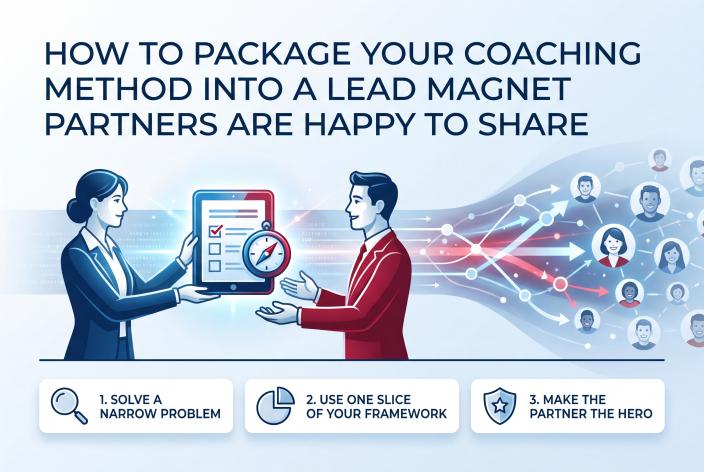
You already have a coaching method.
Maybe you call it a framework, a process, a model, a roadmap, or simply "the way I help clients get unstuck."
The problem is usually packaging.
When a potential partner looks at your free resource, they are asking a silent question:
"Will sharing this make me look good to my audience?"
That question matters.
Podcast hosts, speakers, affiliates, summit collaborators, newsletter owners, and referral partners are protective of their people. They don't want to send their audience to something vague, heavy, confusing, or salesy.
So if you want partners to share your lead magnet, it needs to do more than collect an email address.
It needs to make the partner look helpful, the audience feel understood, and your next step feel natural.
Let's walk through how to build one.
Start With A Narrow Problem Your Partner's Audience Already Feels
A partner-friendly lead magnet should solve a problem the audience can recognize quickly.
That means the problem needs to be visible.
For example, a leadership coach could create a lead magnet around:
- "How To Prepare For A Difficult Conversation With A Team Member"
- "The 5 Questions To Ask Before You Delegate A High-Stakes Project"
- "A 10-Minute Debrief Template For Managers After A Messy Meeting"
Those are easy to understand.
They point to a real moment in the prospect's life.
Compare that with something like "Unlock Your Leadership Potential." It might be meaningful to you, but it gives a partner very little to say when they promote it.
The audience needs to feel, "Yes, I have that problem. I could use help with that."
Here's a tip.
If your lead magnet title could fit almost any coach in your industry, it's probably too broad.
A good partner-friendly topic usually has 3 traits:
- It names a situation the audience recognizes.
- It promises a useful next step without sounding inflated.
- It connects naturally to the coaching work you eventually sell.
So don't start with, "What free thing can I make?"
Start with, "What problem would my partner be proud to help their audience solve?"
That shift changes everything.
Use Your Signature Framework Without Giving Away The Whole Coaching Process
A lot of coaches get stuck here.
They either give away too much, which turns the lead magnet into a mini-course nobody finishes, or they give away too little, which makes the resource feel thin.
The sweet spot is a small slice of your framework.
Your full coaching method may include diagnosis, mindset, strategy, implementation, feedback, accountability, and integration. That belongs in the paid work.
Your lead magnet should help the person make one useful move.
Think of it as a doorway into your method.
Choose One Stage Of The Method
Look at your full coaching process and ask:
- Where do clients usually feel the most immediate pain?
- What mistake do they make before they understand the real problem?
- What small diagnostic would help them see themselves more clearly?
- What early win would make them trust the rest of your process?
For a health coach, the lead magnet might focus on the first step of noticing energy patterns.
For a wealth coach, it might help someone see where money decisions are being made reactively.
For a business coach, it might help prospects diagnose why referrals are inconsistent.
You are not trying to coach the whole transformation in one PDF.
You are helping the right person say, "This makes sense. I want to go deeper."
Turn The Slice Into A Useful Tool
Frameworks become easier to share when they become practical.
Instead of sending partners a vague resource called "My 7-Step Method," package one piece as:
- A checklist
- A scorecard
- A self-assessment
- A short workbook
- A decision guide
- A conversation script
- A planning template
- A mistake audit
These formats work because they feel immediately useful.
They also give partners simple promotion language.
A podcast host can say, "If you want to check where your follow-up is leaking opportunities, grab this short scorecard."
That is much easier to share than, "Go download their free guide about business growth."
Make The Partner The Hero Of The Share
Partners share resources for a reason.
Sometimes they want to serve their audience. Sometimes they want to bring in a useful collaborator. Sometimes they want a reciprocal relationship. Sometimes they want trackable promotion.
Your job is to make sharing feel easy and safe.
That starts with the framing.
A partner should feel like they are handing their audience something useful, not pushing them into your funnel.
Give Partners A Clear Reason To Share It
Your lead magnet should pass the "one sentence test."
Can a partner explain it in one sentence without needing a prep call?
For example:
- "This checklist helps coaches see why their referrals are inconsistent and what to fix first."
- "This template helps managers prepare for difficult conversations without overthinking every word."
- "This scorecard helps wellness professionals spot the hidden stress patterns that affect client consistency."
Simple wins.
When the partner has to translate your idea, simplify your promise, or guess who it's for, promotion becomes heavier.
And when promotion feels heavy, it gets delayed, watered down, or skipped.
Create Swipe Copy That Sounds Human
Partners are busy.
Give them copy they can use.
But please, make it sound like a person wrote it.
Include a few options:
- A short email blurb
- A newsletter paragraph
- A social post
- A podcast mention
- A speaker intro
- A short bio line
Keep the copy plain and specific.
A strong partner blurb might sound like this:
"If your coaching is getting results but your client flow still depends too much on referrals, this short assessment will help you see where the gap is. It walks you through the visibility, trust, follow-up, and conversion pieces that need to work together before your calendar becomes more consistent."
Notice what that does.
It names the person.
It names the pain.
It names the useful outcome.
No hype required.
Build A Dedicated Landing Page For Each Partner Campaign
Please don't send every partner to the same generic opt-in page.
A dedicated landing page can make the experience feel more relevant and easier to measure.
This does not need to be complicated.
You can create a simple landing page that includes:
- A headline tied to the partner's audience
- A short paragraph explaining the specific problem
- A quick preview of what the lead magnet helps them do
- A clean opt-in form
- A thank-you page with the next step
- Tracking or attribution so you know where the lead came from
EventRaptor's guidance around partner-powered visibility is useful here because partner promotion works better when it is organized and measurable. EventRaptor supports unique promoter links, promoter dashboards, performance reports, leaderboards, registrant management, promoter attribution, exports, and CRM sync, which helps hosts see who promoted, who registered, and where momentum came from.
For a coaching business, the lesson is simple.
If a partner is willing to introduce you to their audience, treat that traffic with care.
Don't drop people into a generic page that could have come from anyone.
Make the page feel like a continuation of the partner's recommendation.
Personalize Without Overbuilding
You do not need a fully custom funnel for every partner.
Start with simple personalization:
- "Recommended by [Partner Name]"
- A short note acknowledging the partner's audience
- A specific use case tied to the partner's topic
- A thank-you page that references where they came from
- Tags or fields inside your CRM so follow-up can stay relevant
This is where your event, funnel, and CRM pieces need to work together.
EventRaptor can support the event and partner promotion side, including registration pages, attendee data, promoter tracking, and CRM-connected workflows. GHL/CRMRaptor can support the CRM, funnel, calendar, workflow, automation, and follow-up side.
The practical benefit is that the partner campaign does not vanish into a spreadsheet.
People get captured, tagged, nurtured, and moved into the right next step.
Build A Follow-Up Path That Continues The Trust
The lead magnet is only the beginning.
Someone opts in because the partner created enough trust for them to pay attention.
Now your follow-up has to respect that trust.
A good follow-up path should feel like a helpful continuation, not a sudden hard turn into a sales pitch.
Think in stages.
The First Email Should Deliver And Orient
The first email has one job.
Give them what they asked for and help them use it.
You might include:
- The lead magnet link
- A short note on how to get the most from it
- One simple instruction
- A warm mention of the partner who introduced them
Keep it clean.
No giant life story. No pile of unrelated links.
The Next Few Emails Should Deepen The Diagnosis
After delivery, help the person understand the problem more clearly.
You can send emails that cover:
- The hidden cost of the problem they just assessed
- A common place people get stuck
- A short story or hypothetical example that illustrates the issue
- A useful next step they can take this week
- A gentle invitation to talk if they want help applying it
For example, if your lead magnet helps coaches diagnose inconsistent client flow, your follow-up might teach them how visibility, authority, capture, nurture, and sales conversations fit together.
That kind of follow-up builds trust before the call.
And that's the point.
Good automation can protect the relationship by making follow-up timely, consistent, and relevant.
Make The Lead Magnet Easy To Promote In Multiple Partner Channels
Different partners promote differently.
A podcast host needs a short spoken mention.
A summit speaker may need swipe copy and a link.
An affiliate may want tracking and performance visibility.
A newsletter partner needs a clean angle their readers will care about.
So build your partner kit around real use.
| Partner Type | What They Need | What Helps Them Share |
|---|---|---|
| Podcast Host | A short spoken mention | A one sentence explanation and clean link |
| Summit Speaker | Swipe copy and context | A resource tied to the summit topic |
| Affiliate Or Promoter | Trackable promotion | Unique links and clear attribution |
| Newsletter Partner | A useful reader angle | A short blurb that solves a specific problem |
| Referral Partner | Confidence in your process | A page that feels clear, helpful, and aligned |
This is also why broad lead magnets struggle.
They force every partner to figure out the angle.
A narrow, useful resource gives each partner an easy reason to share it.
Measure Partner Quality By Qualified Conversations
Opt-ins matter.
But they do not tell the whole story.
A partner who sends fewer leads may still be more valuable if those people are better aligned, more engaged, and more likely to become qualified conversations.
So measure partner campaigns beyond the first click.
Look at:
- Who opted in
- Which partner they came from
- Whether they opened or clicked follow-up
- Whether they consumed the resource
- Whether they booked a call
- Whether the call was qualified
- Whether the conversation pointed to real fit
This is where many coaches lose clarity.
They celebrate a bigger list, then feel confused when the sales calendar stays quiet.
A better question is, "Which partners are helping the right people move toward trust?"
EventRaptor's promoter attribution, registrant data, performance reporting, exports, and CRM sync support this kind of visibility on the event side. When that data connects to your CRM and follow-up, you can make better decisions about which partners to invite again, which audiences respond best, and which messages create warmer conversations.
That gives you a growth asset.
Not just a traffic spike.
Use This Simple Packaging Checklist
Before you ask partners to promote your lead magnet, run it through this checklist.
The Partner-Friendly Lead Magnet Checklist
Your lead magnet is stronger when:
- It solves a narrow, visible problem.
- It names a specific audience or situation.
- It uses one slice of your signature framework.
- It gives the prospect a useful diagnostic, tool, or next step.
- It can be explained by a partner in one sentence.
- It has simple swipe copy for different promotion channels.
- It uses a dedicated landing page or partner-specific tracking.
- It connects to a follow-up path that continues the conversation.
- It helps you measure qualified conversations, not only opt-ins.
If any of those pieces are missing, start there.
You do not need a bigger lead magnet.
You need a clearer one.
Turn Your Method Into A Shareable Trust Asset
Your coaching method has value.
But partners do not share your method because it is clever.
They share resources that help their audience, strengthen their own trust, and make the next step feel obvious.
So package your lead magnet with that in mind.
Make it narrow.
Make it useful.
Make it easy to explain.
Give each partner a clean page, clean copy, and a clean follow-up path.
Then measure what happens after the opt-in, because the real opportunity is the movement from attention to trust to conversation.
If you want help applying this to your coaching business, Book your Client Attraction Planning Call. On the call, we can look at your offer, your current visibility, your partner opportunities, and the kind of lead magnet and follow-up path that could make sense for your next campaign.