You can have a strong premium coaching offer and still hear some version of this on sales calls:
"I love this, but I don't think I'm ready yet."
That sentence can be maddening.
Because sometimes it means the person is truly not a fit. They don't have the problem you solve. They don't value the outcome. They want a cheaper shortcut. Or they need a different level of support than you offer.
But sometimes it means something very different.
Sometimes the prospect is right-fit, motivated, and close. They can feel the value of your work. They know something needs to change. They may even trust you. But they haven't built enough confidence to make a premium decision yet.
That's where many coaches lose good opportunities.
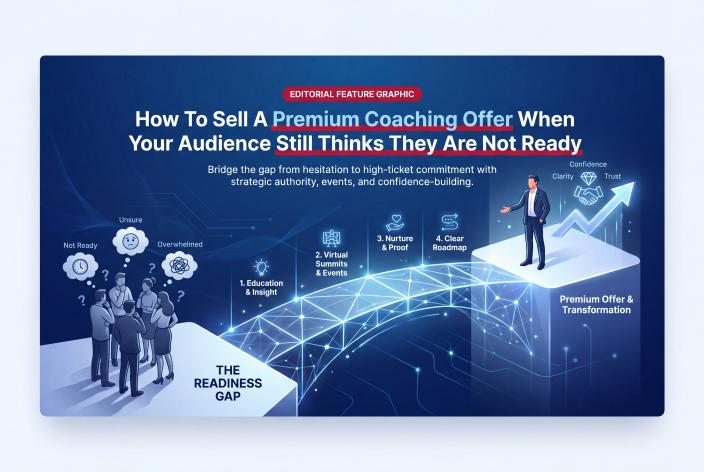
They try to overcome the hesitation on the sales call, when the real work should have started much earlier. Through your positioning. Your education. Your authority-building content. Your events. Your follow-up. Your roadmap.
Let's talk about how to sell a premium coaching offer to people who are closer than they think, without pushing them, chasing them, or watering down the value of your work.
The Real Meaning Behind "I'm Not Ready"
When a prospect says they're not ready, don't rush to handle it like a standard objection.
Pause.
That phrase can mean several different things:
- "I don't understand the value yet."
- "I don't trust myself to follow through."
- "I don't know if this will work for someone like me."
- "I don't see the path clearly enough."
- "I'm afraid of spending money and still being stuck."
- "I like you, but I need more proof that this is the right next step."
Do you see the pattern?
Most readiness doubts are confidence problems.
Your job is to help the right person understand the decision, the path, the support, and the fit more clearly. That starts long before you ask for the sale.
A premium offer asks the prospect to make a bigger commitment. So the trust pathway has to be stronger too.
Separate Bad Fit From Readiness Doubt
This is the first distinction to get right.
Some people should not buy your premium coaching offer. Trying to force them across the line creates bad clients, weak results, and heavy delivery.
A bad-fit prospect usually shows signs like:
- They want the outcome but reject the process.
- They don't have the problem your offer is designed to solve.
- They resist narrowing, deciding, investing, or participating.
- They expect you to rescue them without their involvement.
- They keep asking for guarantees you can't ethically make.
- They want a cheaper version with the same depth of support.
That person needs a different offer, a different timeline, or a different provider.
A right-fit prospect with readiness doubts looks different.
They may say:
- "This sounds like exactly what I need, but I'm overwhelmed."
- "I know I need help, but I don't know where to start."
- "I've tried things before and I'm nervous about investing again."
- "I can see the value, but I need to understand the steps."
- "I don't want to get into something I can't keep up with."
That's not resistance to transformation. That's a request for clarity.
And clarity is one of the most important parts of selling premium coaching.
A Simple Readiness Filter
Before you try to move someone forward, ask yourself 4 questions:
- Do they have the problem my offer solves?
- Do they want the outcome enough to change behavior?
- Do they respect the kind of support I provide?
- Would I be genuinely glad to work with them?
If the answer is yes, their hesitation deserves education.
If the answer is no, their hesitation may be useful information. Let them go with respect.
Build Readiness Before The Sales Call
A premium sales call should not be the first time a prospect hears your thinking.
By the time someone books a call, they should already have some sense of:
- What you believe about their problem
- Why the problem is happening
- What usually keeps people stuck
- What the path forward looks like
- Why your way of helping is different enough to consider
- What kind of commitment the work requires
This is where many coaches make the process too hard on themselves.
They create visibility, then send people straight to a call. The prospect arrives curious, but undereducated. So the call becomes a heavy lift. You have to diagnose, teach, build trust, explain the offer, answer doubts, and ask for a decision in one conversation.
That is a lot to carry.
A stronger client attraction system warms people up before the call. EventRaptor's positioning uses the phrase "from visibility to trust to conversation" because the sequence matters. People are easier to help when they've already been guided through attention, education, registration, engagement, follow-up, and the right next step.
For a coach selling premium work, that sequence can change the quality of the sales conversation.
Use Education To Lower Decision Fear
Education does not mean dumping more content on people.
It means helping them understand the decision they're trying to make.
A good education path answers questions like:
- "Why am I stuck even though I've tried hard?"
- "What needs to happen before this can work?"
- "What should I stop measuring too early?"
- "What does progress look like before the final outcome?"
- "What support will I need to follow through?"
If you're a business coach, your audience may need to understand that a website alone won't create a steady pipeline. They may need a clearer path from authority to attention to trust to qualified conversations.
If you're a health coach, your audience may need to understand why starting with an extreme plan has failed before. They may need a steadier support structure.
If you're a leadership coach, your audience may need to understand that the real issue is showing up in patterns, not one isolated conflict.
See the difference?
You're not trying to convince them harder. You're helping them see the situation accurately.
Teach The Gap They Cannot See Yet
Premium coaching often sells when the prospect recognizes a gap they couldn't name before.
For coaches and consultants, a common gap is this:
They have real skill, but their client flow depends on referrals, random content, networking, occasional launches, scattered tools, and manual follow-up.
So when they say, "I'm not ready," the real issue may be that they don't understand the system required to become ready.
Your content should show them the path:
- Clarify the problem and audience.
- Build authority around a specific transformation.
- Create visibility through useful stages like webinars, workshops, interviews, or summits.
- Capture interest while attention is warm.
- Nurture leads with practical follow-up.
- Invite qualified prospects into a clear conversation.
- Continue measuring and improving the process.
That kind of education makes the decision feel more grounded.
Use Proof Without Making Unsupported Promises
Readiness doubts often come from risk.
The prospect wonders, "What if I invest and nothing changes?"
Proof helps. But only if it's honest.
You do not need exaggerated income screenshots or dramatic promises to sell a premium offer. In fact, those can push away thoughtful buyers.
Useful proof can include:
- Client stories, when you have permission to share them
- Specific before-and-after examples
- Testimonials that name the real problem and result
- Screenshots of feedback, if approved
- Case studies with clear context
- Your own process, explained step by step
- Examples of decisions clients learned to make differently
And if you don't have strong public proof yet?
Use process proof.
Process proof shows that your method has structure. It tells the prospect, "This is not a vague coaching container where we talk each week and hope things improve. There is a path."
You can show:
- How you diagnose the starting point
- How you decide what to work on first
- How support is delivered
- What the client is responsible for
- Where implementation help fits
- How progress is reviewed
- What happens when something needs adjusting
That matters, especially for premium coaching.
People are often less afraid of the price than they are of paying and feeling alone.
Give Them A Roadmap They Can Believe In
A premium offer becomes easier to say yes to when the prospect can see the first few steps.
They don't need every detail.
They do need enough clarity to think, "I can see how this would work."
A simple roadmap might look like this:
| Stage | What The Prospect Needs To Understand | What Your Marketing Can Show |
|---|---|---|
| Diagnosis | Why the current problem is happening | Articles, workshops, assessments, audit questions |
| Direction | What should be fixed first | Frameworks, planning sessions, short videos |
| Support | How they will be guided | Offer breakdowns, onboarding explanations, examples |
| Implementation | What gets done and by whom | Checklists, done-for-you details, project maps |
| Follow-Through | How progress continues | Nurture emails, client journey content, reminders |
Notice how calming this is.
The prospect is no longer staring at a giant decision. They're seeing a guided path.
And when your offer includes done-for-you or implementation support, this becomes even more important.
Include Support And Implementation Without Overpromising
Premium buyers often want more than advice.
They want help applying the advice.
That does not mean you need to promise that everything will be effortless. It means you can design your offer to reduce confusion, prevent avoidable mistakes, and help the client keep moving.
Depending on your niche, premium support might include:
- Strategy calls
- Personalized roadmaps
- Templates or scripts
- Reviews and feedback
- Accountability checkpoints
- Implementation sessions
- Done-for-you setup
- Team coordination
- Follow-up support
For coaches building client attraction systems, this is a big deal.
A client may understand that they need better positioning, a webinar, a summit, a funnel, CRM follow-up, and a sales process. But understanding the pieces does not mean they want to build all of it alone.
That's where implementation becomes part of the value.
EventRaptor, for example, is positioned around helping coaches and experts manage authority-building events, registration, speakers, attendees, reminders, partner promotion, CRM-connected workflows, and follow-up in a more organized system. GHL/CRMRaptor supports the CRM, funnel, calendar, workflow, automation, and follow-up side.
The practical benefit is simple.
The coach does not have to duct-tape the whole client attraction path together across spreadsheets, inboxes, separate page tools, manual CRM updates, and scattered reminders.
If your premium offer includes implementation, explain it clearly:
- What you handle
- What the client contributes
- What decisions they must make
- What support looks like
- What is outside the scope
- What progress can reasonably depend on
That last part matters.
Support is powerful. Done-for-you help is valuable. But it still works best when paired with a clear offer, strong positioning, client participation, and consistent follow-through.
Use Events To Create Readiness At Scale
If your audience keeps saying they're not ready, an event can be one of the best ways to build readiness before the call.
Why?
Because events give people time with your thinking.
A workshop, webinar, summit, or speaker-led campaign can help prospects:
- Hear the problem explained in a new way
- See your framework in action
- Learn from related experts
- Understand what readiness really requires
- Experience your teaching style
- Feel less alone in the problem
- Take a smaller step before a bigger decision
A summit can be especially useful when your audience needs more authority and trust before they buy. It creates a bigger environment around the topic. Speakers, sessions, registration pages, reminders, attendee dashboards, and follow-up can all support the same trust-building journey.
But remember this.
The event is not finished when the last session ends.
The real opportunity continues through follow-up.
People register at different levels of readiness. Some attend live. Some watch later. Some need one more email. Some need a personal invitation. Some need to understand the roadmap. Some need to see whether your offer fits their current stage.
That's why the event and the follow-up system have to work together.
Use Nurture Emails To Keep Confidence Growing
Most prospects do not become ready all at once.
They move in steps.
One email helps them name the problem. Another helps them understand why their previous attempts did not work. Another shows the path. Another answers a fear. Another invites them to take the next step.
Your nurture sequence should not sound like a countdown timer screaming at them.
It should feel like a useful conversation that keeps going.
Here are 5 nurture email types that help readiness grow:
-
The Diagnosis Email Explain the real reason they're stuck. Make it specific enough that they feel seen.
-
The Roadmap Email Show the stages of the journey. Help them understand what happens first, next, and later.
-
The Reassurance Email Address the fear behind the hesitation. This might be time, energy, past failure, overwhelm, or uncertainty.
-
The Proof Email Share an approved client story, testimonial, process example, or useful teaching moment that supports belief.
-
The Invitation Email Invite them into a clear next step, such as a planning call, application, workshop, or consultation.
Good follow-up protects the relationship.
It helps the prospect feel remembered, guided, and respected. And if you use CRM and automation thoughtfully, the follow-up becomes more consistent without becoming robotic.
Build The Sales Call Around Fit And Next Step Clarity
When a readiness-doubt prospect gets on a call, your job is not to overpower their uncertainty.
Your job is to find the truth.
Are they a fit? Is the timing workable? Do they understand the path? Are they willing to participate? Does your offer match the level of support they need?
A strong premium sales call usually covers:
- Their current situation
- The cost of staying there
- What they've already tried
- Where they get stuck
- What they want instead
- Why now matters
- What support they believe they need
- Whether your process fits
- What the next step would look like
If they say, "I don't think I'm ready," ask a better question.
Try this:
"When you say you're not ready, do you mean this isn't the right fit, or do you mean you can see the fit but you're unsure about the first step?"
That question creates clarity without pressure.
If it is not the right fit, bless and release.
If they see the fit but feel unsure, go back to the roadmap. Show them the first step. Explain how support works. Clarify what they will and won't need to figure out alone.
Premium selling becomes calmer when your marketing has already done the trust-building work.
What To Fix If Too Many Prospects Feel Unready
If you keep hearing "I'm not ready" from otherwise good prospects, don't assume your offer is broken.
Look at the path before the call.
Ask yourself:
- Am I attracting the right stage of buyer?
- Does my content show the real cost of waiting?
- Have I explained what readiness actually looks like?
- Is my offer roadmap clear enough?
- Do prospects understand the support included?
- Am I inviting people into a planning conversation too early or too late?
- Do I have follow-up that keeps educating after the first interaction?
- Are my events, emails, CRM, and sales process connected?
This is where a real client attraction system matters.
Visibility alone can create attention. But attention needs a path. The path should help people understand, trust, engage, and move toward a qualified conversation when the fit is there.
That's the bridge many coaches are missing.
They don't need to become louder. They need a clearer trust pathway behind the visibility they already create.
Your Premium Offer Needs A Stronger Trust Pathway
If your audience thinks they're not ready, your answer is not to discount your premium offer or chase harder.
Build more readiness into the journey.
Help right-fit prospects understand the problem, see the roadmap, trust the support, and experience your thinking before they have to make a premium decision.
Use webinars, workshops, summits, nurture emails, CRM follow-up, and planning conversations to create a path that feels clear and human.
And if you want help applying this to your coaching business, Book your Client Attraction Planning Call.
On the call, we'll look at where your client flow is getting stuck, whether the gap is positioning, authority, offer clarity, event strategy, funnel, CRM, follow-up, or implementation, and what kind of client attraction system could make sense next.