If you've helped clients get real results, those stories should be doing more work for you.
Not in a braggy way.
Not in a hype-driven "look how amazing I am" way.
In a clear, grounded, useful way that helps the next right-fit prospect recognize themselves, trust your process, and feel more prepared to talk with you.
Because here's what often happens.
A coach has strong client wins. They mention them casually on sales calls. Maybe they tuck one testimonial onto a website page. Maybe they share a quote on social media once and then forget about it.
But the story never becomes part of the client attraction system.
That is a missed opportunity.
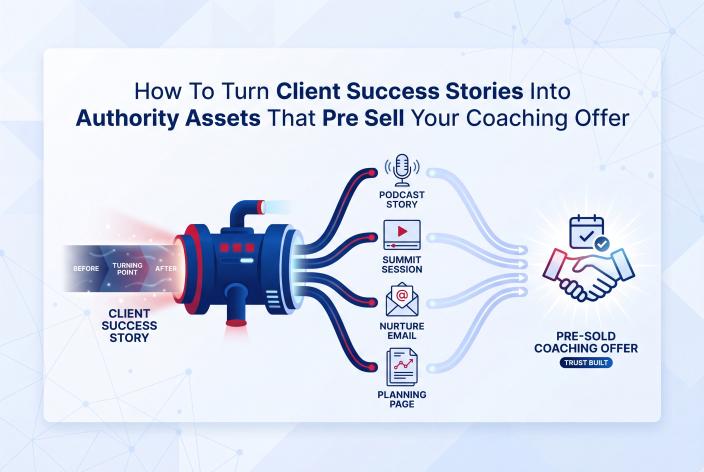
Your client success stories can become authority assets. They can support your talks, podcast interviews, summit sessions, webinar teaching, nurture emails, planning call pages, and sales conversations.
And when you use them well, prospects arrive with more trust before the call even begins.
Let's walk through how to do that.
Why Client Stories Build Authority Faster Than Claims
Your prospects are not only asking, "Can this coach help me?"
They are also asking quieter questions:
- "Will this work for someone like me?"
- "Will I feel pushed or understood?"
- "Is this process practical for my situation?"
- "Can I trust this person with something important?"
- "Do they understand the real reason I've been stuck?"
A well-chosen client story answers those questions without you needing to argue.
It shows the prospect what the work looks like in real life.
It makes your framework visible.
It gives emotional shape to the transformation.
And it helps people understand the value of your coaching before they are sitting across from you on a planning call.
That is the difference between a testimonial sitting on a page and an authority asset working inside your growth system.
Choose Stories That Match Your Ideal Client's Doubts
The best story is rarely the biggest result.
It is the story your ideal client can see themselves inside.
If you coach executives who are exhausted and over-functioning, a story about someone becoming calmer, clearer, and more decisive may be stronger than a generic revenue win.
If you coach health clients who feel ashamed because they have tried everything, a story about rebuilding trust with their body may land deeper than a dramatic before-and-after photo.
If you coach business owners who can sell but do not get enough qualified conversations, a story about building a clearer path from visibility to trust to follow-up may feel immediately relevant.
So before you choose a story, ask:
- What doubt does my ideal client have before they trust me?
- What desire are they already carrying but not saying out loud?
- What situation makes them think, "That's me"?
- What part of my process helped create the shift?
- What can I share ethically, accurately, and with permission?
Here's a tip.
Create a simple "proof bank" with 5 to 10 client stories organized by the doubt they answer.
For example:
| Prospect Doubt | Story Type To Use |
|---|---|
| "I've tried before and failed" | A story about a client who needed a different sequence, support, or lens |
| "My situation is too complicated" | A story that shows your framework handling complexity step by step |
| "I don't want to be pushed" | A story showing how your process created safety and clarity |
| "I'm not sure this is worth the investment" | A story showing the cost of staying stuck and the value of getting supported |
| "I'm not ready yet" | A story about a client who started with one practical next step |
This gives you proof you can use intentionally, not randomly.
Use The Before Turning Point And After Structure
A strong case study does not need to be long.
It needs to be clear.
The simplest structure is:
- Before
- Turning Point
- After
Let's look at each piece.
The Before Shows The Real Problem
The before is where your prospect recognizes themselves.
Do not make this section melodramatic. Keep it honest and specific.
You might describe:
- What the client was trying
- Where they were stuck
- What they misunderstood
- What felt frustrating or heavy
- What they wanted but could not seem to create
For a coaching business, that might sound like:
"Before we worked together, she was getting referrals here and there, but her calendar would go quiet for weeks at a time. She had strong client results, yet her content was not leading to enough qualified calls. Follow-up lived in her inbox, her notes, and her memory. So good people were slipping away simply because there was no clear path behind the visibility."
Notice what this does.
It does not shame the client. It clarifies the situation.
That is what your story should do.
The Turning Point Shows Your Framework At Work
This is where many coaches get vague.
They say, "Then we worked together and everything changed."
That does not teach enough.
The turning point should show how your process created movement.
What did you help them see?
What did you help them decide?
What did you help them practice, build, simplify, or implement?
For example:
"The first shift was realizing she did not need more random visibility. She needed a clearer client attraction path. We tightened the offer message, mapped the prospect journey from first touch to planning call, and built follow-up around the questions her best prospects were already asking."
Now the reader sees your thinking.
You are not just claiming a win. You are demonstrating the way you guide people.
That builds authority.
The After Shows The Meaningful Change
The after should be accurate, grounded, and relevant.
If you have permission to share specific results, use them carefully and in context.
If you do not have permission or the result is private, focus on the nature of the shift:
- More clarity
- Better conversations
- More confidence in the process
- Stronger follow-up
- A cleaner offer message
- Less manual scrambling
- A more mature business backend
You can say:
"After the work, she had a clearer message, a more organized follow-up path, and a better way to guide interested prospects toward a real conversation. The biggest difference was emotional too. She no longer felt like every lead depended on her remembering the right person at the right time."
That is useful.
It gives the reader a picture of the outcome without making exaggerated promises.
Highlight Your Framework Without Overclaiming
Your client stories should make your method easier to understand.
But they should not turn one person's result into a promise for everyone.
That line matters.
A good authority story says:
- "Here is the problem we diagnosed."
- "Here is the sequence we followed."
- "Here is what changed for this client."
- "Here is why the lesson matters."
A weak story says:
- "This proves my process works for everyone."
- "You can get the same result if you sign up."
- "My framework guarantees this outcome."
Stay grounded.
Your authority grows when prospects trust your judgment. Exaggeration may create attention for a moment, but it usually makes serious buyers lean back.
So use language like:
- "For this client, the first shift was..."
- "In her situation, we focused on..."
- "The lesson here is..."
- "This is a useful example of why sequence matters."
- "Your situation may require a different path, but the principle still applies."
That kind of wording feels honest.
And honest authority is powerful.
Turn One Story Into Multiple Authority Assets
You do not need a brand-new story for every platform.
You need a few strong stories used in the right places.
One client success story can become:
- A 2-minute teaching example inside a signature talk
- A podcast story that explains your philosophy
- A summit session example that makes your framework concrete
- A nurture email that answers a common objection
- A planning call page section that helps prospects feel understood
- A sales call reference when a prospect shares a similar concern
The key is to adapt the story to the stage of trust.
Use Stories In Signature Talks
Your signature talk should help the audience understand the problem differently.
A client story can make that shift real.
For example, if your talk is about moving from inconsistent referrals to a predictable client attraction system, tell a story about a client who had visibility but no follow-up path.
Use the story after you teach the principle.
Teach the lesson first. Then show it in action.
A simple flow looks like this:
- Name the problem.
- Teach the principle.
- Share the client story.
- Pull out the lesson.
- Connect it to the next step.
That keeps the story useful, not self-promotional.
Use Stories In Podcast Interviews
Podcast interviews are ideal for story-based authority.
Why?
Because listeners are not only evaluating your information. They are listening for how you think.
When the host asks about your work, do not only describe your process in abstract terms.
Bring it to life.
You might say:
"A lot of my clients come in thinking they need more visibility. One client already had a network and strong referrals, but the leads came in bursts. When we looked closer, the real gap was the path after someone showed interest. There was no consistent nurture, no clear booking path, and no system for following up while trust was warm. Once we mapped that journey, everything became easier to manage."
That kind of story positions you as a diagnostic thinker.
And serious prospects are looking for that.
Use Stories In Summit Sessions And Webinars
Summits and webinars give you a bigger authority stage.
They also require more structure.
The story should support the promise of the session, not wander away from it.
If your session teaches a 3-step framework, use one story to show the whole framework or 3 shorter examples to show each step.
And if you are running your own event, the operational side matters too.
This is where a connected event and follow-up system becomes useful. EventRaptor helps coaches manage the event side, such as registration, event pages, speakers, reminders, attendee data, and promoter tracking. GHL/CRMRaptor can support the CRM, calendar, funnel, workflow, and follow-up side around that event. Together, the story you tell on stage can become part of a bigger path from attention to registration to nurture to qualified conversation.
That is how an event becomes an authority asset instead of a one-time appearance.
Use Stories In Nurture Emails
Nurture emails are one of the best places to use client stories because the reader has already raised their hand.
They are not cold.
They are considering.
A story-based email can follow this simple format:
- Start with a problem your prospect recognizes.
- Share a short client situation.
- Explain the turning point.
- Pull out the lesson.
- Invite the reader to take a small next step.
For example:
"One client came to us with plenty of useful content, but very few calls from that content. The issue was not her expertise. The issue was that the content had nowhere to send people next. Once we connected her visibility to a clearer follow-up path, prospects had a more natural way to keep moving."
Then teach the lesson:
"Content works better when it is connected to a journey. Give interested people a next step while trust is warm."
That is helpful and persuasive.
Use Stories On Planning Call Pages
A planning call page should make the right person feel safe enough to take the next step.
Client stories can help by showing the kinds of problems you help diagnose.
You do not need a giant case study section.
A few short story blocks can work well:
- "If referrals come in bursts..."
- "If your audience likes your content but does not book..."
- "If your summit or webinar created attention but not enough follow-up..."
- "If your CRM and funnel tools feel disconnected..."
Each block can include a short story or scenario showing how the planning process helps clarify the next move.
Keep the promise modest and believable.
The call is a planning conversation. It is not a magic fix.
Get Permission And Protect The Relationship
This should go without saying, but say it anyway.
Do not use private client details casually.
Before turning a client win into public content, decide what level of permission you have:
- Named story with full permission
- First name only
- Anonymous story
- Blended pattern with no identifying details
- Internal sales conversation only
If the result includes sensitive health, money, relationship, career, or business information, slow down.
Your authority should never come at the cost of your client's dignity.
When in doubt, ask.
You can also send the client a simple note:
"I'd love to share a short version of your story because I think it could help other people who are in a similar situation. I can keep it anonymous and remove any details you do not want shared. Would you be comfortable reviewing it first?"
That protects trust.
And trust is the whole point.
Build A Small Story Library
You do not need 50 stories.
Start with 5.
Choose one story for each of these moments:
- A client who came in confused and found clarity
- A client who had tried other things before
- A client who resisted the next step but benefited from taking it
- A client who needed your framework, not just more effort
- A client whose result shows the deeper emotional payoff of your work
For each story, write:
- The client's starting situation
- The doubt or desire it represents
- The turning point in your work together
- The after state
- The lesson for future prospects
- Where you can use it
Now your proof becomes easier to reach for.
You are not trying to remember stories in the middle of a podcast interview, webinar, or sales page draft.
You have authority assets ready.
The Real Goal Is Trust Before The Call
Client success stories should not do all the selling for you.
They should help the right person arrive more prepared.
Prepared to understand your approach.
Prepared to talk honestly about their situation.
Prepared to see why your process might fit.
That is what pre-selling really means in a coaching business. It is not pressure. It is trust built before the conversation.
When your stories are chosen well, structured clearly, and connected to your broader client attraction path, they stop being scattered proof.
They become part of the system.
They help your market know, trust, and remember you.
And when those stories are placed inside talks, events, emails, pages, and follow-up, your authority becomes much easier for prospects to feel.
Your Next Step
Look at your current marketing and ask one simple question:
"Where are my best client stories currently doing useful work?"
If the answer is "mostly on sales calls" or "buried somewhere on my website," there is room to strengthen your authority path.
Start by choosing 3 client stories this week. Write each one using the before, turning point, and after structure. Then place one into a talk, one into an email, and one onto a page where prospects are deciding whether to take the next step.
And if you want help applying this to your coaching business, Book your Client Attraction Planning Call.
On the call, we will look at where your current client attraction path is getting stuck, how your proof could build more trust before the sales conversation, and whether your next step should involve stronger positioning, an authority-building event, funnel improvements, CRM follow-up, or done-for-you implementation support.