Most coaches follow up like every prospect is either ready now or gone forever.
That is where a lot of future clients quietly disappear.
They registered for your summit. They watched part of your workshop. They heard you on a podcast. They downloaded the giveaway. They were interested enough to raise their hand, but not ready enough to book a call that week.
So what happens next?
For many coaches, the answer is a few reminder emails, one offer email, maybe a replay link, then silence.
And that is a shame, because some of your best future clients need more time. They need context. They need to see how you think. They need proof that you understand their problem. They need to trust your voice before they trust your offer.
A premium prospect journey gives them that path.
Why Not Ready Yet Prospects Still Matter
A prospect who does not book immediately is not automatically cold.
They may be busy. They may be comparing options. They may need to talk to a spouse or business partner. They may be aware of the problem but unclear about the cost of leaving it unsolved.
Or they may simply need more trust.
This is especially true in coaching, consulting, and expert-led services. You are not selling a cheap download or a simple commodity. You are asking someone to believe that you can help them make a meaningful change.
That takes more than one registration page.
Here is the important shift.
Your follow-up should not only catch the few people who are already ready. It should also help the right people become ready over time.
That means your nurture path has to respect timing while still leading somewhere.
A good prospect journey does 5 things:
- Reminds them why they raised their hand.
- Teaches them how to think about their problem more clearly.
- Builds trust in your point of view.
- Shows proof, stories, or examples without overdoing it.
- Invites them into the next step consistently.
Notice what is missing?
Pressure.
You do not need to turn every email into a hard pitch. But you do need to keep a clear path open for the people who are ready to talk.
What A Premium Prospect Journey Looks Like
A premium journey feels calm, useful, and intentional.
It does not feel like a random newsletter. It does not feel like a launch sequence that forgot the human being on the other side.
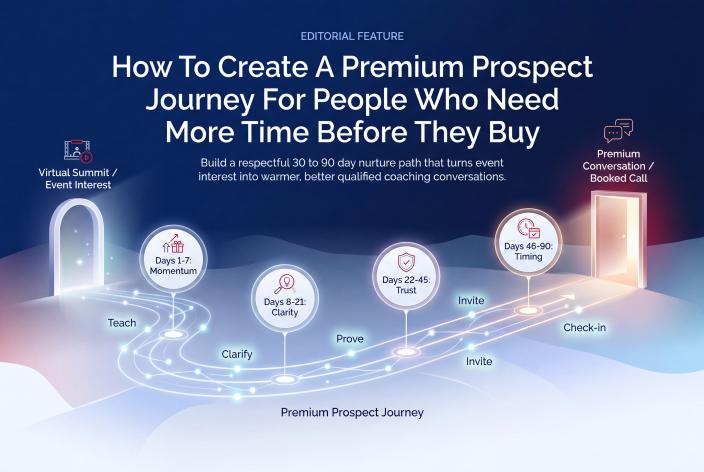
Think of it as a guided conversation across 30 to 90 days.
The person came in through a trust-building moment, such as:
- A virtual summit
- A workshop
- A webinar
- A podcast appearance
- A giveaway
- A speaker-led campaign
- A referral partner introduction
Your job is to continue the thread.
If they attended a summit about building a calmer business, your follow-up should not suddenly jump into generic productivity tips. If they opted in for a guide on client attraction, your follow-up should deepen the same conversation around visibility, trust, follow-up, and booked calls.
Here is a simple way to think about it:
| Timeframe | Prospect State | Your Job | Best Content Type |
|---|---|---|---|
| Days 1 To 7 | Interested And Warm | Reinforce The Event Or Opt-In | Recap, Replay, Best Lessons, Quick Win |
| Days 8 To 21 | Thinking And Comparing | Build Trust And Clarity | Teaching Emails, Frameworks, Mistake Corrections |
| Days 22 To 45 | Evaluating Fit | Show Relevance | Stories, Proof, Objection Handling, Invitations |
| Days 46 To 90 | Not Ready Yet But Still Engaged | Stay Useful And Present | Check-Ins, Fresh Teaching, Soft CTA, Segmented Offers |
That is the rhythm.
Teach. Clarify. Prove. Invite. Check in.
Then keep doing it without sounding desperate.
What To Send After A Summit Or Workshop
After a summit or workshop, your prospect has context. They saw your topic, your positioning, your guests, your teaching style, or your ability to create a useful experience.
Do not waste that momentum.
A strong post-event sequence can include:
A Warm Recap Email
Send this soon after the event or session.
Keep it simple. Thank them for joining, remind them of the main theme, and point them to the most useful next action.
For example:
"If your biggest takeaway was that client flow gets inconsistent when visibility and follow-up are disconnected, start by looking at where prospects currently fall out of your process."
Then include the replay or resource link if you have one.
A Best Lessons Email
Pull out 3 to 5 ideas from the event.
Not fluffy takeaways. Useful ones.
You might frame it like:
- The question every coach should ask before building another funnel
- Why event registrations need a follow-up path
- How to tell whether your prospect needs proof, clarity, or timing
- What changes when your CRM remembers the context of the relationship
This helps people who missed the event still receive value. It also helps attendees organize what they learned.
A Personal Point Of View Email
This is where you connect the event topic to your own belief system.
For VirtualSummits.com and EventRaptor, the point of view is clear: authority-building activity should connect to capture, nurture, follow-up, and qualified conversations.
EventRaptor supports this by helping coaches manage event registration, pages, speakers, reminders, partner tracking, attendee data, CRM updates, follow-up, and reporting in a more organized system. That matters because an event should create a path from visibility to trust to conversation, not just a busy week on the calendar.
You do not need to list every feature. You just need to show the reader what the better system makes possible.
A Clear Invitation
By the third or fourth email, give them a direct next step.
For this audience, that CTA should be consistent:
Book your Client Attraction Planning Call
You can make the invitation calm and useful:
"If this brought up questions about where your own client flow is getting stuck, book your Client Attraction Planning Call. We will look at your current visibility, follow-up, offer path, and what kind of client attraction system could make sense next."
That is enough.
You are not begging. You are opening the door.
What To Send After A Podcast Appearance Or Giveaway Opt-In
Podcast listeners and giveaway subscribers often enter with less context than summit attendees.
They may know one idea. They may not know your full framework yet. They may not even remember your name after the initial moment of interest.
So the first job is orientation.
Start With The Promise They Responded To
If they came from a podcast conversation about client attraction, do not start with a broad welcome sequence about your life story.
Start with the pain they recognized.
"If you are good at helping clients but your calendar still depends on referrals, networking, and bursts of content, the issue is usually the path between visibility and conversation."
That sentence meets them where they are.
Give Them A Useful Diagnostic
People love clarity when they are overwhelmed.
Give them a simple way to see what is broken.
For example, ask them to look at 5 points:
- Where do right-fit prospects first notice you?
- What do they receive after that first touch?
- How are they tagged or tracked in your CRM?
- What proof or teaching do they receive before the call?
- What happens if they are interested but not ready yet?
This turns your email into a mirror.
And when a prospect sees the gap for themselves, the sales conversation becomes more grounded.
Send One Strong Teaching Email Per Week
For 30 to 90 days, you do not need to email every day.
You need a steady rhythm that keeps the relationship warm.
Good topics include:
- Why referrals feel good but do not create a predictable pipeline by themselves
- How authority builds before a prospect ever books a call
- Why a summit can become a pipeline asset when the follow-up is planned
- How automation can make follow-up more human by making it timely and consistent
- Why a CRM is where your strategy becomes trackable
- How to know whether a prospect needs proof, clarity, timing, or a better invitation
Each email should leave them with one useful thought.
Not 12 ideas. One.
How To Use Proof Without Sounding Pushy
Proof is powerful when it helps the prospect believe the next step is responsible.
But proof does not always mean a flashy testimonial.
You can use several types of proof:
- Client stories, when you have permission and specifics
- Personal stories from your own business
- Before and after observations from your process
- Screenshots or examples, when approved
- Event examples, if you can support the details
- Framework proof, where you show the logic behind your approach
If you do not have a sourced client result, do not invent one.
Use teaching proof instead.
For example, you can show how a disconnected event creates dropped context:
A person registers for a workshop. They attend live. They ask a strong question. They click the follow-up link. But the coach has no clear CRM tag, no note about the interest area, and no sequence tied to that behavior.
By the time someone remembers to follow up, the context has gone cold.
Now compare that with a connected journey.
The event registration is captured. The attendee is tagged. Their interest area is known. The follow-up speaks to the topic they cared about. The invitation stays consistent. The coach can see who raised their hand and what happened next.
That is proof through process.
And for thoughtful buyers, process matters.
How To Build A 30 To 90 Day Nurture Path
Here is a practical structure you can adapt.
Days 1 To 7 Focus On Momentum
Send:
- A thank-you or welcome email
- The replay, resource, or promised gift
- A short recap of the most useful idea
- One invitation to take the next step
CTA tone:
"If you already know you want help applying this, book your Client Attraction Planning Call."
Days 8 To 21 Focus On Clarity
Send:
- A diagnostic email
- A teaching email that reframes the problem
- A common mistake email
- A short invitation to reply with their biggest stuck point
CTA tone:
"If you are trying to figure out whether your gap is visibility, follow-up, funnel, CRM, event strategy, or offer clarity, book your Client Attraction Planning Call."
Days 22 To 45 Focus On Trust
Send:
- A story or process breakdown
- A proof-based email, if you have approved proof
- An objection-handling email
- A behind-the-scenes look at how the system works
CTA tone:
"If you want a second set of eyes on your current client attraction path, book your Client Attraction Planning Call."
Days 46 To 90 Focus On Timing
Send:
- A check-in email
- A useful new teaching point
- A segmenting question
- A reminder of the planning call
CTA tone:
"If this is becoming a priority for you now, book your Client Attraction Planning Call."
See how the CTA stays the same, but the reason changes based on where the prospect is in the journey?
That is how you stay consistent without sounding repetitive.
Why Connected Event Data And CRM Follow-Up Matter
This is where many coaches lose leverage.
They create visibility, but the context disappears.
Someone came from a specific summit session, clicked a specific topic, registered through a specific partner, or showed interest in a specific next step. Then all of that gets flattened into one generic email list.
That makes follow-up weaker than it needs to be.
EventRaptor is built to help keep the event side organized, including registration management, attendee data, speaker and session workflows, promoter tracking, event pages, reminders, and follow-up communications. It can also connect event activity to CRM and marketing systems through GoHighLevel contact sync, registrant and speaker sync, tag management, automated tagging, Zapier, and webhooks.
GHL/CRMRaptor supports the CRM, funnel, calendar, workflow, automation, and follow-up side.
Together, the practical benefit is simple.
Your event activity and your follow-up system can share context.
That means your follow-up can speak more directly to what the person actually did, instead of treating everyone like a blank contact record.
And that is what makes automation feel more human.
Not because it pretends to be personal. Because it helps you respond with better timing, better relevance, and fewer dropped threads.
The Premium Feeling Comes From Relevance
Premium does not mean fancy design alone.
Premium means the prospect feels understood.
They receive the thing they asked for. The follow-up makes sense. The teaching respects their intelligence. The proof is honest. The invitation is clear. The next step does not feel like it came out of nowhere.
That is what builds trust before the sales call.
If you are a coach with a valuable offer, this matters because your best prospects may need time to connect the dots.
Give them that time. But do not leave them alone with vague newsletters and forgotten replays.
Build the journey.
Teach them how to see the problem. Show them what a better system looks like. Keep the invitation open.
And when they are ready, make the next step easy to find.
If you want help applying this to your own coaching business, Book your Client Attraction Planning Call. We will look at where your current prospect journey is getting stuck and what kind of authority, funnel, CRM, follow-up, or event strategy could make sense next.