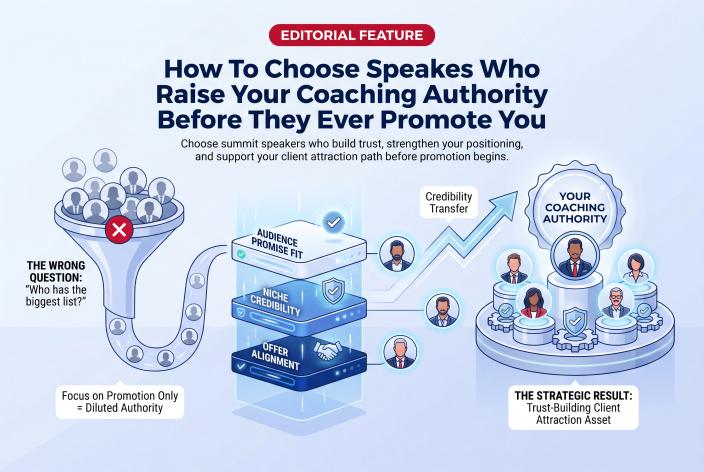
If you're planning a virtual summit, it's easy to start with the wrong question.
"Who has the biggest list?"
That sounds practical. You want registrations. You want reach. You want people to share the event.
But here's the thing...
Before a speaker ever sends one email, their name, topic, reputation, and audience fit are already shaping how people see you.
Your speaker lineup tells the market what kind of host you are.
It tells attendees whether the event feels thoughtful or thrown together. It tells prospects whether you understand their real problem. And it tells potential clients whether you're simply gathering names or leading a useful conversation in your niche.
So yes, promotion matters.
But speaker selection is also authority selection.
Choose well, and your summit can make you look more credible before the first session goes live. Choose casually, and even a decent event can feel scattered, diluted, or misaligned with the coaching business you're trying to grow.
Let's look at how to choose speakers who strengthen your authority, support your offer, and help your summit become a real client attraction asset.
Your Speakers Create Credibility Transfer
People judge events quickly.
They look at the title. They scan the promise. Then they look at the speakers.
And whether they realize it or not, they ask questions like:
- "Do these people seem credible?"
- "Is this event actually for someone like me?"
- "Does the host know the right people?"
- "Will this be useful, or is it another generic online event?"
That is credibility transfer.
When respected, relevant speakers appear on your summit, some of their trust transfers to the event. And because you're the host, some of that trust transfers to you.
This is one reason virtual summits can be so powerful for coaches. A well-run event shows that you can bring people together, organize useful conversations, and create value for a specific audience. EventRaptor's own positioning frames events as authority-building assets that help hosts become more visible, trusted, and memorable through event pages, speaker profiles, public directories, scheduling, and speaker workflows.
But credibility transfer only works when the lineup makes sense.
A random collection of impressive people can still feel confusing.
A smaller group of carefully chosen experts can make the summit feel curated, intentional, and valuable.
That matters because your future client is not only evaluating the speakers. They're evaluating your judgment.
Promotional Reach Is Only One Kind Of Speaker Value
Speaker selection usually gets reduced to list size.
"How many people can they promote to?"
That's a fair question. A summit needs visibility. Partner promotion can be a strong growth channel, especially when you can track who promoted, who registered, and which partners created momentum.
EventRaptor supports this kind of partner visibility through promoter links, attribution, performance reporting, leaderboards, and exports. That can help you see what actually happened instead of guessing after the event.
But list size is only one layer.
A good speaker can bring value in at least 3 ways:
- Promotional reach
- Niche credibility
- Relationship value
Let's make those practical.
Promotional Reach
This is the obvious one.
Can the speaker help get the event in front of more people?
That might come through an email list, social audience, podcast, community, YouTube channel, referral network, or private client base.
Reach matters most when the speaker's audience overlaps with your summit audience. A large audience filled with the wrong people can create noisy registrations, weak engagement, and sales calls that go nowhere.
So don't only ask, "How big is their audience?"
Ask, "How closely does their audience match the person my coaching offer is built to serve?"
That question will save you a lot of pain.
Niche Credibility
Some speakers raise the perceived quality of your event even if they don't have the biggest list.
They may be known for a specific method, body of work, book, podcast, credential, client niche, or strong point of view.
When they join your lineup, attendees feel like the event is worth paying attention to.
This can be especially useful if you're still building authority in your niche. You may already be excellent at your work, but the market may not yet see you as the obvious guide. Smart speaker selection helps you borrow and build authority through association.
By the way, this doesn't mean chasing famous names.
Often, the better choice is a highly relevant expert your audience already respects, or should respect, because their topic fits the transformation your summit promises.
Relationship Value
Some speakers become long-term allies.
They may introduce you to other experts. They may invite you to their audience later. They may become referral partners, podcast guests, collaborators, or contributors to future events.
This is where summits become more than a list-building campaign.
The strongest events create relationships. They open doors. They give you a reason to talk with people you might otherwise never reach.
That relationship value can continue long after the summit is over, especially when speaker data, presentation status, CRM tags, and follow-up are connected to a broader relationship system.
The Best Speaker Is Not Always The Biggest Name
Here's a common trap.
A coach sees a well-known expert and thinks, "If I can get them on the summit, the event will instantly look better."
Sometimes that's true.
Other times, the name is too broad, too unrelated, too unavailable, or too disconnected from the promise of the event.
The speaker may look impressive on paper, but if their topic doesn't help the attendee move toward the summit's core promise, the event starts to feel like a playlist instead of a path.
A strong summit has a clear throughline.
Every session should help the attendee understand one part of the problem, one useful shift, or one step toward the outcome your audience wants.
That doesn't mean every speaker says the same thing. Please don't build that kind of event.
It means each session belongs.
When your attendees scan the schedule, they should feel, "Yes, this was designed for me."
That feeling builds trust in the host.
Choose Speakers Who Support Your Offer Without Competing With It
This part matters if your summit is connected to a coaching offer.
You want speakers who make the event more useful. You want experts who round out the conversation. You want perspectives that help your audience see the full problem more clearly.
But you also need to protect the next step.
If your core coaching offer helps executive leaders communicate with confidence, inviting 8 other executive communication coaches with similar offers may create confusion. Attendees may enjoy the event and then leave wondering which coach to choose.
That's not the cleanest path.
A better lineup might include:
- A leadership expert who talks about decision fatigue
- A voice coach who covers presence in high-stakes conversations
- A workplace culture consultant who explains team trust
- A negotiation specialist who addresses difficult conversations
- You, as the host, connecting those ideas into your coaching framework
See the difference?
The speakers expand the conversation around your audience's problem. They don't crowd the same buying decision.
The goal is alignment.
You want the summit to make your offer feel like the logical next step for the right attendee, not one option buried among a dozen similar options.
Use Speaker Criteria Before You Send Invitations
Speaker recruitment gets messy when you start with names.
Start with criteria.
A clear filter helps you say yes and no with confidence. It also helps your event feel intentional instead of patched together.
Here are the criteria I would use before inviting anyone.
Audience Promise Fit
Your summit should have a clear promise for a specific audience.
For example:
- "Help health coaches attract better-fit clients without relying only on referrals"
- "Help midlife women rebuild energy and confidence after burnout"
- "Help small business owners create cleaner sales conversations without aggressive tactics"
Once the promise is clear, ask:
- Does this speaker help the audience move toward that promise?
- Will their session feel relevant to the attendee's real problem?
- Does their presence make the event feel more credible for this audience?
If the answer is fuzzy, keep looking.
Session Fit
A speaker can be a great expert and still be wrong for this event.
You need a session that fits the summit journey.
Good session topics are specific, useful, and connected to the event promise.
Weak session topics tend to be broad, self-promotional, or disconnected from what the attendee came to solve.
A simple test:
Could your ideal prospect read the session title and immediately understand why it matters?
If not, the topic needs tightening.
EventRaptor can help here because it supports speaker applications, presentation review, presentation tagging, invitations, session details, and speaker profiles. That gives you a more organized way to review submissions and prepare sessions without trying to manage everything through email threads and spreadsheets.
Next-Step Relevance
Your summit should continue after the sessions end.
That doesn't mean every moment needs to sell. It means the event should guide the attendee through a useful journey.
A strong speaker lineup prepares your audience to understand why your next step matters.
Ask:
- What belief does this session help shift?
- What problem does it help clarify?
- What decision does it help the attendee make?
- How does it support the path toward a workshop, call, program, or nurture sequence?
This is where the summit connects to the rest of your client attraction system.
EventRaptor's marketing guidance describes the path as visibility to trust to conversation. People register, attend, engage, and then move into the right next step through organized follow-up.
That's the point.
The summit should build enough trust that the right people want to continue the relationship.
Build A Balanced Speaker Lineup
A balanced lineup usually includes different kinds of authority.
You don't need everyone to play the same role.
Here's a simple way to think about it:
| Speaker Type | What They Add | What To Watch For |
|---|---|---|
| Niche Authority | Credibility and depth around the core topic | They may overlap too closely with your offer |
| Adjacent Expert | Useful context around related problems | Their topic can drift if the angle is not clear |
| Practitioner | Practical examples and grounded advice | They need a clear session structure |
| Community Builder | Trust, warmth, and audience connection | Their reach needs to match your audience |
| Strategic Partner | Long-term relationship and promotion potential | The audience fit still needs to be strong |
A strong event might include a mix of these.
That way the summit feels rich without becoming scattered.
The host's job is to connect the dots.
Your opening remarks, session order, emails, attendee dashboard messaging, and follow-up should all remind attendees why these conversations belong together.
Watch For Speaker Red Flags
Some speakers can drain the authority from your event.
That may sound harsh, but it's true.
Here are a few red flags to watch for:
- Their session pitch is mostly a sales pitch
- Their topic doesn't match your audience promise
- Their audience is large but poorly matched
- Their brand tone clashes with yours
- Their offer competes directly with your core coaching offer
- They are hard to communicate with before the event
- They want access to your audience without contributing value
- They have no clear reason to care about the summit's success
You don't need to be suspicious of everyone.
You do need standards.
Your speaker lineup is part of your brand. If the event feels sloppy, random, or overly promotional, attendees attach that feeling to you.
Make The Speaker Experience Professional
The authority lift goes both ways.
Speakers also judge you by the process.
If onboarding is confusing, links are missing, bios are scattered, agreements are unclear, schedules keep changing, and reminders are inconsistent, even good speakers may hesitate to promote or collaborate again.
A professional process gives speakers confidence.
They know where to submit information. They know what is expected. They know when their session is scheduled. They know how to promote. They know the event is being handled with care.
This is one of the practical places where EventRaptor can help.
It supports public speaker profiles, speaker onboarding, bio and image management, applications, invitations, speaker agreements, presentation review, session scheduling, tracks, dashboards, reminder emails, and promoter tracking. It can also connect speaker and attendee information into the broader CRM and follow-up process.
That matters because a summit has a lot of small moving parts.
When those pieces live in one organized system, the event feels calmer for you, clearer for speakers, and more professional for attendees.
Keep Promotion In Perspective
You still want speakers to promote.
Of course you do.
But promotion works best when the event is easy to believe in.
Speakers are more likely to share when:
- The topic is relevant to their audience
- The event page makes them look good
- Their profile is presented professionally
- The promotional copy is clear
- The schedule and expectations are organized
- They trust that attendees will have a good experience
And when they do promote, you want tracking in place.
EventRaptor's promoter and affiliate tools can give speakers unique links, dashboards, performance reports, attribution, and leaderboards. That makes partner promotion easier to manage and easier to understand.
Without that visibility, you're left trying to reconstruct what happened from memory, inboxes, and spreadsheets.
That gets old fast.
Turn Your Speaker Lineup Into A Trust Path
A summit is strongest when the speaker lineup creates a path.
The attendee arrives with a problem.
The speakers help them see the problem more clearly, learn useful ideas, and build trust in the host's point of view.
Then your follow-up continues the conversation.
That might be a planning call, a workshop, a webinar, a coaching application, a nurture sequence, or another useful next step.
The specific path depends on your business.
But the principle stays the same.
Authority gets attention. Follow-up turns attention into opportunity.
So before you invite another speaker, pause and ask:
- Does this person raise the perceived value of the summit?
- Will their session help my ideal prospect move forward?
- Does their audience match the people I want to serve?
- Does their offer complement mine?
- Could this relationship matter beyond the event?
If the answer is yes, you may have a speaker worth inviting.
If the answer is no, a big list may not be enough.
Your Next Step
If you're planning a summit for your coaching business, don't start by collecting names.
Start by mapping the authority path.
Who does your audience need to hear from? What beliefs need to shift? What topics support your offer? What kind of speaker association will make the event feel credible, useful, and aligned?
Then build the process around that strategy.
If you want help applying this to your business, Book your Client Attraction Planning Call.
On the call, we'll look at where your client flow is getting stuck, what kind of authority-building event could make sense, and how your speaker strategy, funnel, CRM, and follow-up can work together to create more qualified conversations.