If your content is getting attention but not enough sales conversations, you may be teaching too randomly.
That can feel frustrating because you're doing the work.
You're posting. You're emailing. You're showing up on podcasts. Maybe you're hosting webinars, workshops, or even thinking about a summit.
And still, the people who should be leaning in are quietly watching from a distance.
So what's missing?
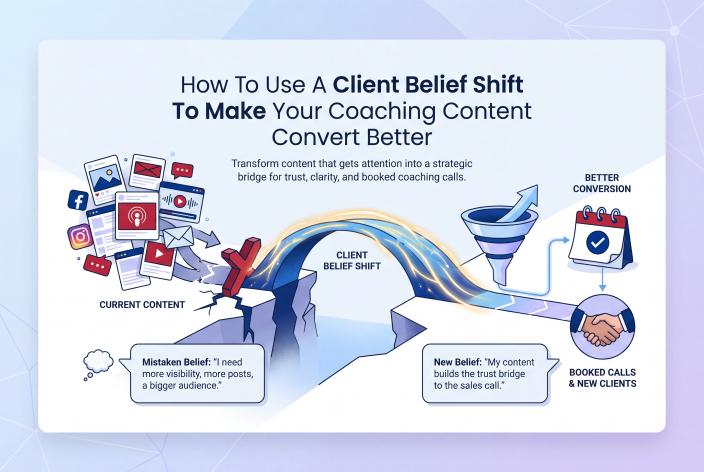
Very often, it's a belief shift.
Before someone books a call, buys a program, joins a workshop, or says yes to your coaching, they usually need to believe something different than they believe right now.
Your content can help them get there.
But only when you know the shift you're trying to create.
What A Client Belief Shift Really Is
A client belief shift is the change in thinking your prospect needs before your offer feels like the logical next step.
It's the bridge between where they are now and where they need to be to take action.
For example, a business coach might need prospects to move toward this belief:
"My inconsistent client flow is a system problem, not a personal failure."
A health coach might need prospects to believe:
"My energy issue is connected to daily patterns I can change, not something I have to tolerate forever."
A leadership coach might need prospects to believe:
"The tension in my team is a leadership communication issue I can learn to handle, not proof that people are impossible."
See the pattern?
The belief shift helps the prospect stop blaming the wrong thing. It gives them a cleaner diagnosis. It helps them see a path forward.
That matters because most people don't book a sales call simply because they learned a tip.
They book when they see themselves differently, understand the real problem more clearly, and trust that you can guide them through it.
Why Belief Shifts Matter Before The Sales Call
If someone arrives on a call with the wrong belief, the call gets heavy fast.
You spend the first half educating. Then you spend the second half trying to undo assumptions. By the time you get to the actual offer, the prospect may be tired, guarded, or unsure why they booked in the first place.
Good content does some of that work earlier.
It helps the right person think:
- "That's exactly what's happening."
- "I hadn't seen it that way before."
- "This explains why what I've tried hasn't worked."
- "I can see why I need help with this."
That's the kind of content that warms up a conversation.
For coaches, this is especially important because your work often requires trust before tactics make sense. A prospect may need to believe in the process, the priority, the timing, and the type of help before your coaching offer feels relevant.
So instead of creating content around whatever topic comes to mind this week, start with the belief your prospect needs to adopt.
Then build the content around that.
How To Identify The Mistaken Belief Your Prospect Has Now
Start with this question:
"What does my right-fit prospect currently believe that keeps them stuck?"
Don't rush this.
The mistaken belief is often reasonable from their point of view. They're not foolish. They're interpreting their situation through the experience they already have.
For example, a proven coach with inconsistent client flow might believe:
- "I need to post more content."
- "I need a bigger audience before a launch will work."
- "Referrals will pick back up if I wait."
- "Automation will make my marketing feel cold."
- "A funnel is just a landing page."
- "A summit is a one-time list-building event."
Those beliefs make sense when the coach has only seen pieces of the system.
But if the real issue is that visibility, capture, nurture, follow-up, and sales conversations aren't connected, more random activity won't give them the calm client flow they want.
Here's a simple way to find the belief shift.
Use The Before And After Belief Exercise
Write 3 short lines:
- "Right now, my prospect believes..."
- "After consuming my content, I want them to believe..."
- "When they believe that, the next logical action is..."
Example:
- "Right now, my prospect believes they need more visibility."
- "After consuming my content, I want them to believe visibility needs a conversion path behind it."
- "When they believe that, the next logical action is to map their authority, funnel, CRM, follow-up, and sales path."
That's useful.
Now you have a content strategy, not just a content topic.
Look For The Hidden Objection
A mistaken belief often shows up as an objection.
Your prospect might say:
- "I don't want to be pushy."
- "My audience isn't big enough."
- "I tried a webinar once and it didn't work."
- "I already have email software."
- "I'm not sure I need a summit."
- "I can follow up manually."
Each one points to a belief underneath.
If they say, "I don't want automation because it feels impersonal," the belief might be:
"Consistent follow-up means losing the human feel of my business."
The shift could be:
"Good follow-up protects relationships by making sure people hear from me at the right time, in the right tone, with the right next step."
Now you can teach that in a way that feels respectful.
You don't have to argue. You help them see.
Turn One Belief Shift Into A Full Content Plan
Once you know the belief shift, you can use it everywhere.
This is where things get easier.
You don't need 50 random ideas. You need one strong belief shift expressed through different angles, stories, examples, and formats.
Let's use this belief shift:
"My client flow is inconsistent because my authority, follow-up, and conversion path are disconnected."
That one shift can become a whole campaign.
Talk Topics
You could speak on:
- Why proven coaches still experience feast-or-famine client flow
- How to build trust before the sales call
- The missing path between visibility and booked conversations
- Why referrals help but shouldn't be your only growth engine
- How authority-building events create warmer conversations
Each talk points to the same belief.
Your audience hears different examples, but the core diagnosis stays steady.
Podcast Angles
A podcast pitch could be:
- "Why good coaches struggle to get consistent clients"
- "How to turn visibility into qualified conversations"
- "The follow-up problem hiding inside most coaching businesses"
- "Why a summit can become a pipeline asset instead of a one-time event"
Notice how these are not just tips.
They help the listener rethink the problem.
Email Ideas
Your email list could get messages like:
- "The Sales Call Shouldn't Do All The Trust Building"
- "What Happens After Someone Watches Your Content"
- "The Quiet Cost Of Manual Follow-Up"
- "Why Your Best Prospects May Need More Nurture Before They Book"
- "The Simple Belief Shift Behind Better Client Conversations"
Each email can teach one layer of the shift.
One email might tell a story. Another might use a framework. Another might answer an objection.
Together, they move the reader.
Event Sessions
If you're planning a summit, workshop series, or speaker-led event, the belief shift becomes even more powerful.
Your sessions should not be a pile of disconnected expert interviews.
They should move the audience through a journey.
A strong event has a purpose behind each session. You decide what the audience needs to understand, feel, and do at that stage. Then you choose the speaker or topic that helps create that movement.
For example, a client attraction event for coaches might include sessions like:
- Why Inconsistent Client Flow Happens To Good Coaches
- How To Become Known For A Clear Problem In Your Niche
- How Partnerships And Stages Help You Borrow Trust
- How A Funnel Guides Attention Toward Conversation
- How CRM And Follow-Up Keep Interest Warm
- How To Turn Event Momentum Into Booked Calls
That's a journey.
And a journey is easier to follow than a content buffet.
This is also why a summit doesn't always need a massive speaker lineup. A focused summit with 10 or 20 well-chosen speakers can tell a clear story when every session has a job.
Use Stories To Make The Shift Feel Natural
People rarely change beliefs because you told them to.
They shift because they recognize themselves in the story.
So show them the moment.
For example:
"Imagine a coach who gets 2 referrals in a good month, then nothing for 6 weeks. She posts more often, books a few networking calls, and tweaks her bio again. But nobody is being guided from attention to trust to a real next step. So every month feels like starting over."
That story makes the diagnosis visible.
Now the teaching lands.
You can say:
"The problem isn't her ability to coach. The issue is that her visibility has no reliable path behind it."
That direct pivot is worth making because it relieves shame.
Your prospect needs to feel, "Oh, this is fixable."
Use Your Own Framework
A simple framework gives the belief shift structure.
For client attraction, you might teach:
- Authority, become known for a clear problem.
- Capture, give interested people a reason to raise their hand.
- Nurture, keep teaching while trust builds.
- Follow-Up, make the next step timely and clear.
- Conversation, invite the right people into a qualified call.
Now your prospect can see the missing piece.
If they've been focused only on visibility, the framework shows why content alone feels slow. If they've been tinkering with tools, it shows why the tools need a strategy. If they've been relying on referrals, it shows why they need a steadier path.
Connect The Belief Shift To Your Offer Without Hard Selling
Once your content creates the shift, your invitation can be simple.
You don't need to over-explain. You don't need pressure. You don't need to turn every lesson into a pitch.
The next step should feel natural because the content has already made the case.
For example:
"If you're realizing your client flow problem may be a missing authority, follow-up, and conversion path, the next step is to map what that system could look like for your business."
That's calm. Specific. Useful.
Then invite them:
Book your Client Attraction Planning Call
On that call, you can look at where the current path is breaking down. Is it positioning? Offer clarity? Authority? Visibility? Funnel? CRM? Follow-up? Sales conversion? Event strategy?
For some coaches, the next move may be a focused webinar or workshop. For others, it may be an authority-building summit. For others, it may be cleaning up the funnel and follow-up system before creating more attention.
This is where EventRaptor and GHL/CRMRaptor can fit naturally.
EventRaptor helps manage the virtual event side, including registration, event pages, speakers, reminders, partner tracking, attendee data, and follow-up paths. GHL/CRMRaptor supports the CRM, funnel, calendar, workflow, automation, and follow-up side.
Together, they help turn authority-building activity into a more organized path from visibility to trust to conversation.
But the strategy comes first.
The belief shift tells you what your content needs to accomplish. The system helps you keep that message moving.
A Simple Belief Shift Planning Worksheet
Use this before you create your next talk, email, podcast pitch, webinar, or summit session.
Fill in the blanks:
- My right-fit prospect currently believes: __________
- This belief keeps them stuck because: __________
- The belief I want them to adopt is: __________
- The emotion they need to feel is: __________
- The action they need to take next is: __________
- One story that can show this is: __________
- One framework that can teach this is: __________
- One invitation that naturally follows is: __________
Here's a tip.
If the belief shift feels too big, make it smaller.
You don't have to transform someone's entire worldview in one post. One email can shift one assumption. One podcast can reframe one problem. One event session can open one door.
That is how trust builds.
The Takeaway For Coaches Who Want Better Content
Content that converts is content with a job.
It helps the right person understand their problem more clearly, trust your way of seeing it, and take a next step that makes sense.
So before you create your next piece of content, ask:
"What does my prospect need to believe before my offer feels relevant?"
Answer that, and your content gets sharper.
Your talks become more focused. Your emails become easier to write. Your summit sessions become more intentional. Your sales calls start with more trust already in the room.
And if you want help applying this to your coaching business, Book your Client Attraction Planning Call.
We'll look at where your client flow is getting stuck and what kind of authority, funnel, CRM, follow-up, or event strategy could make sense next.