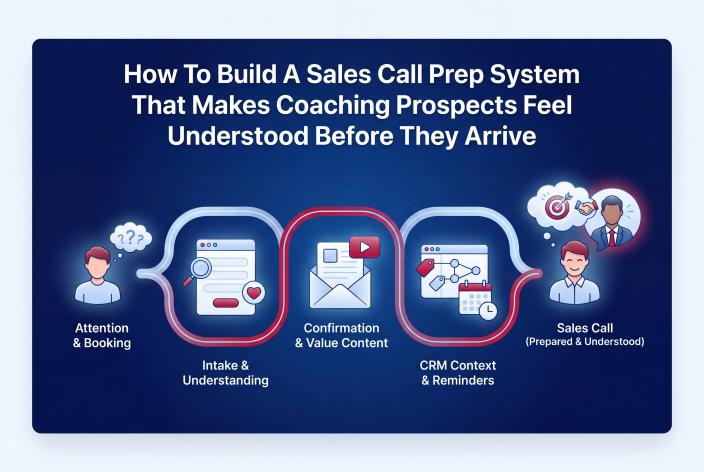
Most coaches think the sales call starts when the prospect shows up on Zoom.
It doesn't.
The call starts the moment someone books.
That small window between booking and showing up can either build trust, create clarity, and help the right person arrive ready to talk... or it can leave them cold, distracted, and unsure why they booked in the first place.
If you're a proven coach, this matters.
You may already be good at having sales conversations. You may know how to listen, diagnose, coach, and invite. But if too many prospects arrive vague, guarded, unprepared, or half-committed, the problem may be happening before the call.
A good sales call prep system helps the prospect feel seen before they arrive.
It also helps you enter the conversation with context, confidence, and a clearer sense of fit.
That's where intake questions, confirmation pages, reminder emails, pre-call content, CRM notes, tags, and segmentation all work together.
Not as random tech chores.
As part of a trust-building path from attention to conversation.
Why Sales Call Prep Matters More Than Most Coaches Realize
When someone books a call with you, they're usually carrying a mixture of hope, doubt, urgency, embarrassment, and curiosity.
They may be thinking:
- "Will this person understand my situation?"
- "Am I going to be pressured?"
- "Is this really for someone like me?"
- "What should I say on the call?"
- "What if I'm not ready?"
If your booking process simply says, "Thanks, see you Tuesday," you leave all of that emotional uncertainty untouched.
And uncertainty creates weak calls.
The prospect shows up without focus. You spend the first 15 minutes trying to understand the basics. They give surface-level answers. You have to work harder to build trust.
A better prep system does a few simple things before the conversation starts:
- It helps the prospect organize their thoughts.
- It shows them you care about their specific situation.
- It gives you useful context before you join the call.
- It reminds them why the call matters.
- It reduces the chance that they disappear because the appointment felt casual.
The takeaway is simple.
The more prepared the prospect feels, the more useful the call becomes.
Ask Pre-Call Questions That Reveal What You Need To Know
Your intake questions should not feel like a tax form.
They should feel like the first moment of being understood.
This is where many coaches go wrong. They ask generic questions like:
- "What are your goals?"
- "What do you need help with?"
- "Tell me about your business."
Those aren't bad questions. They're just too broad on their own.
A stronger intake form helps you understand pain, urgency, fit, readiness, and context before the call begins.
Ask About The Problem They Want Solved
Start with the pain they're aware of.
For example:
- "What's happening in your business right now that made you book this call?"
- "Where does client flow feel most inconsistent or frustrating?"
- "What have you already tried to attract or convert clients?"
- "Where do prospects usually get stuck before becoming clients?"
These questions help the prospect name the real issue.
They also give you language you can use on the call. When you reflect their words back to them, they feel heard because you're not guessing.
Ask About Urgency And Timing
Not every prospect is ready to act now.
That's okay.
But you need to know if the call is exploratory, urgent, or somewhere in between.
Useful questions include:
- "Why is now the right time to look at this?"
- "What happens if this stays the same for the next 3 to 6 months?"
- "Are you looking to solve this soon, or are you gathering information?"
This protects both sides.
You don't need to push someone who is early in the decision process. And you don't want to miss the seriousness of someone who is ready to build properly.
Ask About Fit And Readiness
Fit matters.
A sales call should not become a wrestling match with someone who does not have the offer, audience, willingness, or business maturity needed for the next step.
Depending on your coaching model, you might ask:
- "What type of offer are you currently selling?"
- "Have you sold this offer before?"
- "How do clients currently find you?"
- "Are you willing to become more visible through events, webinars, workshops, interviews, or partnerships?"
- "What kind of support are you looking for right now?"
For EventRaptor's audience, this is especially important because client attraction is rarely one isolated issue. The gap may be positioning, authority, offer clarity, funnel structure, CRM setup, follow-up, virtual event strategy, or implementation.
The intake form should help you see which part of the system needs attention first.
Use Confirmation Pages To Reinforce Trust
The confirmation page is one of the most overlooked parts of the funnel.
Someone has just booked a call. Their attention is high. They are actively thinking about the problem you help solve.
So what should they see next?
A good confirmation page should do more than confirm the date and time.
It should make them feel they made a good decision.
Keep The Message Calm And Clear
Your confirmation page can say something simple like:
"You're booked. Before the call, take a few minutes to think through what you want to change, what's been getting in the way, and what kind of support would make the biggest difference right now."
That kind of message does 2 things.
It reassures them.
And it gently raises the quality of the conversation.
Give Them One Helpful Next Step
Don't overwhelm them with 9 videos, a 40-page PDF, and 6 testimonials.
A sales call prep page should be useful, not exhausting.
You might include:
- A short welcome video.
- A brief explanation of what will happen on the call.
- A simple worksheet or reflection prompt.
- One piece of pre-call content that helps them understand your approach.
- A reminder to add the call to their calendar.
The goal is to help them arrive more focused.
If you're using virtual summits, webinars, workshops, or other authority-building events as part of your client attraction strategy, this confirmation step becomes even more important. People may have entered through an event, a replay, a partner invitation, or a follow-up sequence. Your confirmation page helps connect that attention to the next conversation.
Send Pre-Call Content That Builds Trust Without Overloading Them
Pre-call content should answer the questions that often create hesitation.
Not every question needs to be answered live.
If prospects often ask, "How does this work?" or "Is this right for someone at my stage?" or "What should I expect?" then answer some of that before the call.
Choose Content Based On The Prospect's Situation
This is where segmentation becomes useful.
A prospect coming from a summit session may need different pre-call content than someone coming from a referral.
A coach with an existing offer may need a different message than someone still clarifying their market position.
You can segment by:
- Lead source.
- Offer interest.
- Business stage.
- Main pain point.
- Urgency level.
- Event attended.
- Topic clicked or watched.
Then you can send content that feels relevant.
For example:
- A prospect worried about inconsistent referrals might receive a short article on building a client attraction system.
- A prospect coming from a virtual summit might receive content on turning event momentum into follow-up.
- A prospect with scattered tools might receive a simple explanation of how CRM, funnels, and reminders work together.
This does not need to be complicated.
But it should feel intentional.
Use Content To Prepare The Conversation
Good pre-call content should help the prospect understand your frame.
For example, if you believe client flow depends on authority, capture, nurture, follow-up, and conversion, then your pre-call content should introduce that idea.
That way, when you talk on the call, you're not starting from zero.
They already understand that the issue may not be solved by posting more content or buying another tool. They can see that the real work is building a path from visibility to trust to qualified conversation.
That makes the call more strategic.
And it makes the prospect feel like you have a real way of thinking, not just a script.
Use CRM Tags And Notes So You Enter The Call With Context
Here's a tip.
Never rely on memory for a sales call.
If someone fills out an intake form, registers for an event, clicks a follow-up email, books a call, and watches pre-call content, that information should not be floating around in separate places.
It should be organized in your CRM.
This is where GHL/CRMRaptor can support the CRM, calendar, workflow, automation, and follow-up side of the system. EventRaptor manages the virtual event side, including registrations, speakers, event pages, reminders, attendee data, and follow-up paths. Together, they help connect event activity to the relationship and sales process.
What To Track Before The Call
You don't need to track everything.
Track the details that help you serve the conversation.
For example:
- Lead source.
- Event or webinar attended.
- Main problem selected.
- Offer interest.
- Intake form answers.
- Urgency level.
- Current business stage.
- Notes from prior interactions.
- Confirmation page actions.
- Reminder engagement.
The point is not to become creepy.
The point is to be prepared.
When you open the CRM record before the call, you should be able to answer:
- Why did this person book?
- What do they want help with?
- What do they already understand?
- What might they be worried about?
- What next step might make sense if there is fit?
That changes the feel of the call.
You are no longer interviewing a stranger from scratch. You're continuing a conversation that has already started.
Create Reminder Messages That Improve Show-Up Quality
Reminder messages are often treated like administrative pings.
"Your call is tomorrow. Here's the Zoom link."
That's useful.
But it can do more.
A strong reminder sequence keeps the appointment real, reinforces the value of showing up, and helps the prospect arrive mentally prepared.
Send Reminders With A Human Tone
Your reminders should sound like you.
Not robotic. Not pushy. Not packed with fake urgency.
A simple reminder might say:
"Just a quick reminder that we're scheduled to talk tomorrow. Before we meet, think about where client flow is getting stuck right now, what you've already tried, and what you'd like to be different over the next few months. That will help us make the conversation more useful."
Notice what that does.
It reminds them.
It prepares them.
It positions the call as useful.
Use More Than One Channel When It Makes Sense
Some businesses use email only. Others use email plus SMS reminders.
The right choice depends on your audience, permissions, and communication style.
The principle is consistency.
Good automation protects the relationship because it makes follow-up timely. It means the prospect gets the right information at the right moment, without you manually remembering every touchpoint.
A simple reminder flow might include:
- Immediate confirmation after booking.
- A reminder 24 hours before the call.
- A short reminder a few hours before the call.
- A post no-show follow-up if they miss it.
- A post-call follow-up based on the outcome.
This keeps the relationship moving.
And it reduces the number of people who book casually and vanish.
Build A Simple Sales Call Prep Workflow
You don't need a monster funnel.
You need a clean path.
Here is a practical version you can build from.
| Step | Purpose | What To Include |
|---|---|---|
| Booking Form | Capture context | Pain, urgency, offer, readiness, source |
| Confirmation Page | Reinforce trust | What to expect, one helpful next step, calendar reminder |
| CRM Record | Prepare the coach | Tags, notes, source, intake answers, event history |
| Pre-Call Email | Build readiness | Short content, reflection prompt, expectations |
| Reminder Messages | Improve show-up quality | Date, time, link, reason to prepare |
| Call Notes | Support follow-up | Key pain, fit, next step, objections, timing |
| Post-Call Follow-Up | Keep momentum | Recap, resources, proposal, nurture path, or no-fit message |
This is funnel architecture in the practical sense.
A funnel is the full journey from attention to trust to conversation. The booking page is just one piece.
Connect Sales Call Prep To Your Larger Client Attraction System
This matters even more when you're using events to build authority.
A summit, webinar, workshop, giveaway, or speaker-led campaign can create attention. But the value grows when that attention is captured, organized, nurtured, and followed up with properly.
EventRaptor helps with the event management side, including registrations, event pages, speaker workflows, reminders, attendee data, partner tracking, and follow-up paths. GHL/CRMRaptor supports the CRM and follow-up infrastructure, including contact records, tags, calendars, funnels, workflows, and automation.
That connection matters because your prospect's story does not begin on the sales call.
They may have:
- Registered for your summit.
- Watched a session.
- Clicked a follow-up email.
- Joined a webinar.
- Downloaded a resource.
- Been referred by a partner.
- Booked after weeks of quiet consideration.
When your systems are connected, you can see more of that story.
And when you can see more of the story, you can lead a better conversation.
What This Looks Like In A Coaching Business
Imagine a leadership coach who hosts a virtual workshop for managers struggling with team communication.
A prospect attends, clicks a follow-up email, and books a call.
The intake form asks what is happening with their team, how long it has been going on, what they have tried, and what kind of support they are considering.
The confirmation page explains what will happen on the call and gives them one short article to read before the conversation.
The CRM record shows they came from the workshop, selected "team conflict" as the main issue, and said the problem is affecting retention and morale.
The reminder email asks them to think through what success would look like 90 days from now.
By the time the call starts, the coach does not need to fumble through basics.
They can say:
"I saw that team conflict has been building for a while, and that you've already tried handling it through one-on-one conversations. Let's start there."
That opening feels different.
The prospect feels understood.
The coach feels prepared.
And the conversation can go deeper faster.
Common Mistakes To Clean Up First
If your sales calls feel inconsistent, look at the pre-call path before blaming your sales ability.
Here are the first places to check:
- Your intake form asks vague questions.
- Your confirmation page is purely logistical.
- Your reminders only share the Zoom link.
- Your CRM record has no useful context.
- Your pre-call content is too long or irrelevant.
- Your no-show follow-up is manual or nonexistent.
- Your event leads are not segmented before follow-up.
- Your post-call notes do not guide the next step.
Start with the biggest leak.
If people book but don't show, fix reminders and confirmation.
If people show but feel unqualified, improve intake questions and segmentation.
If calls feel scattered, improve CRM notes and pre-call review.
If good prospects go quiet after the call, fix post-call follow-up.
Don't rebuild everything at once.
Tighten the path one step at a time.
The Simple Test For Your Sales Call Prep System
Before your next call, ask yourself these questions:
- Do I know why this person booked?
- Do I know where they came from?
- Do I know what problem they want solved?
- Do I know how urgent this is?
- Do I know whether they are likely to be a fit?
- Did they receive something useful before the call?
- Did they get clear reminders?
- Do I have a follow-up path ready after the call?
If the answer is mostly no, your sales call prep system needs work.
And that's good news.
Because this is fixable.
You do not need to become louder, pushier, or more performative. You need a better path between interest and conversation.
Your Next Step
If you're already getting attention through referrals, content, workshops, summits, webinars, networking, or partner relationships, the next stage is making sure that attention turns into better prepared conversations.
That means building the intake, confirmation, CRM, reminder, segmentation, and follow-up pieces that help the right prospects feel understood before they arrive.
If you want help applying this to your coaching business, Book your Client Attraction Planning Call.
On the call, we'll look at where your client flow is getting stuck, what happens before prospects arrive on your calendar, and what kind of authority, funnel, CRM, follow-up, or event strategy could make sense next.