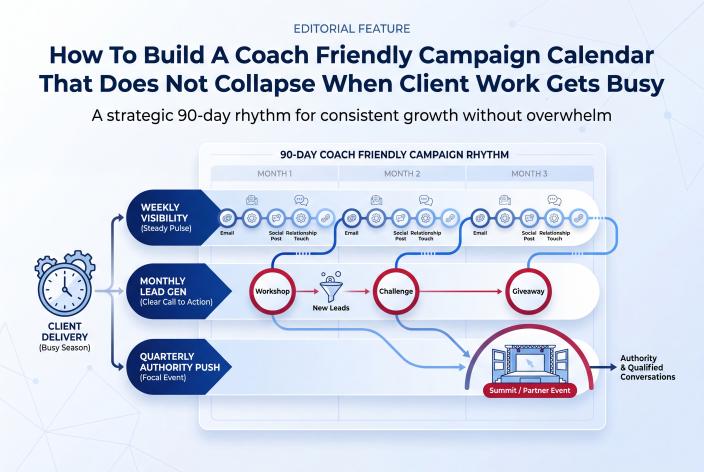
If you're a good coach, client work can quietly become the reason your next clients don't arrive.
You sign a few clients. Your calendar fills. Delivery gets intense. You're in sessions, checking notes, supporting people, creating resources, and doing the real work your clients paid you for.
Then marketing slips.
A week goes by without outreach. Your email list doesn't hear from you. That workshop idea sits in a notebook. Follow-up gets pushed to Friday, then the next Friday, then never.
And a few weeks later, you look up and think, "Why did everything get quiet?"
The answer is often simpler than it feels.
Your business doesn't have a coach friendly campaign rhythm yet.
Not a giant content calendar. Not a complicated launch machine. A simple 90-day rhythm that keeps visibility, lead generation, nurture, and sales follow-up moving even when client delivery gets busy.
Let's build that.
Why Feast Or Famine Growth Often Starts With The Calendar
Most coaches think feast or famine is a lead problem.
Sometimes it is. But very often, it's a rhythm problem.
You already know how to create momentum. You can network. You can post. You can run a workshop. You can have good sales conversations when the right person gets on the call.
The problem is that those activities happen in bursts.
You do a lot when the pipeline feels thin. Then client work picks up, and the growth activities stop. The pipeline looks fine for a while because you're busy serving clients. Then those clients graduate, pause, or complete their package, and now you're back to rebuilding demand from a cold start.
That cycle is exhausting.
A coach friendly campaign calendar solves this by giving your business a basic operating rhythm:
- Weekly visibility so people keep seeing and hearing from you
- Monthly lead generation so new people keep entering your world
- Ongoing nurture so trust keeps building between launches
- Consistent follow-up so warm prospects don't disappear
- Quarterly authority campaigns so your market sees you as a credible guide
The goal is calm consistency.
You want a calendar that keeps the relationship with your market warm while you keep doing great client work.
The 90-Day Rhythm That Works For A Coaching Business
A 90-day campaign calendar is long enough to build momentum and short enough to stay practical.
You don't need to know every post, email, webinar, and partner conversation for the whole year. That's where coaches get overwhelmed and stop planning.
Start with 3 layers.
Weekly Visibility
Weekly visibility keeps you in the conversation.
This could be a useful email, a short video, a podcast appearance, a LinkedIn post, a private community prompt, or a simple story from your client work with identifying details removed.
The question is:
What will help the right people remember what you solve?
A simple weekly rhythm might look like this:
- 1 useful email to your list
- 2 short social posts built from the same idea
- 1 direct relationship touch with a past client, referral partner, or warm lead
- 1 visibility asset that points toward your current offer or upcoming event
That doesn't require you to become a content machine.
It gives your market a steady pulse from you.
Monthly Lead Generation
Each month needs one clear reason for new people to raise their hand.
This can be simple. You don't need a full launch every month.
Use one monthly lead generation action such as:
- A live workshop
- A short challenge
- A guest training inside someone else's community
- A collaborative giveaway
- A lead magnet promotion
- A podcast guest sprint
- A small partner campaign
The key is that the activity should capture leads and move them into nurture.
If people see you but have no clear next step, the attention fades. Give them a reason to register, opt in, reply, attend, or book.
Quarterly Authority Campaigns
Once per quarter, plan something bigger that helps you become more visible, trusted, and remembered in your niche.
This is where summits, multi-speaker events, partner panels, themed workshop series, giveaways, and podcast campaigns can shine.
A quarterly authority campaign gives your business a focal point. It also gives partners, speakers, attendees, and prospects a reason to engage with you around one clear topic.
For a coach, this matters because authority is built through repeated useful contact.
When you lead a focused conversation around a problem your audience already cares about, you're no longer waiting for people to stumble across a random post. You're creating a stage that organizes attention and trust.
What To Schedule Before Client Delivery Crowds The Calendar
Here's a tip.
Do not wait until you're busy to decide how marketing will happen.
Decide the rhythm before the client work expands into every open space.
At the beginning of each 90-day cycle, block these items first.
Your Visibility Blocks
Put visibility on the calendar like a client session.
That might be Tuesday morning from 9 to 10:30. Or Friday afternoon for 45 minutes. The exact time matters less than the fact that it exists.
Use that block for:
- Writing one email
- Recording one short teaching video
- Drafting a few posts from one core idea
- Reaching out to one partner
- Following up with warm prospects
If you leave visibility to leftover time, it will usually get the leftovers.
And leftover energy rarely creates steady client flow.
Your Follow-Up Blocks
Follow-up is one of the easiest places to lose money and trust quietly.
Someone attends your workshop. Someone replies to an email. Someone asks about your program. Someone says, "Circle back with me next month."
Then client work gets busy, and the thread goes cold.
Put follow-up on the calendar every week.
Even better, build simple CRM reminders and automated nurture so the relationship doesn't depend entirely on your memory.
Good automation doesn't make the relationship colder. It helps you respond while interest is still warm.
Your Event Preparation Blocks
If you're running a workshop, summit, giveaway, or partner event, the event day is only one piece.
You also need time for:
- Topic selection
- Registration page copy
- Speaker or partner outreach
- Promotional emails
- Reminder emails
- Calendar links
- Attendee follow-up
- Sales invitation
- Replay or post-event nurture
This is where many coaches underestimate the work.
They put the event itself on the calendar, then squeeze the campaign prep around everything else. That creates stress, rushed messaging, and missed follow-up.
Block the campaign work before you need it.
A Simple 90-Day Campaign Calendar For Coaches
Here is a practical structure you can adapt.
| Timeframe | Main Focus | What To Plan |
|---|---|---|
| Weeks 1 To 2 | Clarify And Prepare | Choose the quarterly theme, define the audience, outline the offer path, set up pages and follow-up |
| Weeks 3 To 4 | Visibility And Outreach | Publish weekly content, contact partners, invite speakers or guests, promote the monthly lead generation activity |
| Weeks 5 To 6 | Lead Generation | Run a workshop, guest training, giveaway, or podcast sprint, then follow up with attendees and leads |
| Weeks 7 To 8 | Nurture And Conversation | Send educational emails, invite qualified prospects to calls, continue partner touchpoints |
| Weeks 9 To 10 | Authority Campaign Push | Promote the larger event, finalize speakers, schedule reminders, prepare sales path |
| Weeks 11 To 12 | Event And Follow-Up | Run the event, send replay and follow-up emails, book calls, review what worked |
| Week 13 | Review And Reset | Look at registrations, attendance, replies, booked calls, partner activity, and next improvements |
Notice the rhythm.
You are not launching wildly every week. You are creating a steady movement from attention to trust to conversation.
That is much easier to sustain.
How To Choose Your Quarterly Campaign Format
You don't need to run the same campaign every quarter.
The right format depends on your audience, your offer, your capacity, and your current authority gap.
Use this simple decision guide.
| Campaign Format | Best When | Watch For |
|---|---|---|
| Workshop | You have a clear problem and want direct sales conversations | Keep the topic specific and connected to the next step |
| Podcast Sprint | You want to build authority through interviews or borrowed audiences | Plan the follow-up path before the episodes or appearances go live |
| Giveaway | You want list growth and partner collaboration around a shared audience | Make sure the gift attracts the right prospects, not just freebie seekers |
| Summit | You want to lead a bigger authority-building conversation in your niche | Prepare speaker outreach, registration, attendee experience, and post-event nurture early |
| Partner Event | You have strong relationships and want a focused audience exchange | Clarify who promotes, who follows up, and what the audience is invited to do next |
Let me make this practical.
If your offer is clear and you need more qualified calls soon, a focused workshop may be the cleanest move.
If your authority is still too quiet in the market, a podcast sprint or partner event can help you borrow trust and get in front of aligned audiences.
If you want to become known for a larger category or movement, a summit can give you a bigger stage.
If your network includes complementary experts with aligned audiences, a giveaway or collaborative campaign may help grow your list and partner base.
The format matters.
But the follow-up matters more than most coaches realize.
The Follow-Up Path Behind Every Campaign
A campaign calendar should never stop at the visibility activity.
A workshop without follow-up becomes a recording. A summit without nurture becomes a busy week. A podcast sprint without a capture path becomes pleasant exposure.
Every campaign needs a simple path.
-
Attention People hear about the topic through your content, partners, speakers, email list, or social channels.
-
Capture They register, opt in, answer a question, join the event, or request the resource.
-
Nurture They receive useful education before and after the campaign, so trust keeps building.
-
Qualification Their behavior, answers, replies, or engagement helps you see who may be a fit.
-
Conversation Right-fit prospects get a clear invitation to take the next step.
-
Longer-Term Follow-Up People who are interested but not ready keep hearing from you in a useful, human way.
This is the part that changes the whole feel of your marketing.
You stop treating every campaign like a single chance to get clients. You start building an asset that keeps creating conversations over time.
How EventRaptor Plus GHL Or CRMRaptor Supports The Rhythm
A campaign calendar looks simple on paper.
Then the moving parts show up.
Registration pages. Thank-you pages. Speaker details. Partner links. Reminder emails. Attendee dashboards. Calendar access. CRM tags. Follow-up workflows. Booking links. Reports. Exports.
This is where coaches often end up duct-taping tools together.
EventRaptor helps manage the virtual event side of the strategy. That includes event setup, registration, speaker and session management, event pages, attendee dashboards, email reminders, promoter tracking, schedules, giveaways, exports, and CRM sync.
GHL/CRMRaptor supports the CRM and follow-up side. That includes contact records, tags, calendars, funnels, workflows, automation, nurture, and booking paths.
Together, they help connect the campaign journey:
- Someone registers for your workshop, giveaway, summit, or partner event
- Their information is captured and organized
- They receive reminders and event communication
- Their activity can be connected to the CRM
- They enter the right nurture or follow-up path
- You can invite qualified prospects into a sales conversation
- You can review what worked instead of guessing from memory and spreadsheets
This is not about adding more tech for the sake of tech.
It's about giving the campaign one organized path from visibility to follow-up.
And when your client work gets busy, that structure matters.
The Weekly Operating Meeting For Your Campaign Calendar
Once your 90-day calendar is built, you need a simple way to keep it alive.
Set a weekly 30-minute operating meeting with yourself or your team.
Use this agenda:
-
Review This Week's Visibility What email, post, interview, outreach, or partner touchpoint is going out?
-
Review Lead Generation Activity What are we inviting people to this month?
-
Review Follow-Up Who needs a personal message? Who should be invited to a call? Who needs nurture?
-
Review Event Or Campaign Tasks Are pages, reminders, speakers, calendar links, and follow-up emails on track?
-
Review The Numbers You Actually Have Look at registrations, replies, attendance, booked calls, partner activity, and sales conversations.
Keep it simple.
The purpose is not to create a reporting burden. The purpose is to stop marketing from disappearing quietly while delivery gets loud.
What To Do This Week
If your client flow has been rising and falling with your delivery load, start small.
This week, do these 5 things:
- Choose one theme for the next 90 days.
- Pick one weekly visibility action you can sustain.
- Choose one monthly lead generation activity.
- Decide your quarterly authority campaign format.
- Block follow-up time on your calendar before anything else takes it.
Then ask one more question.
What happens after someone raises their hand?
If you can answer that clearly, you're building a real client attraction system.
If you can't, that's the next piece to fix.
Build The Rhythm Before You Need The Rescue
A coach friendly campaign calendar gives your business breathing room.
It helps you keep authority, visibility, nurture, and follow-up moving while you serve your clients well. It also gives your marketing a rhythm your future self can trust.
You don't need to become louder, busier, or more complicated.
You need a practical calendar that connects visibility to capture, nurture, follow-up, and qualified conversations.
If you want help applying this to your coaching business, Book your Client Attraction Planning Call.
On the call, we'll look at where your client flow is getting stuck, what kind of 90-day campaign rhythm makes sense, and whether a workshop, summit, giveaway, partner event, funnel, CRM, or follow-up system is the right next move.