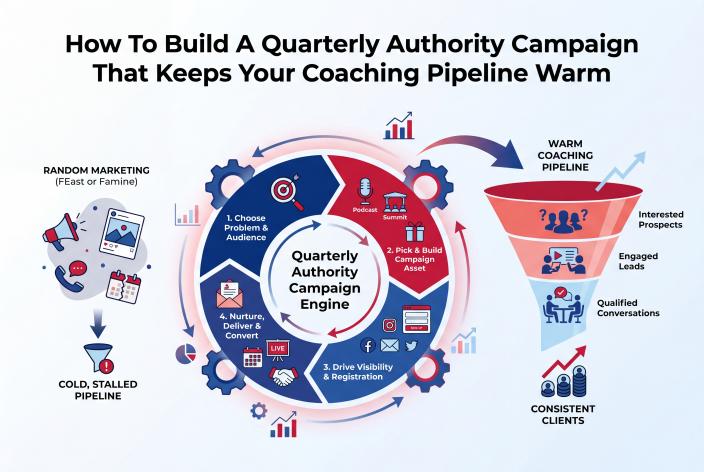
If your coaching works, but your client flow still rises and falls like the weather, you’re probably not missing another random marketing tactic.
You need a rhythm.
A simple, repeatable rhythm that gives your market a reason to notice you, trust you, hear from you, and eventually talk with you when the timing is right.
That’s where a quarterly authority campaign can help.
Instead of trying to post constantly, network endlessly, or wait for referrals to pick up again, you choose one focused campaign each quarter. One problem. One audience. One authority asset. One follow-up path.
That campaign might be a workshop, podcast series, giveaway, virtual summit, interview series, roundtable, or partner event.
The format can change. The strategy stays the same.
You become more visible around a specific problem, capture the people who raise their hands, nurture them with useful follow-up, and guide the right ones toward a qualified conversation.
Let me walk you through how to build one.
Start By Choosing One Audience Problem To Own For The Quarter
Your campaign needs a sharp center.
Not a broad theme like “wellness,” “leadership,” “money mindset,” or “business growth.” Those can work as categories, but they’re too wide to anchor a campaign.
You want one problem your right-fit prospect already feels.
For example:
- A health coach might own “why busy professionals keep falling off their wellness plan after 3 weeks.”
- A business coach might own “why referrals are helpful but not enough to create steady client flow.”
- A relationship coach might own “how high-achieving couples drift into roommate mode.”
- A leadership coach might own “why new managers struggle to lead without over-functioning.”
See the difference?
The campaign becomes easier to promote because it speaks to a real moment in the prospect’s life.
Ask yourself:
- What problem do my best clients usually have before they hire me?
- What are they already trying that isn’t working well enough?
- What misunderstanding keeps them stuck?
- What conversation would make them feel seen and curious?
- What problem naturally connects to my paid offer?
That last question matters.
An authority campaign should build trust and create movement toward your offer. It doesn’t need to pitch every minute. But it should live in the same world as the work you eventually want to sell.
Here’s a tip.
If you can’t see how the campaign topic leads to a sales conversation, the topic may be interesting but disconnected.
And disconnected visibility is one of the reasons coaches stay busy without getting booked.
Pick The Right Authority Asset For This Quarter
Once you know the problem you want to own, choose the campaign format.
Don’t pick the biggest format because it sounds impressive. Pick the format that fits your bandwidth, offer clarity, audience size, and growth goal.
A quarterly campaign should create momentum, not bury you in logistics.
Use A Workshop When You Need A Clear Path To A Sales Conversation
A workshop is often the cleanest format when your offer is clear and you want to teach a practical shift.
It works well when:
- You know the audience and problem.
- You can teach a useful framework in one session.
- You want attendees to understand why your paid work is the next logical step.
- You want a direct invitation to book a call or apply.
A workshop is focused. It’s easier to plan than a larger event. And it gives your audience a concentrated experience of how you think.
The key is to make the workshop specific.
“Build Better Habits” is vague.
“How To Stop Restarting Your Health Plan Every Monday” is much easier to care about.
Use A Podcast Or Interview Series When You Need More Authority Content
A podcast series, video interview series, or short expert conversation series can work well when you want more content, more relationship-building, and more credibility around a theme.
You might interview partners, clients, specialists, or adjacent experts.
This format is useful when:
- You want to borrow and build authority through conversations.
- You need more content assets for email and social.
- You want to strengthen relationships with partners.
- You’re not ready for a bigger summit yet.
The mistake to watch for is treating the series as content only.
Each episode should connect back to the campaign problem. Each conversation should give people a reason to register, subscribe, download, attend, or take the next step.
Visibility needs a path behind it.
Use A Giveaway When List Growth Is The Main Goal
A collaborative giveaway can be useful when your audience is still too small and you need more people entering your world.
The strategy is simple. You bring together contributors who each offer a useful resource. They promote the giveaway to their audiences. Registrants receive access and enter your follow-up system.
This can be a good fit when:
- You have partner relationships or can create them.
- You want to grow an owned audience.
- You have a clear follow-up plan after registration.
- Your offer needs more people in the nurture stage before sales conversations happen.
The follow-up matters here.
A bigger list without nurture becomes another cold audience. You need to welcome people, orient them, teach them why the campaign theme matters, and guide the right people toward the next step.
Use A Virtual Summit When You Need Authority, Partnerships, And Pipeline Momentum
A virtual summit is a stronger campaign when you want to become known around a topic, bring multiple voices together, grow through partners, and create a larger authority asset.
It can support audience growth, speaker relationships, event-based visibility, lead capture, and follow-up.
But a summit has more moving parts.
Speakers. Pages. Registrations. Schedules. Reminders. Session details. Partner links. Attendee access. Follow-up. CRM updates.
That’s why summits work best when you treat them as a client attraction campaign, not a one-time content event.
EventRaptor is built for this kind of work. It helps organize event pages, registration, attendees, speakers, reminders, partner promotion, CRM syncing, and follow-up so the host doesn’t have to run everything through inboxes, spreadsheets, and disconnected tools.
And when the CRM layer is connected through GHL/CRMRaptor, the campaign can keep moving after the event through tags, calendars, workflows, nurture, and booking paths.
That’s where the summit becomes useful for pipeline.
Not just visibility. Organized visibility.
Match The Asset To Your Current Business Stage
Here’s a simple way to decide what kind of campaign to run this quarter.
| If Your Main Need Is | Choose This Campaign Format | Why It Helps |
|---|---|---|
| Clearer sales conversations | Workshop | Gives prospects a focused teaching experience and a direct next step |
| More authority content | Podcast or interview series | Creates reusable conversations and partner connection |
| More audience growth | Giveaway | Uses contributor reach to grow your owned audience |
| Stronger authority and partner momentum | Virtual summit | Brings speakers, attendees, and a niche theme together in one campaign |
| Market feedback on a newer message | Roundtable or live discussion | Lets you hear what prospects respond to before building bigger |
The best format is the one you can execute well and follow up on.
A smaller campaign with excellent follow-up often does more for client flow than a bigger campaign that ends in exhaustion and silence.
Map The Campaign From Visibility To Registration To Nurture To Conversation
This is the part many coaches skip.
They plan the event, promote the event, deliver the event, and then wonder why the pipeline didn’t change much.
The campaign needs a journey.
Think of it in 5 stages.
Stage 1 Is Visibility
This is how people first hear about the campaign.
Visibility can come from:
- Your email list
- Social posts
- Speaker promotion
- Partner promotion
- Podcast appearances
- Community posts
- Direct outreach
- Referral partners
Your visibility message should point to the campaign problem.
Don’t just say, “I’m hosting a free workshop.”
Say who it’s for, what problem it helps with, and why it matters now.
Stage 2 Is Registration
Registration is the moment someone raises their hand.
This is where you capture their information and begin organizing the relationship.
A strong registration path answers:
- What is this?
- Who is it for?
- What will I learn or experience?
- When does it happen?
- What should I do next?
With EventRaptor, registration management can include registrant lists, filtering, VIP indicators, promoter attribution, data exports, registration growth tracking, and CRM sync. That matters because you want to know who raised their hand, where they came from, and how they should be followed up with.
Stage 3 Is Pre-Event Nurture
The relationship starts before the live session.
Your pre-event emails should do more than remind people of the date.
Use them to build trust.
You can send:
- A welcome email that confirms they’re in the right place.
- A short story about why the topic matters.
- A useful question to help them self-diagnose.
- A reminder with the access link.
- A simple invitation to think about what they want help with.
Good reminders also protect attendance and attention.
People are busy. They forget. They mean to attend and then lose the link.
A clear reminder path is a service to your audience.
Stage 4 Is The Authority Experience
This is the workshop, summit, giveaway, panel, or series itself.
Your goal is to help people think differently and trust you more.
That means you need to be useful.
Teach the problem clearly. Name the hidden friction. Show the first few decisions that matter. Give them language for what they’ve been feeling.
And connect the teaching to the next step without making the whole experience feel like a sales pitch.
For a coach, authority is built when prospects feel, “This person understands my situation, and their way of thinking makes sense.”
That is what warms the pipeline.
Stage 5 Is Follow-Up And Qualified Movement
After the event, interest is warm.
This is where a lot of opportunity gets lost.
People attended. Some watched a replay. Some clicked. Some asked questions. Some didn’t show up but still care about the topic.
Your follow-up should help each group keep moving.
You might send:
- Replay access
- A recap of the key ideas
- A diagnostic checklist
- A case for why the problem matters
- An invitation to book a call
- A nurture sequence for people who are interested but not ready
EventRaptor supports welcome emails, scheduled reminders, follow-up emails, personalization placeholders, email status tracking, and CRM syncing. GHL/CRMRaptor can then support the CRM, calendar, workflow, automation, and follow-up side.
That connection matters because the campaign shouldn’t disappear into memory after the event ends.
It should feed your client attraction system.
Use Simple KPIs To Measure Qualified Movement
You don’t need to measure everything.
But you do need to measure enough to know whether the campaign created movement.
Here are practical KPIs for a quarterly authority campaign:
| Campaign Stage | What To Watch | What It Tells You |
|---|---|---|
| Visibility | Which channels and partners brought registrations | Where your audience is responding |
| Registration | Who registered and what they selected or answered | Whether the topic is attracting the right people |
| Attendance | Who showed up or engaged with the event | Who has stronger interest |
| Nurture | Email opens, clicks, replies, and replay activity | Which messages are creating movement |
| Sales Path | Booked calls, applications, or qualified replies | Whether trust is turning into conversation |
| Follow-Up | Tags, segments, and next-step status | Whether leads are being managed instead of forgotten |
The point isn’t to obsess over dashboards.
The point is to stop guessing.
If your registration is weak, the topic, promise, or promotion may need work.
If registration is strong but attendance is low, your reminders and pre-event nurture may need attention.
If attendance is good but calls are weak, the teaching, offer bridge, or follow-up path may need refinement.
If calls are happening but the fit is poor, your audience targeting or qualification path may need sharpening.
Every campaign gives you feedback.
That feedback is what makes the next quarter stronger.
Build A Quarterly Rhythm You Can Repeat
A quarterly authority campaign works best when it becomes a rhythm.
Here’s a simple planning cycle:
- Month 1: Choose the problem, campaign format, partners, message, and registration path.
- Month 2: Promote the campaign, collect registrations, nurture interest, and prepare the authority experience.
- Month 3: Deliver the event, follow up, book qualified conversations, review the data, and choose improvements.
That rhythm gives your business a heartbeat.
You’re not waking up every Monday wondering what to post. You’re not hoping a referral arrives before the end of the month. You’re building one focused authority asset at a time.
And over time, those assets stack.
A workshop can become a replay funnel. A podcast series can become email content. A summit can become a relationship engine. A giveaway can introduce new people to your world. A roundtable can sharpen your message.
The campaign creates visibility. The system captures and nurtures it. The follow-up turns warm interest into the right conversations.
That’s the path.
Keep The System Human
Some coaches worry that funnels, CRM, and automation will make their marketing feel cold.
I get it.
Your work is personal. Your voice matters. Your clients need to feel like they’re dealing with a real person, not a machine.
But good automation doesn’t replace the relationship. It protects the relationship.
It makes sure people get the link. It reminds them when the session is starting. It sends the replay when they miss it. It follows up while the topic is still fresh. It helps you remember who clicked, asked, attended, applied, or needs more nurture.
That’s not cold. That’s considerate.
The key is to build the campaign around your voice, your offer, your audience, and your way of serving.
The tools should support that. They shouldn’t take it over.
Your Quarterly Campaign Checklist
Before you build your next campaign, walk through this checklist.
- Have I chosen one specific audience problem for the quarter?
- Does that problem connect naturally to my paid offer?
- Have I chosen the right campaign format for my bandwidth and goals?
- Is there a clear registration path?
- Do I have pre-event nurture that builds trust before the session?
- Have I planned the follow-up before the campaign goes live?
- Do I know what action I want qualified prospects to take next?
- Are my event tools, CRM, tags, calendar, and follow-up connected enough to manage the campaign cleanly?
- Do I know which KPIs I’ll review after the campaign?
If you can answer those questions, you’re no longer running random visibility.
You’re building a repeatable client attraction rhythm.
The Next Step
If your coaching is strong but your pipeline still feels too quiet between referrals, a quarterly authority campaign can give your business a more reliable rhythm.
Choose one problem. Build one campaign. Capture the attention. Nurture the relationship. Follow up while the interest is warm. Then use what you learn to make the next quarter sharper.
And if you want help mapping this out for your coaching business, Book your Client Attraction Planning Call.
On the call, we’ll look at where your client flow is getting stuck, whether your next move should be a workshop, summit, giveaway, funnel, CRM, or follow-up system, and what kind of client attraction plan could make sense for your business.