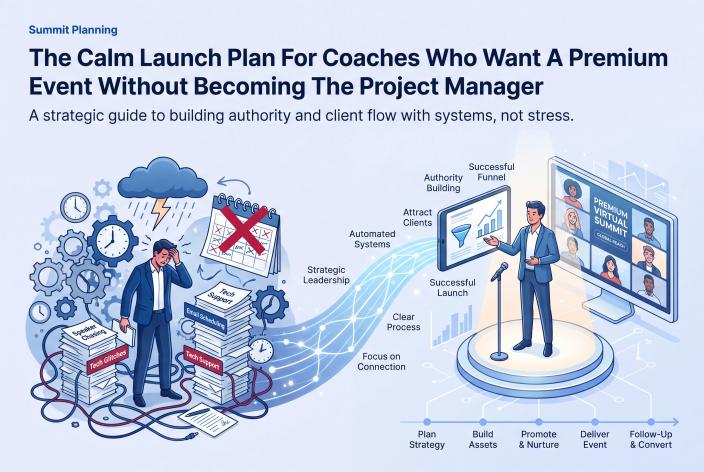
If you've ever thought about hosting a summit, panel, workshop series, or speaker event, you probably saw the upside right away.
More visibility.
More authority.
More warm conversations with people who already understand your work before they book a call.
Then the second thought hit.
Who is going to build the pages, chase the speakers, send the reminders, manage the schedule, fix the links, update the CRM, follow up with attendees, and keep the whole thing from turning into a second job?
That is where a lot of good event ideas quietly die.
The coach wants the authority-building benefit of the event. But they don't want to become the event project manager, tech operator, speaker wrangler, copywriter, email scheduler, and follow-up team all at once.
And honestly, they shouldn't have to.
A premium coaching event needs leadership from you. It also needs a system around you.
Let's walk through what that looks like.
The Real Goal Of A Premium Coaching Event
A premium event is more than a few Zoom sessions on a calendar.
Done well, it helps the right people see you as a trusted guide around a specific problem. It gives your audience useful conversations, introduces them to aligned experts, and creates a natural path into deeper trust with you.
For coaches, that matters because your prospects usually don't buy only because they saw one post.
They buy after a pattern forms:
- They notice you.
- They understand what you help with.
- They trust your point of view.
- They see your standards.
- They feel like the next conversation with you makes sense.
That is the strategic role of a summit, panel, workshop series, or speaker event.
It creates a concentrated authority moment.
But the event needs to be connected to capture, nurture, follow-up, and conversion. Otherwise, you put on a great show, feel proud for 48 hours, and then wonder why the pipeline still feels quiet.
So the calm launch plan starts with this question:
What should this event do for the business after the event is over?
What You Should Own As The Coach
There are some decisions you should not hand off completely.
Why?
Because they come from your expertise, your positioning, your values, and your relationship with your market.
You don't need to personally build every asset. But you do need to lead the strategic choices that make those assets worth building.
Own The Audience Decision
Who is this event really for?
A vague audience creates vague sessions, vague registration copy, and vague follow-up. You want the person landing on the page to feel, "This is speaking to me."
That means getting clear on things like:
- The type of client you want more of.
- The problem they already know they have.
- The problem they have not diagnosed correctly yet.
- The level of sophistication they bring.
- The kind of language they use privately when they describe the struggle.
For example, a health coach hosting an event for "wellness seekers" will have a harder time creating urgency than one hosting an event for high-achieving women dealing with burnout, brain fog, and poor sleep while trying to lead at work and at home.
Specificity makes the event easier to promote, easier to program, and easier to convert.
Own The Offer Direction
Your event should point somewhere.
That doesn't mean every session has to sell aggressively. In fact, a heavy-handed event can damage trust fast.
But your event should make your next step feel obvious for the right people.
Before you plan sessions, clarify:
- What offer do you want this event to support?
- Who is qualified for that offer?
- What belief shifts need to happen before someone is ready for a call?
- What questions should they be asking by the end of the event?
- What would make someone a poor fit?
This helps you shape the event promise, choose speakers, guide session topics, and design follow-up that feels useful instead of random.
Own The Core Promise
The event promise is the reason people register.
It should be simple enough to understand quickly and strong enough to feel worth their time.
A good event promise connects 3 things:
- The audience.
- The problem they want solved.
- The clearer path they will understand by attending.
You are not promising a guaranteed result from attending a free event. You are promising a useful shift in clarity, confidence, strategy, or direction.
Here are simple promise frames:
- Learn how to build a calmer path to consistent client conversations.
- Understand why your referrals, content, and launches are not creating steady client flow.
- See how to turn your expertise into authority, trust, and better sales conversations.
- Map the missing pieces between visibility and booked calls.
The promise guides the whole campaign.
If the promise is fuzzy, everything downstream gets harder.
Own The Voice And Standards
Your marketing should sound like you.
This matters even more for coaches because your work is personal. People are not only evaluating the information. They are evaluating the feel of the relationship.
So you should give direction on:
- Words you use naturally.
- Words you avoid.
- How direct you want the copy to feel.
- How much urgency feels appropriate.
- What claims you are comfortable making.
- How you want speakers and attendees treated.
This keeps the event aligned with your reputation.
You can delegate copywriting, page building, emails, and CRM workflows. But the voice should still carry your fingerprints.
What Can Be Systemized Or Delegated
Now for the good news.
Most of the event execution should not live in your head.
A premium event has a lot of moving parts, but many of those parts can be handled through templates, workflows, checklists, dashboards, reminders, and clear ownership.
Here is where systemization creates breathing room.
| Event Area | What Needs To Happen | Why It Should Be Systemized |
|---|---|---|
| Event Pages | Registration page, thank-you page, attendee dashboard, event access pages | People need a clear place to register, get details, and return on event day |
| Speaker Details | Applications, bios, headshots, session titles, descriptions, files, agreements | Speakers should feel organized and professionally supported |
| Emails | Confirmation, reminders, speaker updates, attendee messages, replay notices, follow-up | Communication should go out on time without relying on memory |
| Schedule | Session times, tracks, calendar details, access links, run of show | Attendees and speakers need clarity about where to be and when |
| Promotion | Partner links, swipe copy, promoter tracking, registration growth | You need to know which relationships are creating momentum |
| CRM And Tags | Contact sync, registration status, VIP status, interest tags, follow-up stages | Leads should be organized for nurture and sales conversations |
| Follow-Up | Post-event emails, booking paths, nurture sequences, segmentation | The relationship should continue while interest is still warm |
| Reporting | Registrations, promoter performance, attendee data, email status, exports | You need enough visibility to make better decisions next time |
This is where coaches often feel immediate relief.
You do not need fewer standards. You need fewer loose ends.
The Difference Between A Professional Event And A Duct-Taped Event
Attendees can feel the difference.
So can speakers.
A duct-taped event may still have good content, but the experience feels a little shaky. The registration page is unclear. The emails come late. The Zoom link is buried. Speakers are confused about deadlines. Attendees ask the same questions because the event hub does not answer them. Follow-up happens days later, if it happens at all.
Nobody may say it out loud.
But they feel it.
And when you are trying to position yourself as a premium coach, that feeling matters.
A professional attendee experience gives people confidence before you ever speak to them.
They know:
- Where to register.
- What they signed up for.
- When sessions happen.
- How to access the event.
- What to expect next.
- How to revisit key sessions or resources if replays are part of the event.
- How to take the next step if the event helped them.
A professional speaker experience matters too.
Speakers need clear invitations, simple submission steps, session details, promotion links, reminders, and confidence that the event host has the operation under control.
That is part of authority.
Not flashy authority. Practical authority.
The kind where people think, "This person runs things well. I trust them."
The Calm Launch Plan In 5 Phases
A calm launch does not mean nothing goes wrong.
It means the event is built with enough structure that the normal moving parts don't create constant panic.
Here is a practical 5 phase plan.
Phase 1 Is Strategy And Positioning
Start here before building pages or inviting speakers.
Clarify:
- Who the event is for.
- What problem the event helps them understand or solve.
- What offer the event supports.
- What authority position you want to strengthen.
- What action should happen after the event.
- What makes someone a right-fit next-step prospect.
This is also where you decide the event format.
A summit may make sense if you want broader partner leverage and multiple expert voices. A panel may work better for a focused authority conversation. A workshop series can help prospects go deeper with a specific framework. A speaker-led campaign or giveaway can support audience growth and partnerships.
The format should serve the strategy.
Phase 2 Is Event Architecture
Once the strategy is clear, map the event experience.
This includes:
- Event name and promise.
- Session themes.
- Speaker criteria.
- Registration flow.
- Attendee dashboard or access point.
- VIP or upgrade path if relevant.
- Calendar and reminder structure.
- Follow-up path after registration, attendance, and replay viewing.
This is where the event stops being an idea and starts becoming a working path.
You are designing the journey from interest to trust to conversation.
Phase 3 Is Asset Buildout
Now the execution team can build.
This may include:
- Registration page.
- Thank-you page.
- Speaker application or invitation flow.
- Speaker profiles.
- Session pages or event dashboard.
- Email confirmations.
- Reminder emails.
- Partner swipe copy.
- Calendar details.
- CRM tags and fields.
- Booking path for qualified next-step conversations.
- Follow-up sequences.
This is the point where a system matters.
EventRaptor manages the virtual event side, including event pages, registration, attendee data, speaker workflows, schedules, reminders, promoter tracking, and event reporting. GHL/CRMRaptor supports the CRM side, including contact records, tags, calendars, funnels, workflows, automation, and follow-up.
Together, they help the event activity and the client attraction system stay connected.
That connection is what keeps you from ending the event with a spreadsheet full of names and no clear next step.
Phase 4 Is Promotion And Pre-Event Nurture
Promotion should not feel like yelling into the void.
You want a mix of channels that match your audience and your relationships.
That could include:
- Your email list.
- Speaker promotion.
- Partner promotion.
- Social posts.
- Direct invitations.
- Podcast or interview mentions.
- Community posts where appropriate.
- Warm outreach to aligned prospects or referral partners.
As people register, the nurture starts.
This is important.
The event relationship begins before the first session. Confirmation emails, reminders, pre-event content, speaker highlights, and simple expectation-setting all help attendees show up with more context and trust.
A calm launch uses these touchpoints intentionally.
Phase 5 Is Event Delivery And Follow-Up
Event day is not the finish line.
It is a trust acceleration point.
During delivery, you want the experience to feel clear and guided. Attendees should know where to go, what is happening next, and how to engage.
After delivery, the follow-up should continue the conversation.
Useful follow-up may include:
- Replay access if available.
- A recap of the most useful ideas.
- Segmented emails based on interest or behavior.
- Invitations to a relevant next step.
- A booking path for qualified prospects.
- Longer nurture for people who are interested but not ready.
This is where many events lose momentum.
The host feels tired, the team exhales, and follow-up slips. But for client attraction, this is one of the most important windows.
People just spent time with your ideas. They saw your standards. They may have questions. They may be closer to a decision than they were before the event.
Good follow-up helps them keep moving.
What Your Role Should Feel Like During The Launch
If you are the coach, your best role is not to babysit every task.
Your best role is to lead the thinking and the relationships.
That means you should be focused on:
- Clarifying the message.
- Approving the event promise.
- Choosing or approving speakers.
- Recording key sessions or hosting live conversations.
- Showing up with presence.
- Building relationships with partners.
- Reviewing qualified opportunities.
- Having sales conversations with the right people.
Your attention should go toward the places where your expertise creates leverage.
You should not be spending prime creative energy hunting for a missing Zoom link, wondering if the reminder email sent, or manually tagging registrants after the event.
That is the whole point of building infrastructure.
It protects your leadership energy.
The Premium Event Readiness Checklist
Before you launch, ask these questions.
Strategic Readiness
- Is the audience specific enough?
- Does the event promise create a clear reason to register?
- Does the event support a real offer or next step?
- Are the sessions designed to build trust around the right beliefs?
- Do you know what makes someone qualified for a call?
Operational Readiness
- Are the registration and thank-you pages clear?
- Are speaker details organized?
- Are reminders scheduled?
- Are access links easy to find?
- Is the event schedule clear?
- Are partner links trackable?
- Is attendee data flowing into the CRM?
- Is post-event follow-up already planned?
Experience Readiness
- Will attendees know what to do next at each stage?
- Will speakers feel supported?
- Does the event look and feel aligned with your brand?
- Does the follow-up sound like a continuation of the relationship?
- Is there a calm path from interest to conversation?
If several of these answers are fuzzy, don't panic.
That is useful information.
It means the event needs a better plan before you start inviting people into it.
A Calm Launch Is Built Before The Pressure Hits
A premium event should make you more visible, more trusted, and more memorable to the people you want to serve.
It should not leave you buried in admin, scattered across tools, and too exhausted to follow up with the people who raised their hands.
The calmer path is to separate leadership from logistics.
You own the audience, offer, promise, voice, relationships, and standards.
The system handles the repeatable execution, including pages, emails, speaker details, registration, reminders, CRM updates, calendar paths, workflows, and follow-up.
That is how an event becomes part of a client attraction system.
It becomes a way to build authority and create qualified conversations without forcing you to personally manage every moving part.
If you want help applying this to your coaching business, Book your Client Attraction Planning Call.
On the call, we can look at where your current client flow is getting stuck, what kind of event or funnel strategy makes sense, and how your authority, CRM, follow-up, and implementation pieces could work together more calmly.