If your coaching business grows through relationships, referrals are gold.
But here's the frustrating part.
Most potential partners are willing to recommend you, but they don't always know how.
They may like you. They may trust your work. They may even say, "I'll send people your way." Then nothing happens.
Why?
Because your offer lives clearly in your head, not theirs.
A partner referral kit fixes that.
It gives podcast hosts, summit speakers, collaborators, past clients, affiliates, and strategic partners the language, links, and context they need to send the right people to you without guessing.
And when it's connected to your follow-up system, it becomes more than a nice PDF. It becomes part of your client attraction system.
Why Good Partners Still Struggle To Refer You
Most coaches assume referrals happen because someone knows what they do.
But knowing you are a coach is not enough.
A partner needs to know:
- Who you help
- What problem you solve
- What language to listen for
- When to recommend you
- What link to share
- What happens after someone raises their hand
Without that, your partner has to translate your offer on the spot.
That's a lot to ask.
They are busy. They have their own audience, calendar, offers, inbox, and follow-up to manage. If recommending you requires them to explain your whole coaching method from memory, they probably won't do it consistently.
So the goal is simple.
Make your coaching offer easy to recognize, easy to explain, and easy to share.
Start With The Client Problem Partners Should Listen For
Before you write swipe copy, create links, or design a pretty partner page, get clear on the exact problem your partners should listen for.
This is where many referral systems get fuzzy.
A partner can't refer someone just because that person wants "growth," "clarity," "confidence," or "better results." Those words can mean almost anything.
Give your partners real-life signals.
For example, if you're a business coach for consultants, your partners might listen for phrases like:
- "I'm getting referrals, but they're unpredictable."
- "I can sell once I'm on the call, but I don't get enough qualified calls."
- "My content gets engagement, but it doesn't turn into clients."
- "I know my offer works, but people don't seem to understand it quickly."
If you're a health coach, they might listen for:
- "I've tried plans before, but I can't stay consistent."
- "I know what to do, but I need structure and accountability."
- "I'm tired of starting over every few months."
See the difference?
You're not asking partners to remember your whole methodology.
You're training them to recognize a moment of need.
Create A Simple Problem Snapshot
Write a short paragraph your partner can understand in 30 seconds.
Use this structure:
- "I help [specific audience]."
- "They usually come to me when [specific problem]."
- "The signs are [3 to 5 real phrases or symptoms]."
- "The best fit is someone who [readiness marker]."
For a coach, that might sound like this:
"I help experienced leadership coaches who are good at delivering results but still rely too heavily on referrals and networking. They usually come to me when their calendar gets quiet and they realize their visibility isn't connected to a real follow-up and conversion system. The best fit is someone who already has a coaching offer and is ready to build a more consistent client attraction path."
That's useful.
A partner can remember it. A podcast host can introduce it. A summit speaker can recognize it. A referral partner can share it without sounding awkward.
Write Referral Language That Sounds Like A Real Person
Your partners should never feel like they have to become your salesperson.
Give them language they can adapt in their own voice.
The best referral copy is short, specific, and calm.
No hype. No exaggerated claims. No pressure.
Try giving partners 3 versions.
The Quick Mention
This is the tiny version they can use in a conversation, podcast episode, workshop, or direct message.
Example:
"You might want to talk to [Your Name]. They help [audience] with [specific problem], especially when [trigger moment]."
The Warm Introduction
This is useful when they are connecting you by email or message.
Example:
"Hi [Name], I wanted to introduce you to [Your Name]. Based on what you shared about [problem], I think their work around [specific outcome] may be relevant. [Your Name], [Name] is looking for support with [context]. I'll let you both take it from here."
The Audience Share
This is useful for newsletters, partner emails, communities, and event promotions.
Example:
"If you're a [specific audience] and you're dealing with [specific problem], [Your Name] has a helpful resource on [topic]. It's a good next step if you want to understand why [problem] keeps happening and what to fix first."
Notice the tone.
It doesn't oversell. It gives the right person a reason to pay attention.
That matters because partner relationships are built on trust. If your copy sounds like a hard pitch, your partners will hesitate to use it.
Build A Simple Partner Referral Kit
Your kit does not need to be complicated.
In fact, simple usually works better.
The best partner kit gives people the exact assets they need, without making them dig through a folder full of random files.
Here is a practical structure.
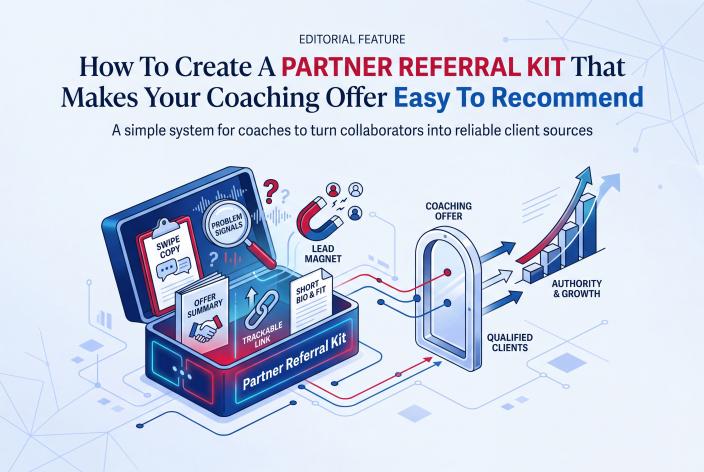
| Kit Asset | What To Include | Why It Helps |
|---|---|---|
| Short Bio | 50 to 100 words about who you help and what you do | Makes introductions easier |
| Offer Summary | A plain-language description of your coaching offer | Helps partners explain the next step clearly |
| Audience Fit | Who is a good fit and who is not | Improves referral quality |
| Problem Signals | Phrases and situations partners should listen for | Makes referrals more natural |
| Lead Magnet Or Planning Resource | A useful first step for referred prospects | Gives partners something helpful to share |
| Next-Step Link | Your call booking page, assessment, event, webinar, or resource | Removes friction |
| Swipe Copy | Short messages for email, DMs, newsletters, and social posts | Saves your partner time |
| Tracking Link | A unique link for each partner or campaign | Makes referrals measurable |
That's enough.
You can build this as a simple page, Google Doc, PDF, or partner dashboard. The format matters less than clarity.
The key is that every asset should answer one question.
"How do I send the right person to you in a way that feels helpful?"
Include A Lead Magnet That Builds Trust Before The Call
Some referred prospects are ready for a conversation right away.
Many are not.
That's why your partner kit should include a useful first step, not only a sales call link.
This could be:
- A diagnostic checklist
- A short video training
- A planning guide
- A webinar registration page
- A virtual event registration page
- A focused assessment
- A practical article or resource hub
The best lead magnet helps the prospect diagnose their problem and see why your approach makes sense.
For EventRaptor and VirtualSummits.com, this is the same logic behind authority-building events. A summit, workshop, meeting, or speaker-led campaign can help the host become more visible and trusted while giving attendees a clear path from registration to follow-up.
EventRaptor supports that event journey through registration pages, attendee dashboards, reminder emails, speaker and session management, promoter links, partner attribution, attendee data, CRM sync, and follow-up workflows. The point is to move from visibility to trust to conversation in a more organized way.
Your referral kit should do the same thing at a smaller scale.
Don't just hand partners a sales page.
Give them a helpful bridge.
Use Trackable Links And Source Tags So Referrals Are Measurable
If referrals are important to your growth, you need to know where they come from.
This doesn't have to be complicated.
At minimum, create a unique link or source tag for each partner, event, podcast, summit, webinar, or campaign.
That lets you see:
- Which partners are sending traffic
- Which audiences are engaging
- Which resources are getting clicks
- Which referrals are turning into conversations
- Which campaigns deserve more attention
This is where many relationship-based campaigns lose clarity.
A partner promotes you. People click. A few leads come in. Someone books a call 3 weeks later. Then you are left wondering what created the opportunity.
When your links, source tags, CRM records, and follow-up are connected, you can make better decisions.
EventRaptor supports partner-powered growth with unique promoter links, promoter dashboards, performance reports, leaderboards, promoter attribution, exports, and CRM sync. GHL/CRMRaptor can support the CRM layer with contact records, tags, calendars, funnels, workflows, automation, and follow-up.
Together, that gives you a clearer picture of how partner activity turns into registrations, nurture, and qualified conversations.
And that clarity helps you treat partners better.
You can thank them specifically. You can see who created momentum. You can notice which audiences are responding. You can follow up while interest is still warm.
Follow Up Without Making The Relationship Feel Transactional
Good follow-up protects the referral relationship.
Think about it from your partner's perspective.
They are lending you trust.
When they introduce someone to you, they want that person to feel respected, helped, and guided. They don't want their audience dumped into a cold sales sequence that feels disconnected from the original recommendation.
So your follow-up should feel human.
That means:
- Acknowledge the referral source when appropriate
- Reference the resource, event, or conversation that brought them in
- Give them useful next steps before asking for a call
- Segment based on interest or readiness
- Keep the tone aligned with how the partner introduced you
- Let the partner know when their referral was received or appreciated, when appropriate
Good automation helps here.
It keeps follow-up timely and consistent, even when you're delivering client work, traveling, or managing a launch. The relationship feels better because people aren't forgotten.
The danger is not automation itself. The danger is lazy automation.
A thoughtful follow-up path can feel personal because it responds to the context of how the person arrived.
For example:
- A podcast listener gets the podcast-specific resource and a short note connected to the episode topic.
- A summit attendee gets session reminders, replay access, and a relevant next step based on the event theme.
- A partner referral gets a warm welcome that acknowledges the shared connection.
- A webinar attendee gets follow-up tied to the problem they just learned about.
That's how referrals become a trust pathway.
Keep The Partner Relationship Alive After The Referral
A referral kit is the beginning of the relationship system, not the whole thing.
Your best partners need light, consistent support.
Create a simple rhythm:
- Send the partner kit before the campaign or collaboration.
- Confirm the audience fit and best next-step link.
- Give them 2 or 3 short messages they can use.
- Track traffic and referrals clearly.
- Follow up with referred leads promptly.
- Thank the partner with specific context.
- Share useful feedback when appropriate.
- Invite future collaboration when there is a natural fit.
This keeps the relationship warm without turning every conversation into a numbers report.
Remember, partners are people.
They want to know their recommendation was handled well. They want to feel good about sending someone to you. They want the collaboration to strengthen their own relationship with their audience.
Make that easy for them.
A Quick Partner Referral Kit Checklist
Before you send your kit to a partner, make sure it includes:
- A clear description of who you help
- The exact problem partners should listen for
- 3 to 5 real-world problem phrases
- A short bio
- A simple offer summary
- Good-fit and poor-fit markers
- A helpful lead magnet or event link
- A clear next-step link
- Short swipe copy for different situations
- A unique tracking link or source tag
- A follow-up plan for referred leads
If any of those pieces are missing, your partner has to work harder.
And the harder it is to refer you, the fewer referrals you will receive.
Your Referral Kit Should Make Trust Easier To Transfer
Partner referrals work because trust is already present.
Your job is to make that trust easy to carry from the partner's world into yours.
That means clear language. Clear audience fit. Clear links. Clear follow-up. Clear tracking.
When those pieces work together, referrals stop feeling random. They become part of a broader client attraction system built around authority, relationships, capture, nurture, and qualified conversations.
And if you're already using summits, podcasts, webinars, workshops, or partner campaigns to grow your visibility, this matters even more.
The attention you create needs a path behind it.
If you want help applying this to your coaching business, Book your Client Attraction Planning Call. We'll look at where your current client flow is getting stuck and what kind of authority, funnel, CRM, follow-up, or partner referral system could make sense next.