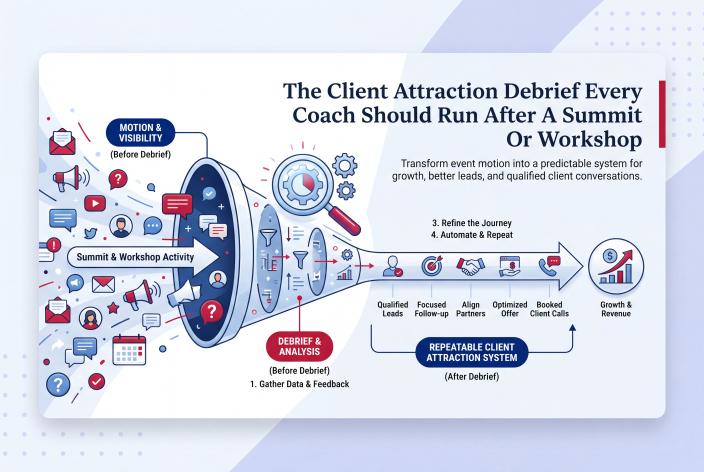
You finished the summit, workshop, podcast sprint, or partner campaign.
The emails went out. The sessions happened. The speakers showed up. The Zoom links mostly behaved. Your calendar had more activity than usual.
And now you are tired.
So the temptation is to say, "That was good," close the laptop, and move on to the next thing.
Please don't skip the debrief.
For a coach, the debrief is where the real learning happens. It is where you stop guessing which parts of the campaign created momentum and start seeing what actually moved people closer to trust, conversation, and becoming a client.
Because your event should become more than a date on the calendar.
It should become part of a repeatable client attraction system.
Why The Debrief Matters More Than Most Coaches Realize
A summit or workshop creates a lot of motion.
Registrations. Speaker promotion. Emails. Comments. Attendance. Replay views. VIP buyers. Sales calls. Follow-up replies. Questions. Objections. Silence.
That motion can feel like success while it is happening.
But after the campaign ends, you need to know what the motion meant.
Did people simply register because a speaker promoted it?
Did they attend and engage?
Did they ask questions that revealed buying intent?
Did the right people book calls?
Did your follow-up move warm leads into the next step?
The debrief gives you the answers. It shows whether your visibility had a clear path behind it.
And that is the part many coaches are missing.
They can get attention in bursts. They can deliver strong content. They can create useful conversations. But the path from attention to trust to booked call is often too manual, scattered, or unclear.
So the debrief is not just a review meeting.
It is the bridge between one campaign and a better client attraction system.
Start With The Numbers That Show Movement
You do not need a giant spreadsheet to run a useful debrief.
You do need a clean look at the numbers that show how people moved through the journey.
Start with these:
- Total registrations
- Registration source, when you can track it
- Attendance
- Replay views or replay engagement, if relevant
- VIP buyers or paid upgrades
- Booked calls
- Sales call show-up rate
- Qualified call rate
- Close rate
- Follow-up replies
- Unsubscribes or negative responses
These numbers tell a story.
Registrations show attention.
Attendance shows interest.
VIP buyers show a willingness to pay for deeper access or convenience.
Booked calls show that trust may be turning into action.
Show-up rate tells you whether the call felt important enough to honor.
Close rate tells you whether the people getting on the call were aligned with the offer, ready for the problem you solve, and clear on the value before they arrived.
Here's a tip.
Do not review these numbers as isolated wins or losses. Review them as a pathway.
A campaign with modest registrations but strong conversations may be more useful than a larger campaign that attracted the wrong audience.
A campaign with good attendance but few booked calls may point to a weak invitation, unclear offer, or missing follow-up.
A campaign with booked calls that do not show up may point to poor pre-call nurturing, weak qualification, or a calendar path that did not reinforce urgency and fit.
The numbers are not there to judge you.
They are there to show you where the path needs strengthening.
Separate Vanity Metrics From Client Attraction Signals
Some metrics feel good because they are visible.
Other metrics matter because they show movement toward qualified conversations.
You need both awareness and conversion. But if you treat all metrics the same, you can end up optimizing for applause instead of clients.
Use this table during your debrief.
| Metric | What It May Tell You | What To Check Next |
|---|---|---|
| Total Registrations | Your topic and promotion created attention | Were they right-fit prospects or broad curiosity seekers? |
| Social Likes And Comments | The campaign had public engagement | Did those people register, attend, reply, or book? |
| Speaker Shares | Partners helped create visibility | Which speakers drove registrations or better conversations? |
| Attendance | People cared enough to show up | Did they stay, ask questions, click, or respond? |
| VIP Buyers | Some attendees wanted deeper access | Did VIP buyers match your ideal client profile? |
| Booked Calls | Trust moved into action | Were those calls qualified and aligned? |
| Call Show-Up Rate | Prospects saw the call as important | Did your reminders and pre-call education support commitment? |
| Close Rate | The offer matched the prospect's need and readiness | Were the right people invited into the call? |
| Follow-Up Replies | People were still engaged after the event | Which messages created the best responses? |
The goal is not to shame registrations, likes, or comments.
They have a job.
The point is to connect them to the rest of the journey. Visibility should feed capture. Capture should feed nurture. Nurture should feed qualified conversations.
When one part breaks, the debrief helps you find it.
Identify Which Partners And Speakers Created Real Momentum
Partner-powered growth is one of the strongest reasons to run summits, workshops, giveaways, and speaker-led campaigns.
But partner activity can become foggy fast.
One speaker may have a large list and send lots of registrants who never engage.
Another speaker may send fewer people, but those people attend, ask strong questions, and book serious conversations.
You want to know the difference.
Review each partner or speaker through a client attraction lens:
- Who promoted on time?
- Who drove registrations?
- Who drove attendance?
- Who attracted the best-fit audience?
- Who created engaged questions or replies?
- Who helped create VIP buyers, booked calls, or qualified conversations?
- Who was easy to work with?
- Who would you invite again?
This is where event tracking matters.
If you are running the campaign through spreadsheets, inboxes, separate page tools, separate email tools, and manual CRM updates, it becomes hard to reconstruct what happened later.
EventRaptor is built to make this easier by helping coaches manage registration, speaker details, partner links, promoter tracking, attendee data, emails, schedules, CRM sync, and reporting in a more organized event growth system. That matters because the host should be able to see what worked instead of piecing the campaign together from memory.
The practical takeaway?
Do not only thank your partners. Learn from them.
Your best partners are not always the loudest promoters. They are the people whose audience trusts them enough to take the next step with you.
Review Which Topics Created The Best Conversations
Your summit or workshop topics are market research in motion.
Every registration tells you something.
Every attended session tells you something.
Every chat question, email reply, and sales call objection tells you something.
So after the event, review your topics by response quality.
Ask:
- Which session titles attracted the most registrations?
- Which topics had the strongest attendance?
- Which sessions created the most questions?
- Which topics led to replies after the event?
- Which topics were mentioned on sales calls?
- Which topics seemed to attract people who were ready for your offer?
This is especially useful for coaches whose messaging still feels a little fuzzy.
Your audience may be telling you which part of your work they understand first.
For example, a business coach might think the audience wants "scaling systems," but the event questions may keep circling around inconsistent sales calls, poor follow-up, or unclear positioning.
A health coach might think the audience wants broad wellness education, but the best conversations may come from a session about feeling stuck after trying multiple plans.
A leadership coach might promote executive presence, while the most engaged attendees respond to difficult conversations, burnout, or team trust.
This does not mean you chase every topic that gets attention.
It means you listen for the language your best prospects already use.
Then you bring that language into your offer, emails, registration page, follow-up, and future event themes.
Turn Questions And Objections Into Better Follow-Up
The questions people ask during and after your event are not interruptions.
They are clues.
A question usually means the person is trying to place your idea into their own life or business.
An objection usually means they are interested enough to think about the cost, risk, timing, or fit.
Capture these during the debrief:
- What did people ask in the chat?
- What did they reply to by email?
- What came up in sales calls?
- Where did people seem confused?
- What promises did they respond to?
- What language made them lean in?
- What made them hesitate?
Then sort the answers into buckets.
Offer Clarity Questions
These reveal whether people understand what you do, who it is for, and what problem it solves.
If you hear, "Would this work for someone like me?" or "Is this for beginners or advanced people?" your positioning may need tightening.
Trust Questions
These reveal whether people believe your approach, your process, or themselves.
If you hear, "How do I know this will fit my situation?" your follow-up may need stronger education, proof, or diagnostic framing.
Timing Questions
These reveal urgency.
If you hear, "Should I do this now or later?" your event may need clearer teaching around the cost of waiting, the right readiness markers, and what the first step looks like.
Implementation Questions
These reveal whether people want the result but worry about the work.
If you hear, "How much do I have to do myself?" your emails and sales conversations should explain the implementation path more clearly.
This is where your follow-up gets sharper.
You are no longer writing generic nurture emails. You are answering the real questions your audience already asked.
That feels more human.
And it usually makes the path to conversation much clearer.
Find The Biggest Leak In The System
Every campaign has a leak.
That is normal.
The mistake is trying to fix everything at once.
After you review the numbers, partners, topics, questions, and objections, look for the biggest leak.
Use this simple diagnostic:
- If registrations were low, review your topic, partner strategy, audience fit, and promotion plan.
- If registrations were strong but attendance was weak, review reminders, event timing, session promise, and attendee commitment.
- If attendance was strong but calls were low, review your offer bridge, invitation, follow-up, and call-to-action.
- If calls were booked but people did not show, review your calendar flow, reminders, pre-call education, and qualification.
- If people showed up but did not buy, review offer fit, sales process, pricing confidence, urgency, and whether the right people were invited.
- If partners promoted but results were unclear, review tracking, attribution, and partner expectations.
- If the event felt successful but no one followed up, review your CRM, email sequences, SMS reminders where appropriate, tags, and ownership of next steps.
That last one is big.
Many coaches lose momentum after the event because follow-up depends on memory, mood, or spare time.
Good automation protects the relationship by making sure the right message goes out while interest is still warm.
EventRaptor can support the event side with registrations, reminders, attendee data, partner tracking, speaker workflows, and follow-up communication. GHL/CRMRaptor can support the CRM, calendar, funnel, workflow, automation, and follow-up side. Together, they help turn the campaign into a managed journey rather than a pile of disconnected tasks.
The system still needs your strategy, message, offer, and voice.
But the moving parts become much easier to manage.
Create Your Next Campaign Improvement List
End your debrief with decisions.
Not vague reflections.
Actual decisions.
Create a short list with 3 categories.
Keep
What worked well enough to repeat?
This might include a topic, speaker type, email angle, session format, VIP offer, call invitation, reminder sequence, or partner approach.
Improve
What needs a clearer version next time?
This might include the registration page, event title, speaker onboarding, schedule, pre-event nurture, sales bridge, replay deadline, or post-event follow-up.
Remove
What created work without useful movement?
This might include a topic that attracted poor-fit registrants, a partner type that did not engage, a manual process that caused stress, or a tool gap that made follow-up harder than it needed to be.
Keep this simple.
A useful debrief should give you a better next campaign, not a 40-item guilt list.
Your event growth system improves through clean iteration.
Clarify the audience. Sharpen the topic. Strengthen the path. Improve the follow-up. Track what matters. Repeat what works.
That is how a summit or workshop becomes an asset.
Use The Debrief To Build A More Predictable Client Attraction System
A strong debrief changes how you see the event.
You stop treating it as a one-time push.
You start seeing it as a source of data, authority, partnerships, audience growth, content, nurture, and qualified conversations.
The event gives you attention.
The debrief tells you what to do with it next.
That may mean refining your offer.
It may mean changing the next topic.
It may mean inviting different partners.
It may mean improving the call invitation.
It may mean finally connecting your event activity to your CRM and follow-up so warm leads do not disappear after the last session.
The coaches who benefit most from events are not just the ones who host well.
They are the ones who learn well afterward.
They review what happened, find the leak, and build a cleaner path for the next campaign.
Your Next Step
If you recently ran a summit, workshop, webinar, podcast sprint, or partner campaign, do not leave the learning sitting in your inbox.
Review the numbers. Study the conversations. Look at partner performance. Read the objections. Find the biggest leak.
And if you want help applying this to your own coaching business, Book your Client Attraction Planning Call.
On the call, we will look at where your client flow is getting stuck and what kind of authority, funnel, CRM, follow-up, or event strategy could make sense next.